The Benefits Cliff and Why Working More Can Pay Less
Earning more can mean losing benefits faster than income rises.

A benefits cliff happens when a raise or a few extra hours a week pushes a household's income just past an eligibility line, and the value of the benefits lost outright exceeds the value of the money gained. It's not a metaphor. It's arithmetic, and for millions of working families, that arithmetic says: don't take the promotion.
That's the trap built into the safety net. Government assistance is supposed to phase out as income rises. Sometimes it doesn't phase, it just stops. And the households caught in that gap, earning too much for benefits but too little to replace what those benefits covered, are stuck in a stretch of income where working harder makes them poorer.
Distinguish two mechanisms here, because they get lumped together and they're not the same thing. A cliff is a sudden, hard cutoff: one more dollar of income and a benefit disappears entirely. A plateau is different, more like quicksand than a cliff edge: each dollar earned gets offset by a dollar of benefits lost, so net income stays flat no matter how much more someone works. Both trap families. They just trap them by different math.
The exposure here is wide. Households using public benefits and earning up to roughly $60,000 a year sit inside the risk zone, and the danger concentrates hardest among workers earning $13 to $17 an hour, the exact wage band where a raise or a second shift is most likely to cross a threshold. A federal health agency has estimated more than 3 million households with children, earning below 200% of the federal poverty level, would face a cliff or a plateau if their income rose. In plain terms: income too high to qualify, still too low to cover what the benefits were paying for. The gap between those two lines is where families get stranded, and the behavioral response to that gap, which appears later in this piece, is that some families stop trying to climb.
How the arithmetic turns a raise into a loss
The number that matters here is the effective marginal tax rate, or EMTR: the share of every additional dollar earned that vanishes through taxes and benefit reductions combined. When the EMTR crosses 100%, a household nets less by earning more. That's the technical signature of a cliff, and it's worth sitting with, because it means the system can make working harder mathematically irrational.
Start with the taper logic, since it's the gentler version of the problem. SNAP reduces benefits by $1 for every $3 increase in earned wages, a 33-cent loss per dollar. On its own, that's tolerable. Annoying, but tolerable, assuming nothing else is phasing out at the same time.
Nothing else usually cooperates. SNAP's phaseout rate of 24 cents on the dollar and the Earned Income Tax Credit's phaseout rate of 21 cents on the dollar already stack to roughly 45 cents lost per dollar earned, before a single hard cutoff even triggers. Add payroll and income taxes, and a household can lose most of a raise before it ever gets used.
Then there's the cliff itself, the part that isn't gradual at all. As a household nears SNAP's gross income limit, a small raise can wipe out the remaining benefit completely rather than shaving it down. Medicaid works the same way, only starker: it's binary. One dollar over the threshold, and coverage doesn't shrink, it ends. No partial version, no step-down.
Modeled EMTRs tied to benefits cliffs typically range from 17% to 65%, which is bad but survivable. At hard cutoff points, though, EMTRs can exceed 100%, which means the household is working for less than zero.
North Carolina offers a clean, if brutal, illustration. A mother receiving a full package of benefits would need to earn $70,000 a year to have a higher net income than she'd have at $30,000 with full benefits intact. Everything between those two figures, roughly a $40,000 range, is dead zone. Earning more inside that band produces no net gain, or an outright loss. A $40,000 raise that leaves a family no better off isn't a policy footnote. It's the disincentive in its purest, starkest form.
The programs most likely to trigger a cliff, and what makes each one dangerous
Not every benefit behaves the same way, and the differences matter for anyone trying to navigate this.
SNAP tapers gently at first, that $1-for-$3 rate, but turns sharp near the gross income eligibility limit. Families get lulled by the gradual phase and then lose the remaining balance all at once when they cross the line.
Medicaid doesn't taper at all. One dollar over the threshold ends coverage entirely, with no partial reduction. Losing employer-unaffordable coverage overnight makes this the most health-consequential cliff on the list.
ACA marketplace subsidies represent another cliff point, where households crossing income thresholds can face sharp reductions or loss of premium assistance, making health coverage suddenly unaffordable.
Child care subsidies produce the steepest cliff of any program, by a wide margin. One documented case: a $0.10-an-hour raise, working out to $200 more a year in income, cost a mother $9,000 a year in child care assistance. A roughly $200-a-month gain triggering a $9,000-a-year loss isn't a rounding error in the system, it's a design flaw, and it hits hardest for families with young children at the income ranges where subsidy eligibility cuts off.
Housing vouchers can also produce severe cliff effects. Losing a housing subsidy destabilizes a household immediately, in a way that losing food assistance, serious as that is, usually doesn't.
The EITC doesn't cut off hard. It phases out. But its phaseout rate stacks on top of everything else phasing out at the same income range, which means it doesn't cause a cliff by itself so much as it makes every other program's cliff worse.
Put these together and the real problem comes into view: a nutrition assistance program, a tax credit for working families, a child tax credit, and a health coverage program, the most common combination among low-income families with kids, all phase out over overlapping income bands. That overlap compresses the cliff zone and makes the drop steeper than any single program would produce alone. A Crisis Assistance Ministry survey found roughly 40% of respondents had already lived through this, a cliff triggered by a raise, a promotion, or a change in employment. This isn't a theoretical risk sitting in a policy paper. It's something that's already happened to a huge share of the households it affects.
What it looks like when a family hits the cliff
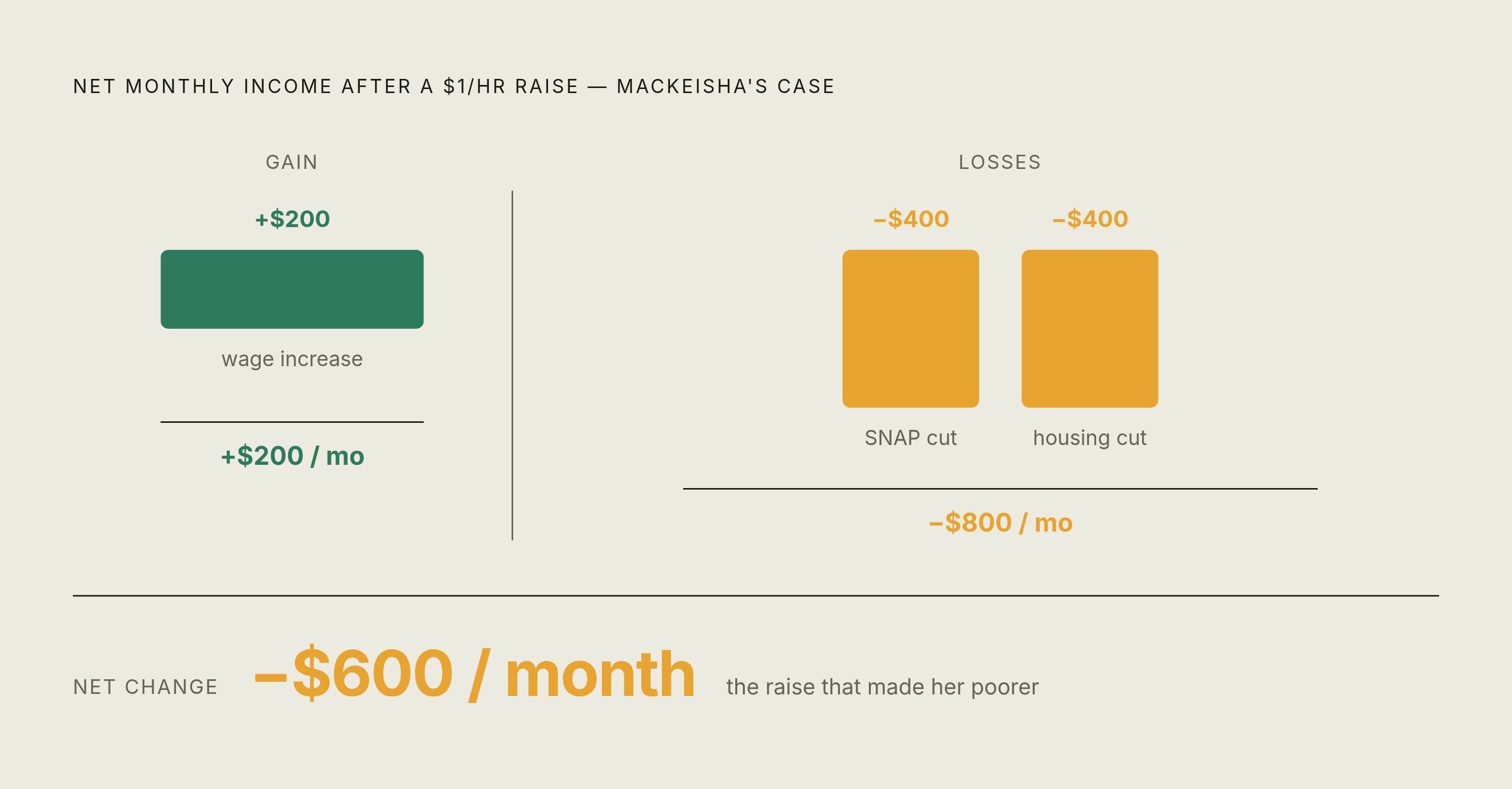
Mackeisha worked nearly full-time, six days a week, raising four kids. A $1-an-hour raise pushed her over the income threshold for both SNAP and housing assistance at once. She gained about $200 a month in wages. She lost more than $800 a month in benefits. Net loss: over $600 a month, for taking a raise she'd earned.
Haley cleaned houses for $14 an hour, rebuilding her life in addiction recovery after leaving an abusive relationship. SNAP and TANF both cut the moment she reported new income, and she found out by letter. "The moment I felt stable," she said, "they snatched them out from under me."
In East Tennessee, a woman was offered a salaried position paying $26,000 a year. Taking it meant losing SNAP and TANF eligibility. The net result: a loss of more than $300 a month, nearly $4,000 a year, compared to where she'd started. The raise cost her money, full stop.
The pattern shows up consistently in qualitative research: among women who have navigated the safety net, declining a raise or leaving a job to protect benefits is a common, recurring theme.
The pattern across every one of these stories is the same. The discovery moment is a letter that arrives after the decision's already made, not a warning beforehand. These aren't families navigating a system they understand. They're absorbing a shock they didn't see coming, after the fact, when there's nothing left to do about it.
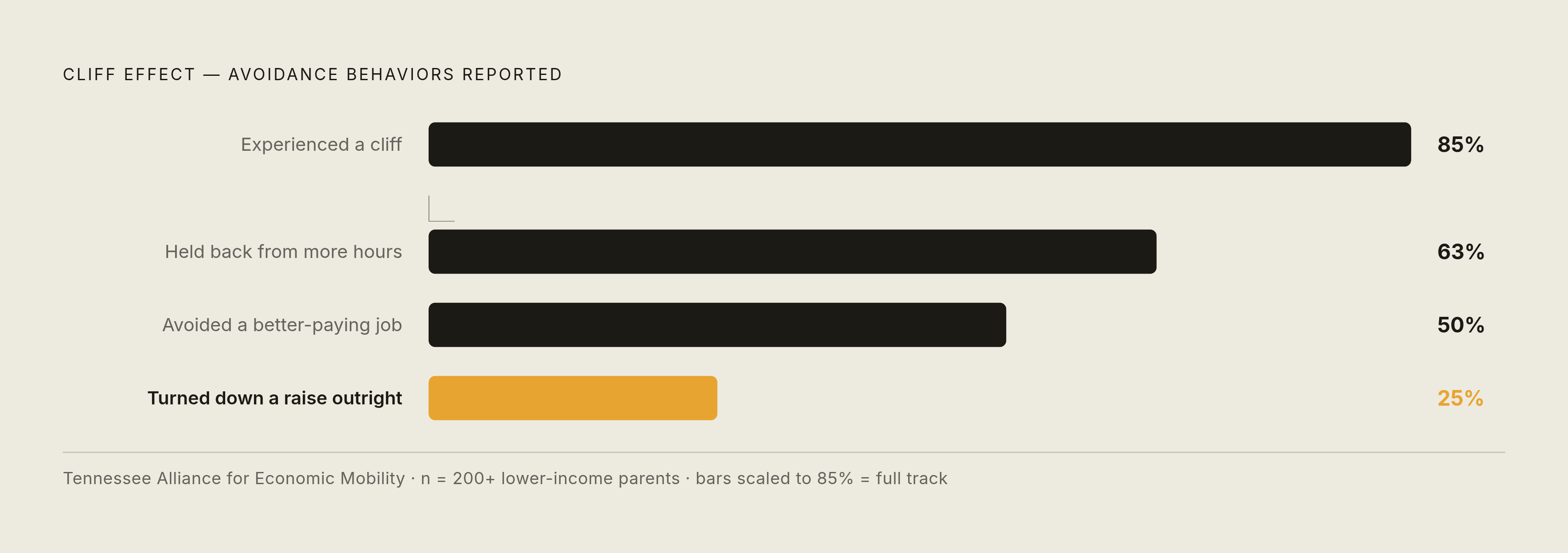
The Tennessee Alliance for Economic Mobility ran a survey of more than 200 lower-income parents, and once the concept of a benefits cliff was explained to them, 85% said they'd experienced one. Inside that group, 63% had held back from taking on more hours, half had avoided applying for a better-paying job, and a quarter had turned down a raise outright.
Why so many families respond by earning less on purpose
None of this is irrational. If earning more genuinely produces a net loss, then limiting earnings is the financially correct move, given how the rules are written today. Calling it a personal failing misses the point entirely, the system built the incentive.
A Center for Social Development report found 22% of public assistance recipients had taken at least one deliberate action to dodge a cliff, whether that meant turning down a raise, cutting back hours, or declining a job offer altogether. A Sutherland Institute survey of Utah adults currently or recently on safety-net programs found 62% felt stuck in a low-income job, believing that earning more would trigger benefit losses steep enough to make the raise not worth taking.
California data puts a number on the scale of this. Roughly 1 in 6 Californians sitting in the cliff zone are actively capping their own earnings, turning down raises, refusing extra hours, passing on better jobs. Each family forgoes an estimated $2,100 a year in wages doing this, and a 2025 survey of benefit recipients estimated the aggregate cost to the state at a substantial sum each year in wages simply never earned.
The damage runs both directions. A 2019 survey of Ohio business owners found 1 in 5 had run into personnel problems tied directly to employees worried about losing benefits. Hiring, promotions, retention, all of it gets shaped by a calculation the employer often doesn't even know is happening. And the effect compounds in fields like nursing, home health care, child care, and social work, where career ladders run straight through multiple cliff zones. Workers who are ready to advance get held back, and that raises staffing shortages in hospitals, schools, and care facilities eventually.
The cliff even reaches into decisions that have nothing to do with a job. Almost a third of Americans say they personally know someone who avoided marriage out of fear of losing means-tested benefits. Combine two incomes under one roof, and a household can cross an eligibility line that neither income alone would touch. That's the cliff's logic extending into family formation itself.
How states are trying to smooth the cliff, and how far those efforts reach
The most common fix on the table is extending eligibility further up the income scale, so benefits taper more gradually instead of cutting off hard. It costs more money to run that way, and a report from a public policy think tank argues the tradeoffs don't pencil out without a broader restructuring behind them.
Scale is the honest starting point here. The federal government runs a large array of means-tested programs and, per the Congressional Budget Office and the National Association of State Budget Officers, will spend nearly $1.2 trillion on them in fiscal year 2025, with states adding at least an estimated $341 billion on top of that. A system this large doesn't get fixed by a handful of state pilots. It needs federal action.
States have still moved where they can:
One state's bill. 1267, passed in 2024, created the School Readiness Plus program. Families now stay eligible for child care subsidies until household income hits 100% of the state median income, up from the old 85% limit, and they pay a rising share of costs as wages climb instead of falling off a cliff. The law also required a financial forecasting tool, so families can actually model what a raise will do to their benefits before they take it.
Another state's bill. 45, from 2023, built a transitional benefits framework and expanded the state's transitional child care program statewide.
A third state's bill. 1259, passed in 2022, aligned TANF redetermination timelines with other programs, updated income calculations, added future cost-of-living adjustments, expanded earned income disregards, and raised base TANF benefits by 10%. The law was designed to reduce churning, the pattern of families leaving and quickly returning to TANF, and to improve participation among eligible households.
Ohio, starting in October 2024, phased in a gradual taper for some benefits up through 200% of the Federal Poverty Level. That's a real improvement. But a family of four still ends up losing all support roughly $15,000 short of the United Way's survival budget estimate for that household size. The taper helps. It doesn't close the gap.
Washington, D.C.'s Career MAP pilot takes a different approach entirely: up to five years of enhanced rental assistance and cash payments, designed to offset benefits lost to rising earnings. It's limited to 600 families. Once rent assistance phases down, families can receive additional cash support designed to offset benefit losses from rising earnings.
The AEI report lands on a hard conclusion: state-led fixes can produce partial progress, but sustainable change requires comprehensive federal reform to fix the fragmented rules across programs and actually reward work. On the employer side, Towards Employment runs the NEO Employer Resource Network in Ohio, placing on-site success coaches at workplaces to help employees see, ahead of time, how a raise or promotion will hit their benefits, and to find ways to soften that impact before it lands. It is a workforce-level fix rather than a policy one, and it does not require a legislative body to act.
Most families, though, can't wait for any of this.
Practical ways families navigate the cliff without waiting for policy to change
None of what follows makes the cliff disappear. These are ways to reduce the shock, buy time, or preserve benefits a little longer. The goal isn't to avoid the edge. It's to cross it without free-falling.
Know the exact thresholds before a raise hits. Every program has its own cutoff, and a worker can be right at the edge for one program while nowhere near it for another. Tools like the National Center for Children in Poverty's Family Resource Simulator and the Women's Fund of the Greater Cincinnati Foundation's Self-Sufficiency Simulator let a family model different income scenarios before accepting a job offer or a raise, rather than finding out by letter afterward. One state's bill. 1267 built this kind of forecasting tool directly into its program, and the underlying logic is something anyone can replicate using the simulators already available.
Timing the transition matters. Some programs have a reporting lag or a review cycle built in, and understanding exactly when income gets reported versus when benefits actually change can buy a household weeks, sometimes months, to build up savings before the drop hits. Transitional benefit windows exist in some states, another state's bill. 45 created one, so it's worth checking whether a state has something similar rather than assuming benefits vanish the instant income rises.
Use pre-tax accounts to lower countable income. Contributions to a retirement account, a flexible spending account, a health savings account, or a dependent care flexible spending account reduce the gross income figure that most benefit calculations actually use. A modest pre-tax contribution can keep a household under a threshold without cutting take-home pay by much at all. Employer-offered pre-tax perks, transit passes, parking, HSA contributions from the employer, work the same way.
Ask employers to structure pay around the cliff. A one-time bonus, rather than a permanent wage bump, keeps base income under a threshold while still rewarding the work. Non-cash compensation, extra paid leave, an employer-paid transit pass, subsidized meals, adds value without touching countable income at all. The ERN model in Ohio shows this can become standard HR practice rather than a one-off favor, and it's not uncommon for a worker to value a transit pass more than an equivalent-cost raise, purely because of how the benefits math works out on the other side.
Sources
- The benefits cliff, explained
- Stranded by the Safety Net: How to Fix the Benefit Cliff Problem | American Enterprise Institute - AEI
- Introduction to Benefits Cliffs and Public Assistance Programs
- pn3policy.org
- All about the benefits cliff: challenges and solutions
- uschamberfoundation.org
- Real-Time Takes: The Benefits Cliff - Employer Solutions - Towards Employment