Subscription Creep as a Paycheck-to-Paycheck Accelerant
Hidden subscription charges are quietly pushing more Americans into financial instability.
Subscription creep is what happens when 67% of American workers say they're living paycheck to paycheck, per PNC Bank's Financial Wellness in the Workplace Report, up from 63% the year before, and the gap between those numbers isn't explained by a single bad month or a layoff or a rent hike. It's explained by a slow accumulation of small recurring charges that nobody sat down and decided to keep paying. A financial institute's research puts nearly 24% of a national population of households in 2025 at spending over 95% of income on necessities alone, up 0.3 percentage points from 2024. Two different surveys, two different populations, same direction: more people, less margin, and no dramatic event to point to.
The mechanism matters here. PYMNTS Intelligence found that 78% of consumers reported at least one bill increase in the prior year, and among paycheck-to-paycheck households already struggling, that number climbs to 82%. Bills are doing the damage, not wages falling. And it isn't just a low-income problem: Goldman Sachs' survey of more than 5,100 people found that roughly 40% of workers earning $300,000 or more say they live paycheck to paycheck. Income doesn't explain that. Spending patterns do. Goldman calls it "lifestyle creep," the process by which luxuries quietly become necessities. Taylor Nelms at the Financial Health Network frames it as rising fixed costs, housing, healthcare, insurance, eating a bigger share of income even when paychecks inch upward. Subscriptions are the smallest, quietest version of that same story.
What subscription creep means and why it differs from ordinary overspending
Subscription creep isn't one bad decision. It's the accumulation of small, individually reasonable charges that add up to something the household never actually agreed to as a total.
Each one, on its own, looks fine. A modest fee for this, a slightly smaller one for that, and a bit more for something you signed up for during a free trial eight months ago. The damage isn't in any single line item. It's in the sum, and the sum is nearly invisible on a bank statement with 40 other transactions competing for attention.
Some of this is by design. Companies have long understood what's sometimes called the "roach motel" principle: make sign-up frictionless and make cancellation a maze. That's not an accident of bad UX. It is structural, and it appears again and again in enforcement records (more on that shortly).
There's also a psychological asymmetry at work. A $200 one-time purchase gets scrutinized. A $16.99 monthly charge that recurs 12 times a year, totaling more, barely registers as a decision at all. It just happens.
This is different from lifestyle inflation in the broad sense, buying a bigger house, upgrading the car. Goldman Sachs' findings point to that broader pattern as the driver behind higher-income households slipping into paycheck-to-paycheck territory. Subscriptions are the low-friction, low-visibility version of the same instinct. The problem was never a moment of financial weakness. It's months, sometimes years, of under-monitoring.
The gap between what people think they spend on subscriptions and what they spend
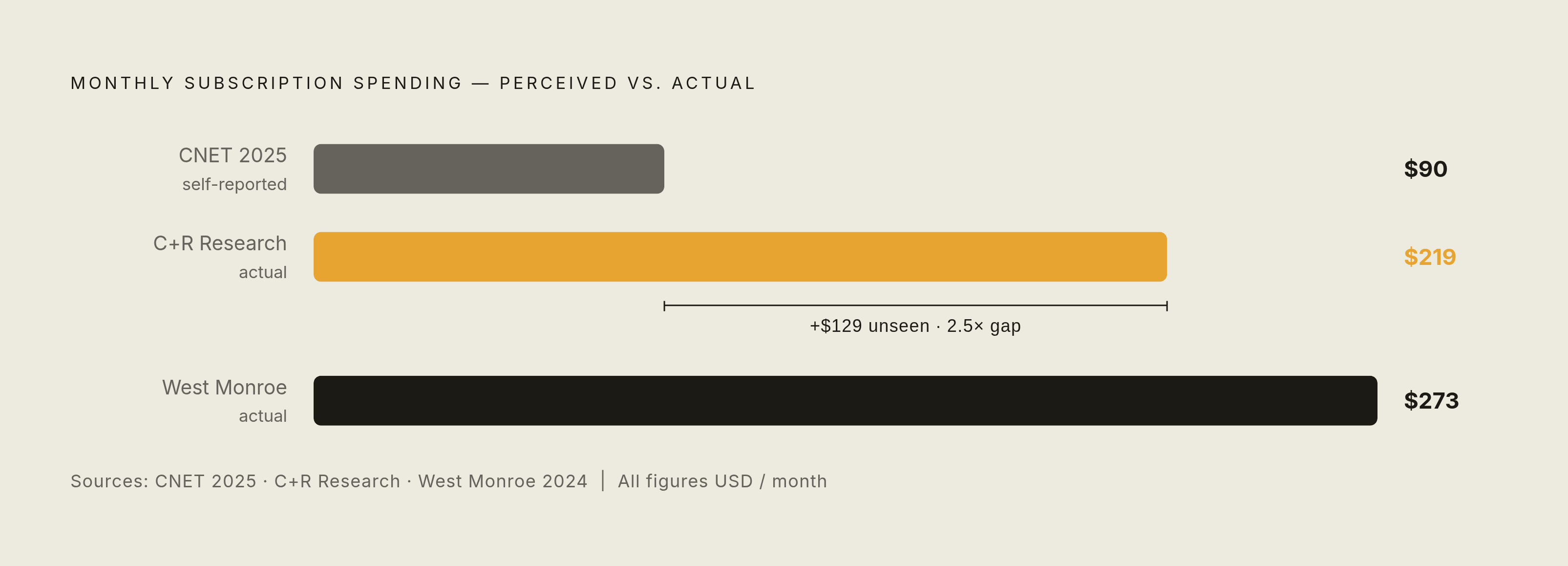
Ask someone how much they spend on subscriptions monthly, and CNET's 2025 survey says they'll answer around $90, or $1,080 a year. Have that same person sit down and itemize every recurring charge, and C+R Research found the real number is $219 a month. That's not a rounding error. That's 2.5 times higher than what people believe.
West Monroe's data puts it even higher, at $273 a month, up from $237 when the firm first started tracking this in 2018. Nearly a decade of steady climb, and no plateau in sight.
The gap between perception and reality, nearly $130 a month by C+R Research's figures, adds up to a substantial annual sum spent without the household even knowing it's happening. That's real money leaking out of a budget that, for a paycheck-to-paycheck household, doesn't have $1,500 of slack to spare.
Part of the reason is sheer volume. The average American now holds 8.2 active subscriptions, according to aggregated industry data. Deloitte's 2025 Digital Media Trends survey found the average person pays for four streaming services alone, a combined $69 a month, up 13% year-over-year just in that one category. Connectivity and TV services together eat up 5.4% of the average worker's monthly earnings, based on the median income of $62,192 a year. worker's monthly earnings, based on the median income of $62,192 a year. And that share only grows as prices rise and services multiply.
The perception gap is the whole argument in miniature: most people believe they're on top of their subscriptions. The data, over and over, says otherwise.
How unused subscriptions and price hikes silently widen the drain
Waste and price increases don't operate separately. They compound.
A financial services company's 2026 survey of 1,272 people in a national population of respondents found the average monthly value of unused paid subscriptions is $26.79, up sharply from $10.57 in 2025, though still below the $32.84 recorded in 2024. That volatility means this number is genuinely hard to pin down, which makes it even harder for an individual household to track without help. Meanwhile, 59.9% of respondents said they have at least one subscription going unused, up from 54.9% the year before. A majority of subscribers are paying for something they don't use, full stop.
The unglamorous stuff is where the real bleeding happens. Gym memberships nobody visits. Annual software renewals that auto-charge a card once a year and vanish from memory until the statement lands. Free trials that quietly convert to paid plans because nobody set a reminder.
Then prices go up on top of that. Netflix raised its Standard plan from $15.49 to $17.99 in January 2025 and its Premium tier from $22.99 to $24.99, after already discontinuing its cheapest ad-free Basic option in mid-2024. Then it raised prices again in March 2026, Standard to $19.99, Premium to $26.99. Two hikes in under two years. Disney+ moved its no-ads Premium tier from $15.99 to $18.99 in October 2025.
Research consistently shows price sensitivity among streaming customers, yet most don't act because most don't notice the increase has already landed on their card. An unused subscription that also gets a price hike is extracting money twice: once for sitting idle, once for the higher rate nobody clocked.
Generationally, this lands hardest on Gen Z. CNET's survey found Gen Z wastes $23 a month, $276 a year, on unused subscriptions, the highest of any generation. Yet Gen Z also leads total subscription spending at $377 a month, ahead of Millennials at $276. The generation adding subscriptions fastest is also the one bleeding the most from the ones it forgets.
Why subscription creep is so hard to catch without ongoing surveillance
Cancellation itself is riddled with traps, and the biggest one is platform mismatch. Subscribe through Apple, and you have to cancel through Apple. Subscribe through Google Play, cancel through Google Play. Subscribe on the company's own website, cancel there. Get the channel wrong, and the charge keeps coming even after someone genuinely believes they've cancelled.
Paramount+ is a documented example of this: cancel through Paramount's own website after subscribing via Apple, and the charges continue, because the company's system never registered the cancellation. The customer did everything right and still got billed.
Autopay makes this worse, not better. Per PYMNTS data, only 26% of struggling paycheck-to-paycheck consumers use autopay, yet autopay by its nature routes charges through without prompting a second look when prices change. Convenience turns into camouflage. The charge just goes through, silently, at whatever the new rate happens to be.
Annual subscriptions carry their own blind spot. A charge that hits once a year is almost designed to be forgotten between billing cycles. By the time the renewal notice (if there even is one) arrives, it doesn't feel like a decision. It feels like something that already happened to you.
Free trials operate on the same logic. The "choice" was agreeing to the trial. The conversion to paid is automatic, buried in terms nobody reads twice.
Add it all up, and detection isn't a task you complete once. It requires either a thorough manual review of several months of statements, something most households never actually finish, or a system watching continuously. Subscription sprawl is a slow drain. A one-time audit patches the hole for a month. New services get added, prices shift, trials convert, and the leak reopens right where it was.
What the FTC's enforcement record says about how deliberately difficult cancellation has been designed to be
The clearest evidence that cancellation friction is intentional, not incidental, comes from enforcement.
Amazon's Prime settlement, finalized in September 2025, required the company to pay a $1 billion civil penalty and set aside $1.5 billion for consumer refunds. The court found that clicking "End Membership" didn't actually end the membership. Customers had to reaffirm their decision to cancel three separate times before it took effect. Eligible customers received refunds up to $51, sent automatically in November and December 2025. That refund mechanism alone tells you how many people got enrolled or retained without anything resembling real consent.
Amazon isn't alone. The FTC settled with Instacart in 2025 for $60 million over enrolling free-trial users into a paid annual plan without clear disclosure. Match Group agreed to pay $14 million over deceptive advertising, a misleading guarantee, retaliatory account lockouts, and a cancellation process built to be difficult. Chegg agreed to pay $7.5 million for similar conduct, including simply failing to honor cancellation requests it received.
The regulatory backdrop remains unsettled. A federal "click-to-cancel" rule, which would have required cancellation to be as easy as sign-up, got vacated by a federal appeals court in July 2025 on procedural grounds. appeals court in July 2025 on procedural grounds. The FTC reopened rulemaking on it in March 2026, but as of now, there's no single national law governing this. Enforcement runs on a patchwork: ROSCA, the FTC Act, and state-level auto-renewal laws in places like California and New York.
Consumers can't wait on policy to fix this. The enforcement record proves the problem is real and systemic, not paranoia. But without a national rule in place, the burden of working around cancellation friction still sits with the household.
Practical tactics that reduce subscription drag, and where each one breaks down
Start with the audit: pull 60 to 90 days of bank and credit card statements and list every recurring charge you find. It's necessary. It's also just a snapshot, a single frame from a movie that keeps playing after you close the laptop.
Cancelling a trial the moment it starts is counterintuitive but arguably the strongest single move available. Most services preserve access through the full trial period regardless of when you cancel, so there's no downside, and the conversion risk disappears entirely.
Virtual cards, the kind offered through services like Privacy.com, Capital One Eno, or built into some banking apps, let you set a hard spending limit so a subscription can't silently upgrade itself or charge more than you authorized. Useful for containing damage. Less useful as a system, since it requires setup for every individual subscription.
Pausing instead of cancelling is underused. Research into subscriber behavior has found that ease of cancellation influences willingness to subscribe in the first place, and that pausing is a genuine alternative many consumers prefer over cancelling outright. Yet pause options remain far from universal across services. Where it exists, it works. It's just rarely offered.
And always, always cancel through the same channel you subscribed through. Mismatching that channel, Apple versus the company website versus Google Play, is the single most common reason a charge survives a cancellation attempt.
Here's the ceiling on all of this: every one of these tactics requires a person to remember, to initiate, and to repeat the process as new subscriptions pile on and prices shift. They solve the moment in front of you. They don't solve the pattern. A one-time audit is not a surveillance system, and subscription creep, by its nature, is continuous. The fix has to be too.
Tools built to track subscriptions continuously and what each one does
A handful of tools exist specifically to close the gap manual tactics can't close.
Copilot Money folds subscription tracking into a broader budgeting and spending picture for a monthly fee. Its strength is the wide view of where money goes overall, not subscription-specific action like cancellation or negotiation.
NerdWallet's free budgeting tool is one option that emerged as Mint alternatives after Intuit shut down Mint on March 23, 2024. It tracks spending categories, subscriptions included, but it functions mainly as a dashboard. It shows you the data. It doesn't do anything with it on your behalf.
Compass+ takes a different approach: read-only connections to bank accounts, email, calendar, Amazon, and subscription services, monitoring continuously for unused subscriptions, price increases, trials about to convert, and duplicate charges. Each finding comes with a specific dollar figure attached and a next action already identified, no digging required. Once it's set up, there's no ongoing manual effort needed from the person using it, which matters most for someone who suspects money is leaking somewhere but doesn't have a spare afternoon to run a full audit.
Across the field, the real dividing line isn't which tool has the nicest interface. It's whether a tool tells you what you're spending, or whether it actually takes or enables action, cancellation, negotiation, a pause request. The tools that matter most for a paycheck-to-paycheck household do both, and they do it on an ongoing basis, not just at the moment of setup.
Read-only account access does not compromise privacy. It's the exact information a tool needs to surface something specific and quantifiable instead of a vague warning. More context, more precision, smaller leaks caught sooner.
Why subscription creep doesn't fix itself and what continuous monitoring changes
Subscription creep is a pattern, not an event, and patterns don't resolve themselves just because someone noticed them once. The audit gets done in January. By June, two new trials have converted, one price has gone up twice, and the spreadsheet is already out of date.
That's the entire case for continuous monitoring over periodic review. A household spending 95% or more of its income on necessities, as nearly 24% of a national population of households now do according to Bank of America Institute figures, doesn't have room for a $130-a-month blind spot. It doesn't have room for $26.79 a month leaking out on services nobody uses, per Self Financial data, especially when that number is trending upward again after a brief dip.
The FTC's enforcement record makes clear that companies aren't going to make this easier voluntarily. Billion-dollar settlements happen after the damage is already done, refunds capped at modest amounts, and no national click-to-cancel rule currently in force to prevent the next version of the same problem.
So the fix sits with the household, or with a system built to watch on the household's behalf. Manual tactics work in the moment they're applied and then go stale. Continuous tracking doesn't ask someone to remember to check next month. It already checked. That distinction, checked once versus checked continuously, is the entire difference between managing subscription creep and just discovering it again every few months, a little poorer each time.
Sources
- Two-Thirds of Consumers Say They Need Their Next Paycheck to Pay the Bills | PYMNTS.com
- 2025 sees rise in Americans living paycheck to paycheck
- Nearly 1 in 4 American households living paycheck to paycheck, report reveals
- Lifestyle inflation: 40% of those making $300K+ say they live paycheck to paycheck
- substract.co
- resubs.app