Free Trial Conversions and Their Outsized Impact on Thin Budgets
Opt-out trial structures deliberately charge people who forget to cancel.
Who absorbs the hit when a conversion charge lands unexpectedly
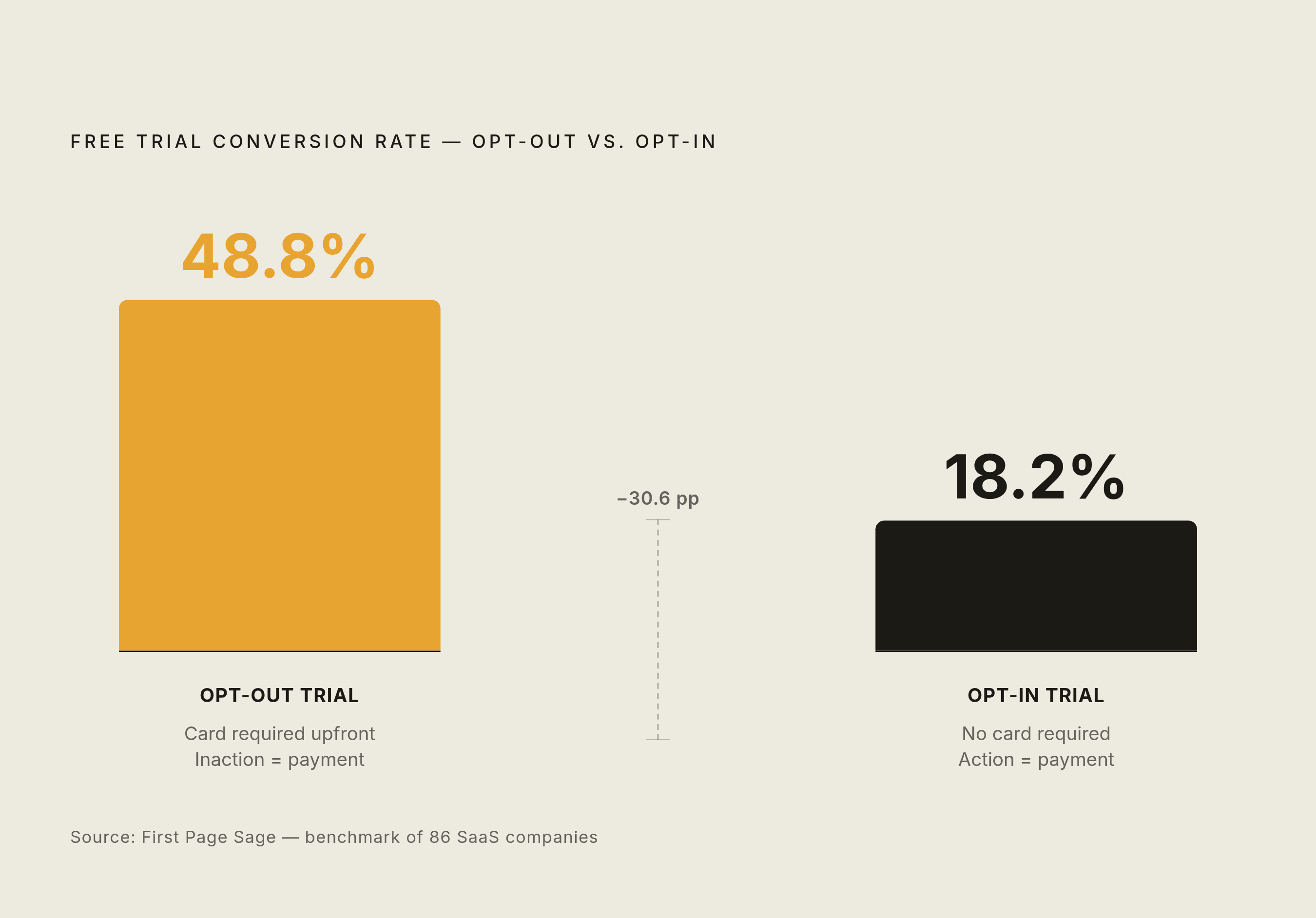
Free trial mechanics split into two categories, opt-in and opt-out, and that split explains almost everything about how people end up paying for things they never meant to keep. Opt-in trials don't ask for a card up front, so becoming a paying customer takes an active choice. Opt-out trials ask for the card on day one and charge it automatically the moment the trial ends, unless someone cancels first. According to First Page Sage's benchmark of 86 SaaS companies, opt-out trials convert at 48.8%, opt-in trials convert at 18.2%. That gap exists for one structural reason: in an opt-out model, nobody actively decides to pay. The user has to act to avoid a charge, not act to become a customer, and that single flip in default behavior is the whole trick.
Once the card is on file, it works as an exit barrier as much as an entry point. Signing up takes one click. Canceling usually takes several: finding the settings page, sitting through a retention offer, sometimes calling a support line or arguing with a chatbot trained to keep you subscribed. None of this requires bad intent on anyone's part. It's just what happens when a business optimizes for retention and a person is busy optimizing for everything else in their life that isn't a subscription renewal date.
Basic math makes the sting proportional, not absolute. A $15 monthly charge barely registers against a $2,000 weekly budget. Against a $200 weekly budget, that same $15 is a real bite, and it's rarely the last one. Research has found that consumers in major markets spend well over a thousand dollars a year on subscriptions, and that figure assumes people are tracking their subscriptions closely. Most budget-constrained households aren't, and the gap between perceived and actual spend is where the real damage sits: research has found consumers consistently underestimate their monthly subscription spend, with the itemized number coming out roughly two to three times higher than what people guess. That gap between perceived and actual monthly spend isn't a rounding error. For someone with a thin buffer, it's rent money, grocery money, or the utility payment that was supposed to clear on the 3rd.
The damage rarely stops at the charge itself, either. An unexpected debit on a low-balance account can trigger an overdraft fee, bounce a scheduled payment, or throw off a bill sequence calibrated down to the dollar. There's a mental cost too: for someone managing money on a tight margin, a surprise charge isn't just a financial event. It cracks the mental accounting system holding the rest of the budget together.
Why trial tracking is especially hard to do manually
Subscription sprawl is the baseline condition now, not the exception, and small recurring charges just don't register the way a big one-time purchase does. A $200 purchase gets noticed. A small recurring charge slides by, especially when there are six or seven of them stacked across different billing cycles and different cards.
Trial start dates aren't memorable by design. Signing up is a split-second decision, often made while distracted, and the end date is abstract at the moment of sign-up. By the time it actually arrives, weeks or a month later, it's long gone from memory. Trial lengths aren't standardized either. Some run 7 days, some 14, some 30, and anyone juggling several at once has no consistent rhythm to track them by.
Industry data suggests free trial conversion has softened in recent years. That points to people signing up for more trials than they intend to keep, not to sharper purchase decisions. Financial stress makes the problem worse: financial pressure tends to narrow attention toward whatever feels most immediate, and a trial ending in three weeks doesn't stand a chance against rent due Friday.
Regulators noticed the same pattern. The FTC finalized its "Click to Cancel" rule in October 2024, following a proposed rulemaking in March 2023, requiring that canceling a subscription be as easy as signing up for one. The Eighth Circuit vacated the rule in July 2025. Even with enforcement intact, the rule only ever addressed future design, not the trials already running on someone's card right now. The information about when a trial converts sits scattered across a confirmation email, a calendar nobody updated, and a billing page nobody checks, and piecing it together is left entirely to the user.
The conversion data reveals who free trials are optimized for
Go back to that 48.8% opt-out conversion figure, but ask a sharper question this time: of the roughly half who convert, how many actually meant to? From a business's side, an opt-out trial is built to capture revenue from anyone who doesn't cancel in time. From the consumer's side, this means the model is built to charge people who forgot.
Industry reporting has found that shorter trials tend to hit the highest conversion rates of any length tested. That's not a coincidence. The shorter the trial, the less time anyone has to actually use the product, form a real judgment, and act on it before the card gets charged.
A report from ChartMogul, Growth Unhinged, and ProductLed, covering 200 products, found a median trial conversion rate of 8%, but that median hides a bimodal split: most products cluster either below 2.5% or above 25%, a roughly 10x gap between the top 20% of self-serve products and the bottom 20%. Some products earn their conversions by being genuinely useful within the trial window. Others are fishing for whoever slips through by accident, and the short-trial, opt-out design is built specifically to maximize that second group. That's the system. It is the system.
The specific charges that catch thin budgets off-guard
Streaming is the clearest everyday example. Several services run short promotional trials, and a household testing two or three at once can convert on all of them in the same week without noticing until the statement lands.
Software and productivity tools carry a sharper edge. First Page Sage puts fintech trial conversion at roughly 19%, and these tools often flip a monthly-feeling trial straight into an annual charge. A modest monthly expectation turns into a much larger hit, all at once, with no monthly cushion built to absorb it. The trial itself is priced low to feel risk-free, but the first real charge lands as a full year up front, ten or twelve times larger than whatever number the user had in their head.
Then there are trials embedded inside a purchase, where a device, an app, or a bundle activates a free period automatically the moment someone buys something else. These are the easiest to miss, because the user never explicitly chose the trial, it just came along for the ride. It just came along for the ride.
Businesses have also learned that a "pause" feature keeps people subscribed better than an easy cancel button does. Research has found that a substantial share of consumers who were likely to cancel would use a pause option instead, if offered. It's built to stop a cancellation before it happens, not to help anyone manage their spending. Across every one of these situations, the charge was technically disclosed at sign-up, so there's no dispute to file and no chargeback to win. Catching it before it clears is the only real protection that exists.
What passive trial monitoring catches that manual attention misses
Manual attention works fine for a trial someone remembers signing up for, on a service they use often, with an end date that happened to stick. It falls apart on a trial started three months ago for an app tried once and forgotten, a trial buried inside a purchase, a confirmation email sitting in a folder nobody opens, and a charge that happens to land during the exact week the account balance is at its lowest.
Passive monitoring closes that gap by connecting to bank accounts and email to watch for trial start patterns, upcoming charge dates, and the first post-trial debit, without asking anyone to dig any of it up themselves. For someone on a thin budget, a missed cancellation causes real financial damage, because the cost was never just the subscription fee. It's the overdraft fee stacked on top, the priority payment that bounces, the bill sequence thrown off for the rest of the month.
Research consistently finds that the vast majority of consumers underestimate their own subscription spending. A system that surfaces the real number, in real time, turns a default that happens quietly in the background into a decision someone actually gets to make. Read-only account access is the right design for this: the system needs to see the transactions to spot the pattern, but it never needs the ability to move a dollar. Visibility is the entire job, and each finding should come with a specific number attached and a clear next step instead of a vague warning to "review your subscriptions.""
How Compass+ monitors free trials and related charges without ongoing user effort
Compass+ is built for the person who suspects money is leaking somewhere but doesn't have the hours to sit down and audit every statement line by line. Setup happens once. Monitoring runs continuously after that, with nobody needing to remember to check back in.
It connects to the actual places trial information lives instead of relying on a single bank statement to tell the whole story. From there it flags free trials approaching conversion, subscriptions that have quietly crept up in price, duplicate charges, and refunds that were promised but never showed up. Free trials are one piece of a broader pattern of passive financial leaks, and Compass+ is built to catch the whole range of that pattern.
The connection is designed so Compass+ can see transaction data without ever being able to move money, the same principle behind secure open-banking infrastructure, where access to account data never requires exposing login credentials. Every finding arrives with a specific dollar figure and a clear next action attached, closer to a completed task than a dashboard waiting to be interpreted.
For someone working with a thin margin, the real comparison is between catching a problem early and finding out about it too late: a trial conversion caught before it triggers an overdraft fee, versus discovering both on next month's statement at the same time. Compass+ is a monitoring agent. It's a monitoring agent that notices what would have otherwise slipped through, and hands the problem back already solved.