Gig Stacking and the True Economics of Multiple Income Streams
Most gig stackers lose more to fees, taxes, and hidden costs than they realize.

Gig stacking means holding down a primary job while running one or more side gigs at the same time, and it has stopped being a fringe hustle. It now counts as a defining feature of how Americans earn money. The real subject here is not how many people are doing this, but what it actually pays once every cost is accounted for.
Why more workers are stacking gigs
A few decades ago, moonlighting meant a second part-time job with its own schedule, its own commute, and its own boss. Gig stacking looks nothing like that anymore. App-based platforms let a worker turn an income stream on or off within hours, with no contract, no interview, and no fixed shift. That shift in friction is what turned gig stacking from an occasional backup plan into a standing feature of how people build their income.
These forces are structural, pushing workers toward multiple income streams. Rent in major U.S. metro areas now eats up roughly a third of an entry-level salary before taxes are even taken out. Student loan payments cut into what's left. Grocery prices have climbed. At the same time, the platforms that make stacking possible, including delivery apps, freelance marketplaces, task platforms, and content and e-commerce tools, have made it simple to add a new income stream in an afternoon. Those two forces together make stacking look less like a side hustle and more like a portfolio strategy: workers building several small income streams the way an investor builds several small positions, each one meant to absorb risk the others can't cover.
The labor market itself is reorganizing around this behavior. Platforms that source talent, match supply and demand, enforce compliance, and manage pay now run a parallel system alongside traditional employment, not just supplemental infrastructure. It runs on platform-based work, flexible worker classification, and fast turnaround from completed task to paid wage. None of this is temporary scaffolding. It's a second labor market taking shape next to the traditional one, and gig stacking is the behavior that lives inside it.
What platform fees leave gig stackers
The number a platform shows a worker after a shift, a delivery run, or a completed project is not the number that worker actually keeps. Platform fees come out of that figure before taxes are calculated and before a single expense is subtracted. That deduction is structural: it applies to every dollar earned, on every platform, every time.
Fee structures differ sharply depending on the platform and the type of work, and most workers are classified as independent contractors by default. That classification carries real legal and financial weight, and the responsibility for understanding it falls on the worker, not the platform. A worker who treats a platform's advertised rate as the real rate is already working from the wrong number.
Each added stream compounds the deduction gap. Every platform in a stacker's rotation charges its own fee, on its own schedule, against its own gross earnings. If you add a third gig, you aren't managing one fee structure anymore. You're managing three, and each one shaves its own percentage off the top before anything else gets calculated. The fee drag doesn't average out across streams. It stacks right alongside the income.
How self-employment tax compounds when income streams are layered
Self-employment tax is the cost most gig stackers forget about until it appears on the filing-time bill, and it doesn't shrink just because the gig income sits on top of a steady paycheck. It applies to net freelance earnings once they cross a low annual threshold, regardless of what else the worker already earns from a W-2 job. W-2 wages do count first against the Social Security wage base, so that lowers the Social Security portion of the tax for high earners. But that's a technical offset, not relief: combined income doesn't reduce the obligation. So it adds the gig income's tax liability on top of whatever the salaried job already generates.
A salaried worker never sees the full weight of Social Security and Medicare taxes, because the employer covers half of it. A gig worker earning the same dollar amount pays both halves alone, the employee's share and the employer's share. It means a dollar earned through gig work is worth less, after tax, than a dollar earned through a paycheck at the identical rate.
When a worker stacks two or three gigs, the obligation doesn't split across them. It runs independently against each one. If you hold a full-time job plus two separate freelance channels, you may owe self-employment tax calculated separately against both of those channels' net earnings. Tax and legal responsibility, covered in its own section of the 2026 gig economy guide from Jobbers, makes the point directly: independent contractor status shifts full tax-compliance responsibility onto the worker, including the obligation to make estimated payments four times a year.
That quarterly payment requirement creates a cash-flow problem no salaried employee ever has to think about. A gig stacker has to set aside a portion of every single payment that comes in, all year, or risk a penalty for underpayment when the return gets filed. Nobody automates that step for them. It has to be done manually, continuously, against income arriving from multiple sources on different schedules.
The untracked expenses that quietly erode gig income before a penny is spent
Gig work generates real business expenses that can reduce your taxable income, but only if you actually track them. Most stackers don't. That failure costs them twice: once in taxes paid that didn't need to be paid, and once in a distorted picture of which gigs are actually worth the time.
The specific deductible expenses shift depending on the type of gig. A share of home internet and phone costs applies to freelance and remote work. Equipment and software subscriptions apply to almost any digital gig. Mileage and vehicle costs apply to delivery and rideshare work. Platform-specific tools required just to maintain good account standing apply across nearly all of them. Each of these requires deliberate tracking. Each one has to be logged, categorized, and kept separate from personal spending, and most workers simply don't do it.
The burden compounds the moment a second or third stream enters the picture. Each gig carries its own cost base, so if personal and gig-related spending run through the same bank account or the same card, you can barely separate the two after the fact. A worker trying to reconstruct six months of mixed spending at tax time is working from guesswork, not records.
Layered on top of fee drag and self-employment tax is a cost that never appears on any invoice: the loss of employer-provided benefits. Health insurance, retirement contributions, and paid leave are a distinct financial burden the 2026 Jobbers guide identifies for gig workers specifically, and they function as an implicit cost that salaried income absorbs quietly and gig income doesn't. For a stacker who holds no W-2 job at all, this cost is unavoidable: health coverage, retirement savings, and anything resembling paid time off all have to come directly out of gross earnings. None of it appears anywhere in a platform's stated payout figure.
Financial leakage on the spending side scaling with each new income stream
Every new income stream tends to bring its own quiet tax in the form of recurring tools. Project management software, invoicing platforms, cloud storage, communication apps, design tools, AI productivity subscriptions: each one gets added to support a specific gig, and most of them keep renewing long after anyone checks whether they're still needed. A stacker running three gigs might be paying for six or more active subscriptions, purchased one at a time for one job at a time, that have quietly become a fixed monthly cost nobody added up.
These subscriptions don't disappear when the gig that justified them does. A freelancer who stops taking video editing jobs but keeps paying for the editing suite is funding a tool that generates zero income, a pattern that repeats every time a stacker picks up a new gig, buys the tool it requires, and then moves on to the next thing without canceling the last one.
Fees compound on the income side in the same way. Delivery platforms used as a gig vehicle carry their own layered charges, including delivery fees, service fees, small-order fees, and fuel surcharges, all of which cut into the margin on a single run before the driver's own vehicle costs even get applied. The gross payout on the app and the actual margin left in the driver's pocket are two very different numbers.
Running a gig stack without auditing any of this leaves it looking like a small business with no profit-and-loss discipline. Deposits land in the bank account. Costs drain out across several billing cycles that rarely land in the same week, and no single statement reflects them together. Nobody reconciles it because nobody set up a system meant to catch it.
The gap between a stacker's calculated hourly rate and the true one
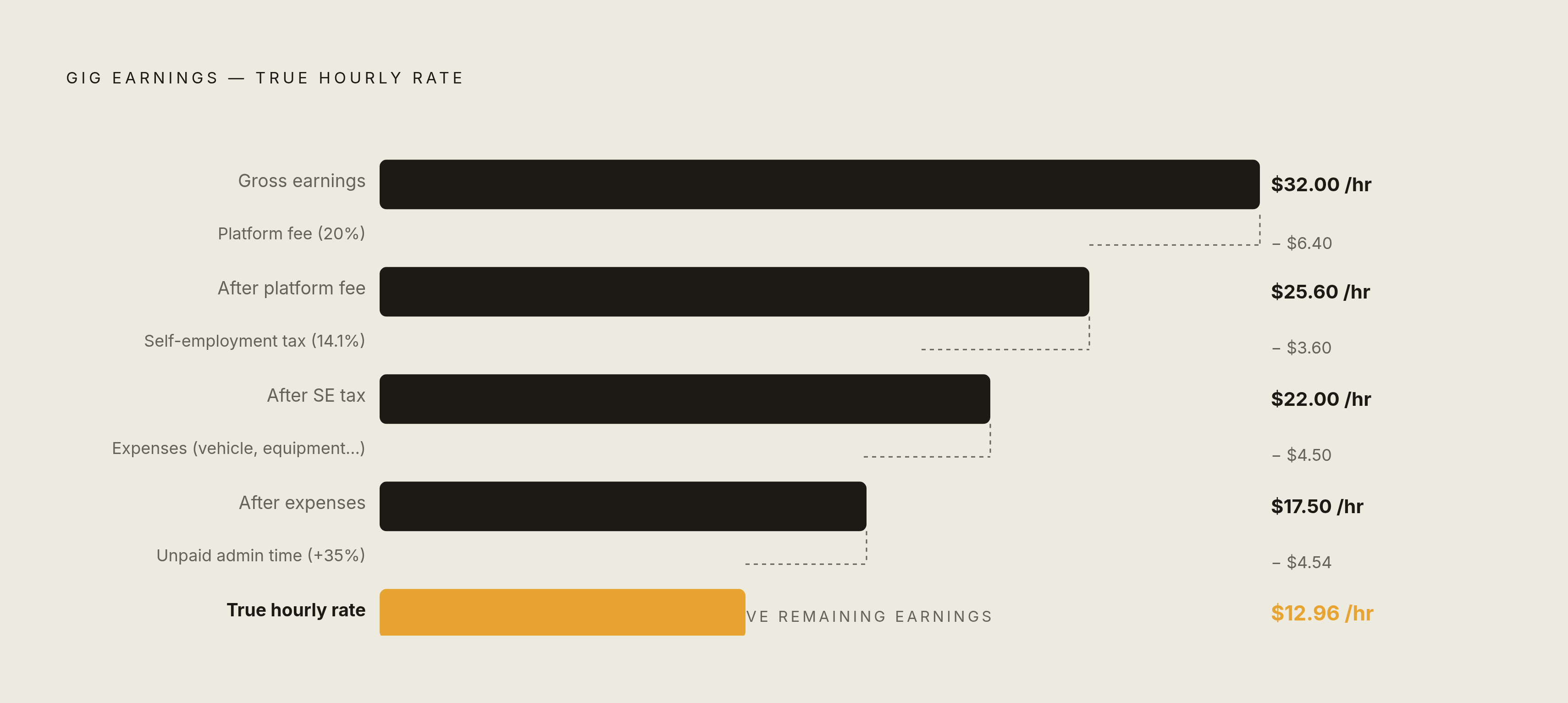
Picture a worker running a weekend delivery gig that pays a quoted hourly rate before anything is subtracted. Take out the platform's fee cut, then the self-employment tax owed on that net income, then a reasonable share of vehicle costs and phone data, and the number left is already meaningfully lower than that quoted rate. Now add in the time spent managing the app, logging mileage, and dealing with a denied delivery credit, none of which gets paid, and the real hourly return drops further still. Most stackers never run that calculation, yet it is what decides whether a gig is worth keeping.
The full calculation looks like this: gross earnings, minus platform fees, minus the self-employment tax owed on net income, minus allocated expenses like tools, equipment, vehicle costs, and a share of internet service, divided by total hours worked, including every hour of unpaid admin time spent on invoicing, platform management, support disputes, and client communication. Skipping any one of those subtractions makes the resulting hourly rate fiction.
Admin time is the input stackers miss most consistently. Every hour spent managing a platform account, following up on a late payment, or disputing a denied credit is an hour that doesn't appear anywhere in gross earnings, yet it reduces the real hourly rate just as surely as a platform fee does. Stacking multiplies this overhead directly: three income streams mean three separate platform interfaces, three payment cycles, three sets of tax records, and three channels of client or customer communication, each adding hours nobody is tracking or getting paid for.
The appeal of an extra paycheck is obvious, and workers describe that appeal in exactly those terms: a second or third income stream feels like security, or like discretionary money they didn't have before. What usually goes unexamined is whether that paycheck is being measured against what it actually costs to earn. A lower-than-expected hourly rate is still more income than not having the gig at all, and that's true as far as it goes. But it only holds if the gig isn't crowding out a better use of that same time, and if its overhead isn't quietly draining income the worker is mentally crediting to a different stream. A stacker decides which gigs to keep, and which to drop, based on numbers that were wrong from the start.
Unclaimed money owed to stackers
The same time pressure that pushes workers to stack multiple income streams in the first place leaves them with no bandwidth to track the deadlines and windows that consumer protections depend on. Money owed to them sits unclaimed for the same reason money gets overspent: nobody's watching closely enough to catch it.
Late delivery credits are a clear example. Amazon offers compensation for deliveries that miss a guaranteed delivery date, as opposed to merely an estimated one, but a customer has to wait out a required period before filing, and has to file the claim directly. Shipping fee refunds may process automatically on qualifying orders, but if you want additional account credits, you have to request them.
Price-drop refunds work the same way. Some retailers, including ones selling the equipment gig workers rely on, will refund the difference if a price drops within a set window after purchase, but only if the buyer notices the drop and files before that window closes. If you don't have some form of automated tracking, you can't catch that window consistently while juggling several income streams at once.
Subscription trial conversions follow the same pattern. A worker signs up for a productivity tool on a free trial, forgets the date it converts to a paid plan, and ends up paying for a full month, or several, before canceling, by which point any refund window has already closed. This becomes a bigger problem for stackers specifically, because each gig tends to generate its own trial sign-ups across its own set of tools and platforms. So the active trials running across three income streams can add up to more than anyone could reasonably track by hand.
Duplicate charges and quiet price increases on recurring subscriptions are just as hard to catch. A charge that doubles on one platform is easy to miss against the ordinary noise of multiple income streams and multiple spending accounts, and the busier the stack gets, the easier that charge is to overlook.
Auditing the economics of a gig stack
You start auditing a gig stack with gross earnings by stream, pulled directly from each platform's own reporting, not an estimate. From there, platform fees get subtracted stream by stream, since each one charges differently. You calculate self-employment tax against net earnings from each stream independently, not against the stack as a whole. Tracked expenses, including vehicle costs, equipment, software, and a share of home internet, get subtracted next, stream by stream again. You list recurring subscriptions tied to each gig and check them against whether that gig is still active. Unpaid admin hours, including invoicing, account management, and dispute time, get estimated and added to total hours worked. Only after all of that is the true hourly rate calculated: net income after every deduction, divided by total hours including the unpaid ones.
That order matters because each step depends on the one before it. Skipping the expense step inflates the apparent profit of a gig. Skipping the admin-time step inflates the apparent hourly rate. Running the full sequence, in order, for every stream in the stack produces the only number worth using to decide which gigs are actually worth keeping.