Layaway Programs in the Era of Buy Now Pay Later
BNPL's instant gratification masks stacking debt and overdraft risks that layaway never created.
Layaway and buy now, pay later get treated as the same idea wearing different clothes: both let a shopper spread a purchase across several payments instead of handing over the full price at the register. That surface resemblance, fixed payments, no credit card required, often no interest, hides a split at the foundation. Layaway makes a customer wait until the full price is paid before the item goes home with them. BNPL hands over the item first and collects the money afterward. That single reversal changes who carries the risk, and it ripples into debt exposure, fees, refund headaches, and how much of a shopper's financial life gets logged by an app. Picking between them is really picking between two different philosophies of ownership and risk, not just two payment schedules.
How layaway works
Layaway has been around for roughly a century, and while far fewer retailers carry it today, it hasn't disappeared. The mechanics haven't changed much over that span. A customer picks out an item and pays a deposit, usually a percentage of the price or a flat minimum, whichever is greater. The store sets the item aside under that customer's name and doesn't sell it to anyone else. The customer then makes scheduled payments until the balance hits zero, at which point the item goes home with them for the first time. If a customer backs out before finishing, some retailers charge a modest cancellation fee, but there's no debt left behind, no collections call, and nothing reported to a credit bureau.
Burlington still runs a layaway program as of 2025. It works in-store only: a minimum deposit gets the item held, the hold lasts for a limited period, and the balance has to be paid in full by the layaway's expiration date or the item goes back on the floor. Walmart tells a different story. It discontinued its traditional layaway program before the 2021 holiday season and replaced it with a BNPL option through Affirm, a move that got noticed widely at the time and signaled how far mainstream retail had already shifted toward pay-later financing.
Layaway's survival comes down to structure, not nostalgia. Because the store never releases the goods and never extends credit, there's no return logistics to untangle, no debt risk sitting on a consumer's books, and none of the regulatory scrutiny that BNPL has drawn. That simplicity is the whole appeal, and it's also why layaway has stayed small.
How BNPL displaced layaway
BNPL flipped layaway's order of operations. A customer gets the item right away and pays for it over the following weeks, solving the need to have the thing today, which layaway never could. The most common structure is called Pay in 4. Around a quarter of the total cost comes due upfront, and the rest splits into three equal installments spaced two weeks apart, usually with no interest charged as long as every payment lands on time.
The reach of BNPL has grown well past the big-ticket categories it started in. Electronics and apparel were the early use cases, but BNPL now shows up at checkout for restaurant delivery, groceries, travel, and plenty of inexpensive everyday purchases. It has become a general-purpose layer of short-term financing rather than a tool reserved for furniture or a new laptop. Approval is close to instant: most providers run a soft credit check that doesn't touch the applicant's credit score, and the answer arrives before checkout finishes.
Walmart's shift from layaway to Affirm ahead of the 2021 holiday season shows how fast a major retailer could make that substitution at scale, and Affirm's APR can run as high as 36%, depending on the purchase amount and the applicant's credit profile. The convenience is genuine. So is the cost structure that convenience sits on top of.
The hidden costs that accumulate when BNPL is used frequently
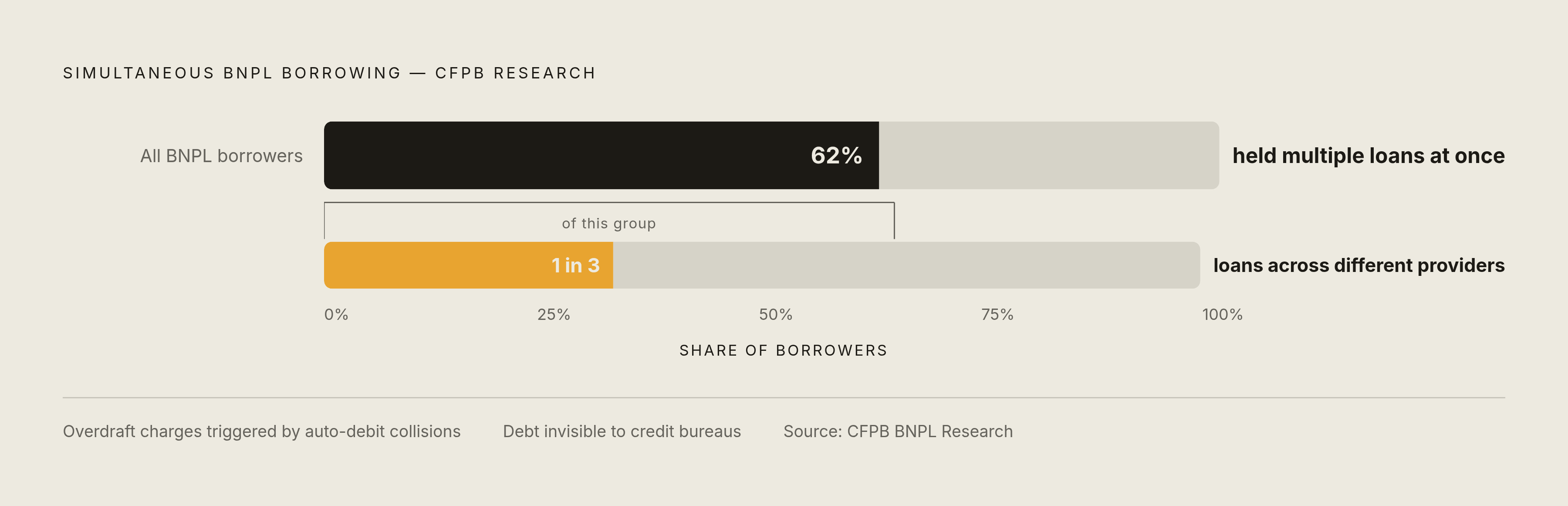
BNPL's biggest danger is the pile-up of several plans running at once, something few consumers can see clearly in one place because each plan lives with a different provider and a different app. Holding multiple BNPL plans simultaneously, a practice known as loan stacking, is common. Research from the CFPB found that more than three-fifths of BNPL borrowers held multiple simultaneous BNPL loans at some point during the year, and about one-third of those borrowers had loans open across different providers at the same time.
Most BNPL loans never get reported to credit bureaus, and that absence creates what regulators have called phantom debt. It doesn't appear on a credit report or in most budget tracking, but it drains a checking account when two or three auto-debits from separate providers hit the same day.
Fee structures vary by provider. Affirm and PayPal's Pay in 4 charge no late fees. Other providers do, and the "0% interest" headline that draws a shopper in at checkout says nothing about that fee exposure. The costs that matter most often sit outside the BNPL statement. Compared to non-users, BNPL users rack up more overdraft charges, pay more credit card interest, and accumulate more credit card late charges. All of that traces back to the payment timing pressure that BNPL creates by stacking due dates a consumer didn't plan around, even though none of it shows up on the BNPL provider's own records.
Layaway carries no equivalent failure mode. Fall behind on a layaway payment and the store simply keeps holding the item while charging, at most, a modest cancellation fee. No collections agency gets involved, no credit score takes a hit, and no overdraft cascade follows.
BNPL for groceries versus BNPL for a laptop
BNPL was built and best suited for planned, large purchases: appliances, electronics, furniture, items where an installment structure lines up with how a household actually budgets ahead of time. Using it to buy a laptop in four payments is a financing decision made in advance, with a known end point.
Using it to buy groceries is a different animal. The debt doesn't resolve after the fourth payment the way it does with a laptop. It restarts with the next grocery run, and the next one after that, becoming a rolling short-term obligation that never fully clears. Layaway offers no fallback here at all, since nobody can hold a carton of milk on a shelf for three weeks. The shoppers using BNPL to cover groceries aren't choosing between BNPL and layaway. The real comparison for them is a cash reserve or an earned-wage-access product. What they're managing isn't a purchase decision but a cash flow gap.
BNPL works best for planned, essential purchases that fit inside a budget that already exists. It isn't designed to stand in for income or savings on everyday spending, and yet that's precisely how a growing share of users have started deploying it.
What the refund and return experience reveals
Returning something bought on BNPL is more complicated than it looks at checkout, and most of that complication lands on the consumer. When a BNPL purchase gets returned, the refund has to travel from the merchant back to the BNPL provider first, and only then to the consumer, a chain with its own timeline and its own places to break down.
New York's proposed BNPL regulation, published February 23, 2026, and implementing the BNPL Act that Governor Hochul signed on May 9, 2025, would set a clock on that chain. BNPL lenders would need to make reasonable efforts to get merchants to transmit a credit statement to the lender within seven business days of agreeing to a refund, with the lender then required to credit the consumer within three additional business days. No such timeline exists today as a federal requirement. Without it, a consumer can keep making scheduled BNPL payments on an item already sitting back on a store shelf, waiting for the credit to catch up to the return.
Layaway sidesteps this problem by design. Because the goods never left the store in the first place, canceling is a straightforward store-side transaction governed by a fee structure the retailer discloses at the moment of enrollment.
The data BNPL apps collect
Choosing a BNPL app is an agreement to hand over an ongoing stream of personal and behavioral data to a fintech company whose core business is lending money. Research has found that BNPL apps collect an average of 14 data types about their users and share an average of five data types with third parties, some of it sensitive. That footprint reflects what the business actually needs: a continuous model of a user's creditworthiness and spending behavior, not just a snapshot taken at one transaction.
New York's February 23, 2026 proposal takes direct aim at this. It would require BNPL lenders to get the consumer's separate, informed, affirmative consent, signed electronically or in writing, for each specific use case before using, selling, or sharing consumer data beyond what's needed to make a particular loan, service the account, or meet legal obligations. Regulators built that provision because they view the data collection as built into how the BNPL business model makes money, not as an accidental side effect of it.
None of this makes BNPL dangerous to use. It makes the data trade-off a real cost that deserves a conscious decision rather than a box checked without thought during checkout. Layaway, by comparison, carries almost no data footprint at all: the transaction runs through a store system or a paper form, with no app relationship and no behavioral data generated between one payment and the next.
Regulatory status and consumer protections
BNPL sits inside a regulatory landscape that's actively being built and unevenly applied, and that unevenness means the protections a given consumer has depend heavily on where they live and which provider they chose.
New York is furthest along among the states. The BNPL Act, signed by Governor Hochul on May 9, 2025, sets up the first state-level licensing regime built specifically for BNPL lenders, along with disclosure requirements, dispute resolution standards, limits on fees and charges, and data privacy protections. The New York State Department of Financial Services published a pre-proposed regulation implementing the Act on February 23, 2026, in the middle of an ongoing debate over whether BNPL should be regulated more like a credit card.
A consumer who assumes BNPL carries the same baseline protections everywhere that a credit card does is working from a wrong assumption. The rules are still being written, state by state, and what applies in New York doesn't automatically apply anywhere else. Layaway needs none of this scaffolding, because no credit changes hands. The consumer's only legal relationship runs to the retailer directly, and the terms sit in the deposit and cancellation policy disclosed at the moment of enrollment, not in a regulation still working its way through a comment period.
Matching the model to the purchase
The choice between layaway and BNPL comes down to what kind of purchase is on the table and what kind of risk a shopper is willing to carry. A planned, big-ticket purchase, like a couch or a laptop, fits either model reasonably well, since both are built for exactly that kind of spending. A shopper who wants zero debt exposure and doesn't mind waiting to take the item home gets that from layaway, along with a disclosed fee structure and no credit check. A shopper who needs the item now and can realistically meet four payments on schedule gets that from BNPL, along with fast approval and no interest if every payment lands on time.
The calculation changes for recurring, essential spending like groceries or gas. BNPL there becomes a recurring stopgap for a cash flow problem, something a shopper manages fresh with every new bill. Layaway was never built to solve that problem.
Before opening a BNPL plan, a shopper gains from checking three things: whether another BNPL plan is already open with a different provider, whether the provider reports late payments or charges late fees, and whether the retailer's return policy makes clear how a refund flows back once an item goes back to the store. Before choosing layaway, the only real check is the cancellation fee and the expiration date on the hold. One model asks a shopper to wait. The other asks a shopper to trust that four payments, spread across eight weeks, will go exactly as planned.