Employment Credit Checks and Their Disparate Impact
Research shows credit checks don't predict job performance but do screen out workers of color.
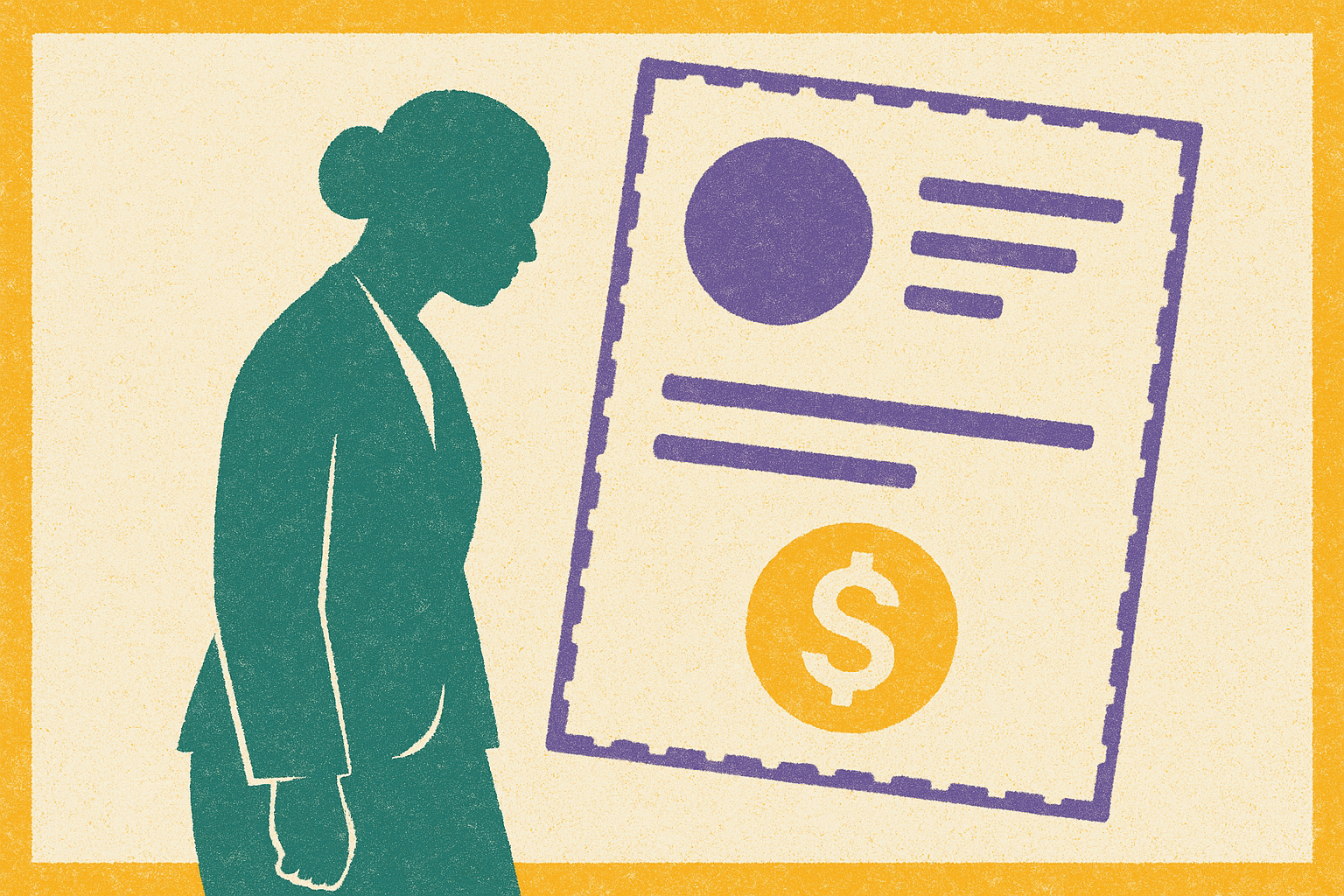
An employment credit check is a background screen that pulls a version of an applicant's credit report, built for employers rather than lenders, and employers use it to stand in for two things they can't observe directly. The first is dependability: the idea that someone who manages bills responsibly will manage job duties responsibly too. The second is risk: the idea that financial stress makes an employee more likely to steal or cut corners, especially in a role that touches cash, inventory, or other people's money. Credit is usually just one piece of a larger screening process that also looks at work history, education, and criminal records, but it carries the same legal weight as any other factor once it's used to decide who gets hired. The Fair Credit Reporting Act sets rules for employers who pull these reports through third-party vendors, covering things like disclosure and consent, and that framework exists on its own, separate from anything in discrimination law.
Why the employer rationale lacks an empirical foundation
But do credit checks even work as advertised? The research says no. Industrial-organizational psychologists Dr. Jerry Palmer and Dr. Laura Koppes, both at Eastern Kentucky University, studied credit reports belonging to close to 200 current and former employees in financial-service jobs across six companies, and they found no link between credit history and either job performance or turnover. An industrial psychologist testifying at a public EEOC meeting made a related point: plenty of research backs using credit scores to make lending decisions, but almost none of that research carries over to hiring decisions. Lending and employment are different questions, and the employer rationale treats them as if they were the same one. A New York Fed working paper adds another piece of evidence against the theory. It found that removing a hidden bankruptcy flag from someone's credit file had zero measurable effect on their employment or earnings. The flag tracked closely with worse outcomes in credit markets, but it predicted nothing about how someone performed at work. Put together, these findings describe a tool that was built to answer a lending question and then handed a job it was never tested for.
Racial wealth gaps and disparate impact
A policy can discriminate without ever mentioning race. That's what "facially neutral" means: the rule itself is colorblind on paper, but applying it produces results that split sharply along racial lines. Credit reports never list race, but they carry its fingerprints. The gap in credit scores between Black and white Americans traces back to decades of lending, housing, and wealth-building practices that were openly discriminatory and, for much of that history, perfectly legal. That gap didn't come from different spending habits. It came from redlining, exclusion from federally backed mortgages, and a dozen other policies designed to keep Black families out of the credit system that built white wealth.
Opportunity Insights, the Harvard-based research group, published findings showing that the average credit score gap between Black and white individuals is large and holds steady across a person's entire life. It's there at age 30, and it's still substantial at age 60. The Past Imperfect report adds a second layer to the problem: Black and Latino consumers are disproportionately "credit invisible" or carry files too thin to generate a score at all, at rates well above white and Asian consumers. That means the screen doesn't just rank these applicants lower. It filters many of them out before a number even exists to judge them by.
The criminal legal system adds another layer of weight. Communities of color carry a disproportionate share of fines, fees, and court debt, and that debt flows straight into credit records, compounding disadvantages that started elsewhere. On top of all this, the credit report itself is an unreliable document. A substantial share of consumers find errors on their reports, and a meaningful portion of those errors are serious enough to drag a score down. The tool employers lean on is racially skewed in its outcomes and inaccurate on its own terms.
The poverty trap: how a bad credit score blocks the income needed to repair it
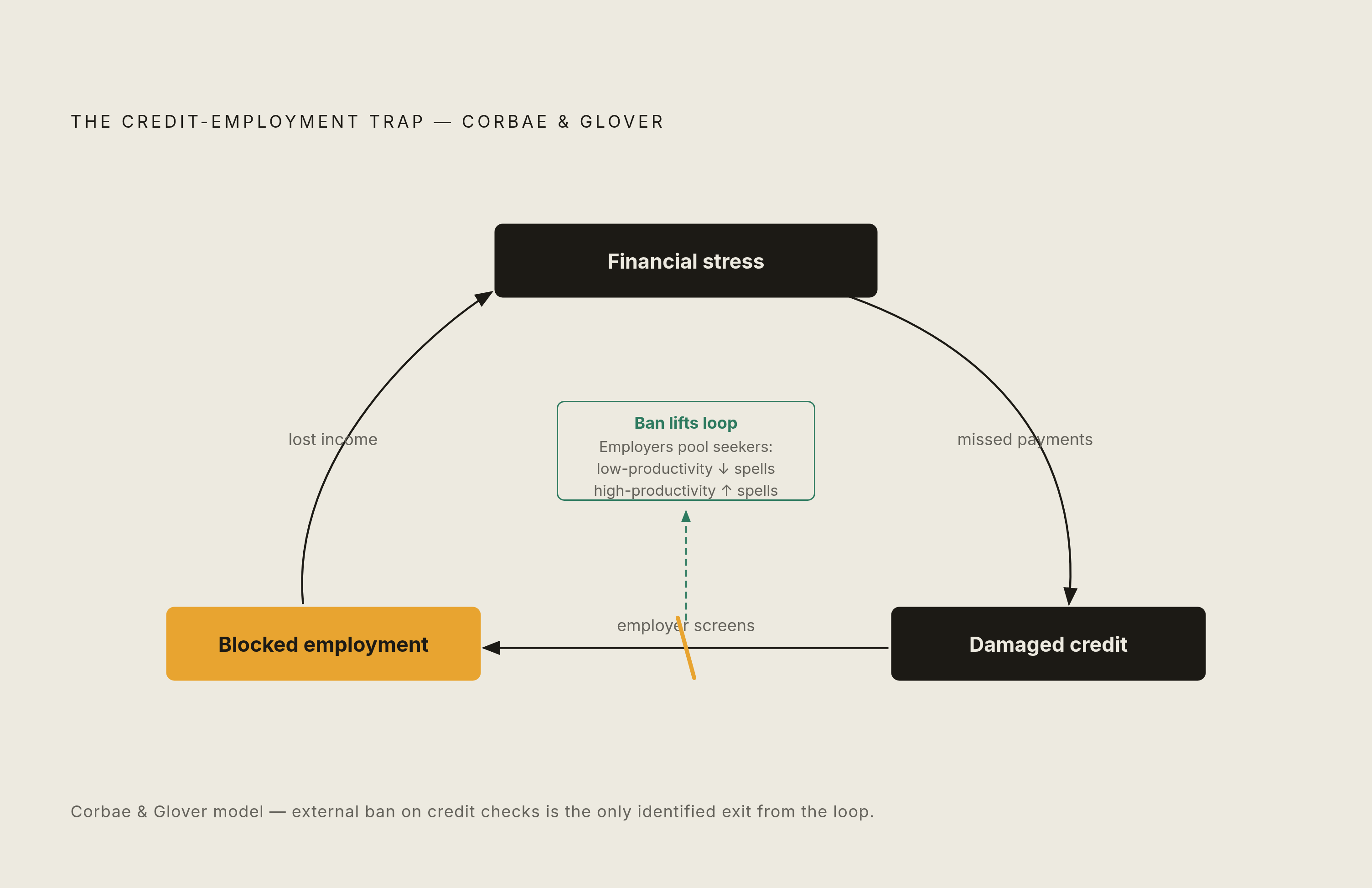
The usual defense of credit checks, that people can simply improve their scores over time, falls apart once you look at how the loop actually runs. Financial stress damages credit. Damaged credit blocks employment. Lost employment deepens the financial stress that damaged the credit to begin with. Economists have a name for this kind of closed loop: a poverty trap, where the condition and its cause keep reinforcing each other with no clear exit.
A study by Corbae and Glover, published in the Review of Economic Studies, modeled this exact tradeoff. If employers can't run credit checks, the poverty trap that bad credit creates breaks. The same model shows a cost to that fix: without credit information to sort candidates, employers pool job seekers together, which slows down matching. Low-productivity workers actually see shorter unemployment spells under a ban, because they're no longer screened out automatically, but high-productivity workers see slightly longer ones. A Demos study found that a meaningful share of unemployed people surveyed said they had been denied a job specifically because of their credit, which confirms the trap isn't a theoretical construct sitting inside an economic model. It appears in real hiring decisions, not just in the economic model. And because the racial wealth gap is what produced the credit score gap in the first place, the same structural forces are blocking the one thing, a steady paycheck, that could start closing that gap.
Federal courts and EEOC challenges to credit and background checks
The EEOC's attempts to challenge credit and background checks in federal court ran into serious trouble, even in cases where the underlying argument about structural harm held up. In EEOC v. Kaplan Higher Education Corporation, decided by the Sixth Circuit in 2014, the agency alleged that Kaplan's credit background checks, used across several position types including ones with access to students' financial-loan information, disproportionately excluded African-American applicants. The court affirmed summary judgment for Kaplan and went further, criticizing the EEOC for using background checks in its own hiring for comparable job-related reasons, and calling the statistical analysis from the agency's expert "laughable."
EEOC v. Freeman followed a similar path. The agency alleged that Freeman discriminated against African-American applicants through its credit history criteria, and against African-American, Hispanic, and male applicants through its criminal history criteria. Judge Titus granted summary judgment for Freeman: he ruled that the EEOC's expert statistical analysis was unreliable, and he found, separately, that the agency hadn't identified facts to support a disparate impact claim tied to any specific practice.
The agency brought similar theories against BMW Manufacturing Co. and Dollar General, and in both cases it argued that criminal background check policies disproportionately harmed Black applicants without being job-related or justified by business necessity. Across all these cases, a pattern holds: courts demanded statistical proof more rigorous than the EEOC could deliver, and judges gave real weight to employer claims of business necessity, especially for jobs with access to money or financial assets. Litigation alone was not getting the job done.
The 2012 EEOC criminal background check guidance and its role in structuring employer practice
Before the current retrenchment, the EEOC's 2012 guidance gave employers a working framework for managing their disparate-impact risk, and many companies treated it as their baseline for compliance for well over a decade. That guidance addressed criminal history specifically, not credit history. The two screens raise related legal questions, but they aren't the same tool, and they shouldn't be confused with each other.
The 2012 guidance explained that using criminal histories in hiring could violate Title VII under two separate theories: disparate treatment, or intentional discrimination, and disparate impact, a neutral-looking policy that lands harder on one group even without intent. It specifically flagged the disparate impact that criminal history screens have on Black and Hispanic applicants and employees. It also laid out the standard three-step process courts use to evaluate a disparate impact claim: the person bringing the claim has to point to a specific practice and show its disparate impact, the employer then has to show the practice is job-related and backed by business necessity, and the claim can still succeed if the plaintiff can point to a less discriminatory alternative that would serve the same purpose. Within that framework, the guidance set out the "Green factors," which look at the nature and seriousness of the offense, how much time has passed since it occurred, and the nature of the job itself, along with nine more individualized factors employers could use to show a given screen was job-related.
According to Ogletree, the EEOC has submitted a draft to rescind this guidance. If that happens, the agency would likely keep pursuing cases built on intentional discrimination, but would step back from disparate impact charges. Private plaintiffs could still bring those claims under Title VII itself and the case law built around it, because the guidance was never the statute. It was only the agency's interpretation of it.
The federal executive branch's move to dismantle disparate-impact liability across agencies
The retreat from disparate-impact enforcement is a coordinated position running across the federal executive branch, not limited to one agency's enforcement choices. Executive Order 14281, issued April 23, 2025, states outright that "disparate-impact liability is wholly inconsistent with the Constitution," and it directs every agency to strip the theory out of its guidance, regulations, and enforcement work.
The Department of Justice put that position into a formal opinion on June 9, 2026, arguing that the EEOC's disparate impact guidelines are unconstitutional because they "pressured employers to engage in race discrimination," while also allowing employers to face liability for unequal outcomes "without regard to the employer's likely intent." That's the administration's affirmative constitutional claim: disparate-impact liability, in its view, forces employers to manage outcomes by race in order to avoid lawsuits, and that amounts to race discrimination in itself. It's a position readers can evaluate on its own terms, whether or not they find it persuasive, and it marks a real shift from treating disparate impact as settled law to treating it as a constitutional problem.
The EEOC's own actions track the same direction. On January 22, 2026, the agency voted 2-1 to rescind its 2024 harassment enforcement guidance. Chair Andrea Lucas said the rescission doesn't give employers license to engage in unlawful harassment and that federal employment laws remain in place, but the vote itself signals where the agency is headed.
The clearest move came from the CFPB. On April 22, 2026, with an effective date of July 21, 2026, the agency issued a final rule amending Regulation B under the Equal Credit Opportunity Act, asserting that the ECOA does not cover disparate-impact liability. That reverses fifty years of consistent interpretation by Congress, the courts, and regulators, and it undoes positions held by every administration since 1977. The rule is being challenged in National Fair Housing Alliance v. Consumer Financial Protection Bureau, filed in the federal court for the District of Columbia under case number 1:26-cv-01820, where plaintiffs are seeking to have it vacated.
None of this changes the statute itself. Executive orders, DOJ opinions, and agency rules are not the same thing as an act of Congress or a high court ruling. Title VII's text, along with the body of case law interpreting it, still stands regardless of where any single agency currently points its enforcement priorities.
State laws filling the federal retreat
With federal enforcement pulling back, state legislatures have stepped in directly, passing laws that ban employment credit checks outright and don't depend on the EEOC, the DOJ, or any federal disparate-impact theory to function. New York is the newest and most far-reaching example. Effective April 18, 2026, General Business Law § 380-b(d) bars every employer in the state, regardless of size, from requesting or using an applicant's consumer credit history in making an employment decision.
New York's law does something none of the other states with similar bans have done: it also stops consumer reporting agencies from supplying employment-purpose credit reports in the first place, unless a narrow exemption applies. That shuts off the supply side of the problem, not just the demand side. An employer can't quietly work around the ban by getting the data some other way. The exemptions that remain are tightly drawn: jobs requiring a federal or state security clearance, non-clerical jobs with regular access to trade secrets or national security information, and jobs where someone has signatory authority over third-party funds or assets worth $10,000 or more.
New York paired this ban with a second move on the very same day. On December 19, 2025, the state signed the credit-check ban into law and also codified disparate-impact liability directly into its Human Rights Law, as Executive Law § 296(5-a). That provision states that an unlawful discriminatory practice can be established by a policy's discriminatory effect alone, with no need to prove intent, for any employment discrimination occurring on or after that date. The pairing matters. New York didn't just outlaw one specific screening tool. It locked the underlying legal standard into state law, so that other screening practices with similar discriminatory effects remain challengeable even as the federal government moves away from that same standard. Ogletree notes that state and local background-check laws have multiplied in recent years, with requirements that vary widely from one jurisdiction to the next; that creates a genuine headache for employers operating across state lines, and it signals that state agencies are ready to fill the enforcement gap the EEOC is leaving behind.
Where a job applicant's protections stand today
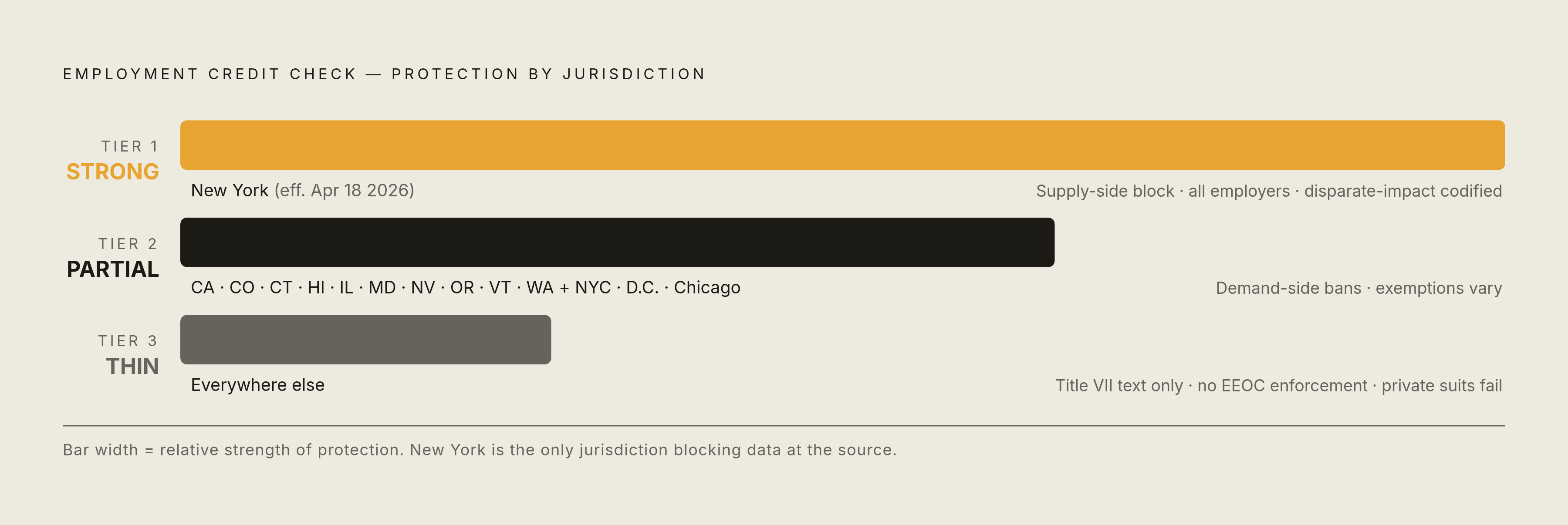
Whether a job applicant has any real protection against a credit check in 2026 comes down almost entirely to where the job is located. In New York, any credit check requested after April 18, 2026, is presumptively illegal unless the position fits one of the narrow statutory exemptions, and the consumer reporting agency on the other end of that check faces its own separate prohibition. Ten other states, California, Colorado, Connecticut, Hawaii, Illinois, Maryland, Nevada, Oregon, Vermont, and Washington, have similar bans on the books, along with cities and counties including New York City, Washington D.C., Chicago, and Cook County, though the scope and exemptions differ from place to place.
Outside those states, the picture is thinner. Federal disparate-impact protection under Title VII is still written into the statute and backed by decades of case law, but the EEOC shows little appetite for pursuing it, the DOJ has called the underlying theory unconstitutional, and private litigants face the same evidentiary wall that sank the EEOC's own cases against Kaplan and Freeman. One thing holds steady no matter the state: the FCRA's procedural rules, disclosure, authorization, and adverse action notice, apply nationally to any employer using a third-party vendor to run a background check.
What that leaves is a country split into two very different legal realities for the same hiring practice, with the DOJ's constitutional challenge to disparate-impact liability, the pending suit against the CFPB's Regulation B rule, and the growing patchwork of state statutes all still unresolved. The rules governing an employment credit check today are not guaranteed to be the rules governing one a year from now.