Credit Scores as Rental Housing Gatekeepers
Landlords use credit scores to screen tenants because they're defensible, not because they work.

Credit scores have become the default gatekeeper in rental housing because they're cheap, fast, and easy for landlords to defend, not because they predict who pays rent on time. That convenience comes at a real cost: millions of renters sit at or below the threshold landlords set, and the gap between what a credit score measures and what a landlord actually needs to know is where that cost lands.
Why landlords adopted credit scores as a screening tool
Tenant selection used to be a manual process. A landlord read an application, made a judgment call, and lived with the legal exposure that came with it. Every individual decision carried the risk of a bad tenant on one side and a fair housing complaint on the other. A credit score solved both problems at once. It compressed a messy human judgment into a single number that looked neutral, came from a third party, and could be applied the same way to every applicant who walked through the door.
That's the appeal in plain terms: cost and scale. One number produces one automated decision, with no individual review required, and a paper trail that holds up if a rejected applicant ever challenges the outcome. The Consumer Financial Protection Bureau found that a majority of landlords use some form of automated screening, with estimates reaching as high as nine in ten. That adoption rate didn't happen because credit scores are the best available measure of tenant reliability, after all. It happened because they're the most defensible one.
Defensible and accurate are not the same thing. A number that protects a landlord from liability does not necessarily protect a tenant from an unfair rejection, and the rest of this piece is about that distance.
What Credit Scores Measure
A credit score exists to answer one question: will this person be late on a loan? It was built for lenders underwriting mortgages, car loans, and credit cards, not for landlords trying to figure out who will make rent. The National Consumer Law Center's 2023 report is direct about the result: there is "absolutely no evidence that credit scores have value in predicting whether a renter will pay their rent. The instrument was purpose-built for one job and has never been validated for the job landlords are now using it to do.
The gap in rental payment data behind that finding is large. Standard credit scores cover rental payment history for only a tiny fraction of U.S. renters, roughly one in eight, with actively reporting households closer to one in fourteen. The actual record of whether someone pays rent on time, month after month, is invisible to the instrument for the overwhelming majority of applicants. The score instead counts a different kind of payment history: credit cards, auto loans, mortgages. None of that tells a landlord what they're actually trying to find out.
The mismatch produces outcomes that run backward. Picture two applicants. One has a high credit score but spends a very large share of income on rent, leaving little room for a job loss or a medical bill. The other has a lower score but spends much less of their income on rent, leaving real room to absorb a bad month. The NCLC points out that the first tenant carries more actual payment risk than the second. A credit score cannot see that difference. It produces the same output regardless of rent burden, because rent burden was never part of what it measures.
Automated screening turns an imperfect instrument into a hard rejection
A flawed metric used as one factor among several is a manageable problem. A flawed metric used as an automated floor is a different thing entirely, and that's what screening software has built. The sequence is mechanical and repeats the same way at property after property: a landlord sets a minimum score, an applicant submits a rental application, the screening software pulls a credit report and compares it against the threshold, and if the number falls below that line, the system generates a rejection before anyone on the landlord's side looks at the file.
Income never enters the picture at that stage. Rental history never enters the picture. Any compensating factor the applicant might offer, a steady job, a cosigner, years of on-time payments to a previous landlord, never enters the picture either, because the software has already closed the file.
The mechanism punishes the act of searching for housing. Every credit pull tied to a rental application counts as a hard inquiry, and each one lowers the applicant's score. If a renter applies to five properties in a tight market, they lose points five times over, simply for looking. That's a structural penalty built into the search process itself, independent of anything the applicant has done financially.
Once the software issues a rejection, there's rarely a path back. NCLC's survey found that landlords frequently make leasing decisions based solely on screening scores and recommendations, and are unlikely to hear disputes or weigh mitigating factors. A CFPB survey found that few landlords allow applicants to explain negative information. For most renters who fall below the line, the rejection is final before they get a chance to say anything.
Who the automated floor systematically filters out
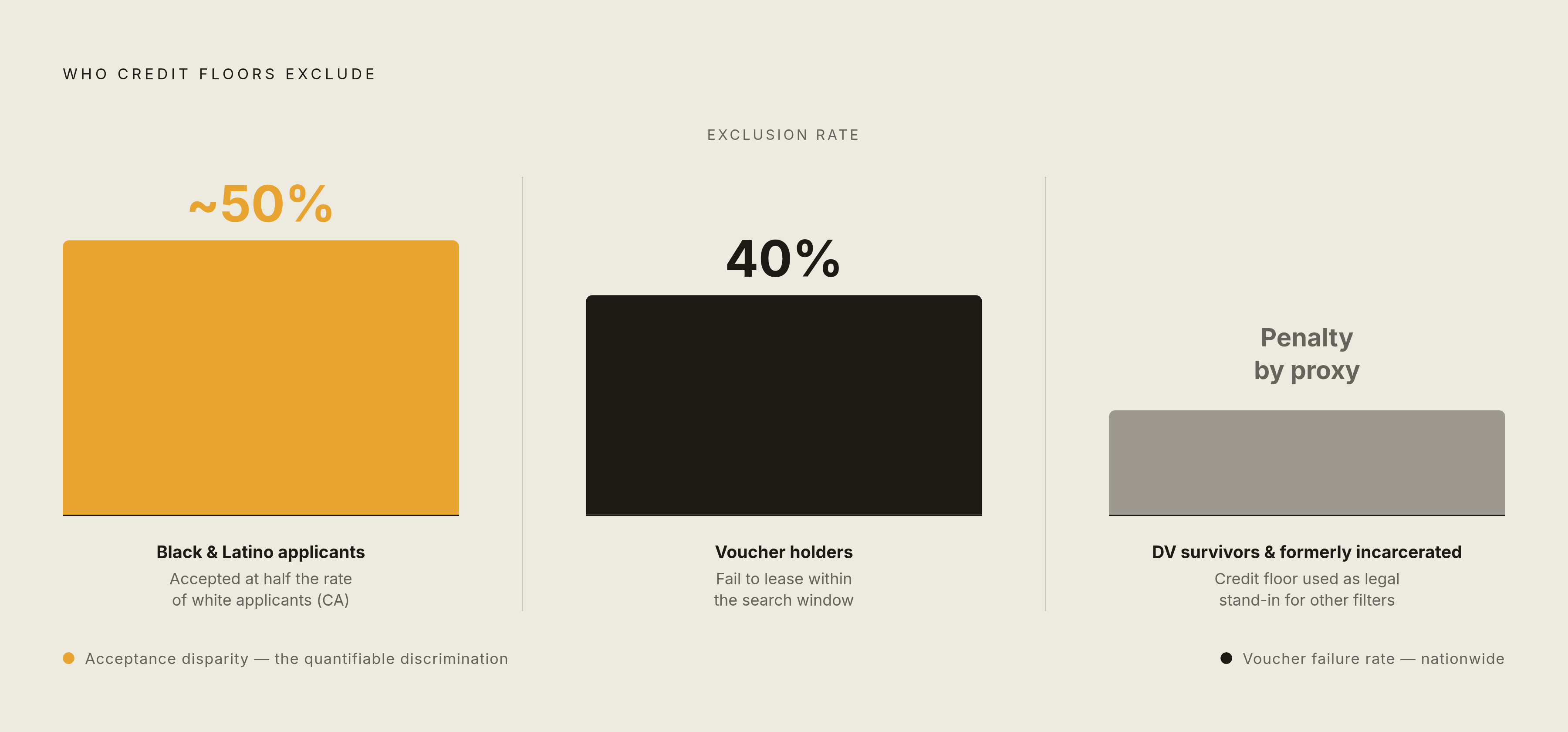
A credit floor set at 620 to 680 does not sort reliable renters from unreliable ones. It sorts renters by whether structural disadvantage shaped their financial histories, and three groups show how.
Black and Latino renters face a credit reporting system built on history more than behavior. Georgetown Law's poverty journal documents that communities of color are more likely to carry lower credit scores because of the economic consequences of redlining, employment discrimination, and aggressive debt collection, the very structural forces that built the data sitting inside their credit reports today. CFPB data cited in the NCLC report shows that Black and Hispanic Americans have no credit history at all at substantially higher rates than white and Asian Americans. A survey of screening outcomes in California found that Black and Latino applicants were accepted at roughly half the rate of white applicants, a result that suggests automated screening doesn't neutralize racial bias so much as formalize it.
Housing Choice Voucher holders face a different failure. The voucher program covers most of the rent, so the usual landlord concern about income-to-rent ratios mostly disappears. Credit score thresholds step in to do the excluding instead, a pattern documented in a 2025 Housing Studies analysis of a large sample of tenant screening criteria. That analysis identified minimum credit score requirements, along with bankruptcy-related criteria, as key determinants of exclusion for voucher holders. A Capital & Main investigation, republished through Stocktonia News, found major Los Angeles landlords, including properties affiliated with Equity Residential, Essex Property Trust, AvalonBay Communities, Prime Residential, G.H. Palmer Associates, Greystar, and Jamison Properties, continuing to reject Section 8 applicants based on credit history alone, despite California's SB 267 prohibiting exactly that practice since January 2024. Leasing agents at properties run by Equity Residential, Essex Property Trust, and Greystar described policies that did not comply with the law, even where corporate statements claimed otherwise. A 2021 HUD study cited in that same reporting found that nationwide, four in ten Section 8 recipients who receive a voucher are unsuccessful at leasing a unit within the allowed search window.
Survivors of domestic violence and formerly incarcerated people face something closer to proxy discrimination. The Center for Democracy and Technology documents that survivors of domestic violence often have difficulty building independent credit because they lack control over or access to household finances. The algorithm then penalizes the outcome of that abuse as if it were a sign of unreliability. The Seattle Renters' Commission has raised a parallel concern for formerly incarcerated applicants: landlords barred from denying housing based on criminal record can set an unrealistic credit score requirement instead, using credit as a stand-in for the filter the law no longer lets them apply directly.
How screening errors amplify harm for people who can least absorb them
Even setting aside whether credit scores measure the right thing, the data feeding into them is often wrong, and the applicants most likely to be rejected on bad data are the least likely to have any way to fix it. Georgetown Law's analysis cites a CFPB finding that tenant background check reports are "filled with largely unsubstantiated information that holds inconclusive accuracy or predictive value," including records that belong to someone else entirely, outdated information, and arrest or eviction records that are inaccurate or misleading.
Screening software generally offers no mechanism for an applicant to correct a mistake or add context before a decision is made. Many landlords don't properly inform applicants of their right under relevant consumer protection law to dispute an error, so the mistake simply carries forward into the next application and the one after that.
The Connecticut CrimSAFE case, documented in Georgetown Law's analysis, shows how rigid these systems are even when a landlord wants more nuance. The screening tool grouped traffic accidents and vandalism into the same category. A landlord who wanted to screen out vandalism had no way to do that without also screening out applicants whose only mark was a traffic incident. The software offered no setting to separate the two. The same inflexibility runs through credit-based screening: a debt referred to collections can sit on a credit report for up to seven years, so a single period of hardship, a medical crisis, a layoff, an abusive relationship an applicant has long since left, follows that renter through every housing search for years after the event itself ended.
The Landlord's Legitimate Objection
Landlords have a real interest at stake here, and it deserves to be taken seriously on its own terms. A landlord who rents to a tenant who cannot or will not pay faces a financial loss, a lengthy and expensive eviction process, and property damage that may never be recovered. Screening exists because some applicants genuinely do pose that risk, and no landlord should be expected to rent blind.
The case for some form of risk assessment is sound. What it does not establish is that a credit score is the right tool for that assessment. A tenant with an excellent score can still be carrying so much rent burden relative to income that a single missed paycheck triggers default. A tenant with a thin credit file, someone who simply hasn't taken out loans, can have a years-long record of on-time rent payments that a credit score never sees and therefore cannot credit. The objection to credit screening is that the number landlords rely on doesn't reliably tell them where the risk they want protection against actually sits.
Alternative data isn't a clean fix either, and the NCLC says so directly. Reporting rent payments to credit bureaus can help a renter who pays on time, but it can also hurt a renter who falls behind during a hard stretch, since negative rent payment data gets recorded just as readily as positive data. Any financial record, rent included, still carries the imprint of the same racial and economic inequality that shapes credit scores today. The problem sits in the structure of financial data itself, not simply in which dataset a landlord happens to pull from.
How The Legal Landscape Is Responding
Lawmakers in several states are moving to rein in automated credit floors, and the response is arriving faster than enforcement can keep pace with it.
Portland, Oregon's FAIR Ordinance took effect January 1, 2025, and is codified in City Code 30.01.086. It sets up a two-track system. Under the low-barrier track, a landlord cannot reject an applicant with a credit score of 500 or higher. Under the landlord-choice track, stricter criteria are allowed, but only alongside an individual assessment before any denial. Oregon's SB 282 adds another protection on top of that: landlords cannot consider unpaid rent or debt that accrued between April 1, 2020 and March 1, 2022, the pandemic window, and that exclusion remains in effect.
California's SB 267 took effect in January 2024. It bars landlords from rejecting Section 8 applicants based on credit history alone and requires landlords to let those applicants submit lawful, verifiable alternative evidence of their ability to pay their share of the rent, with a requirement that landlords actually consider that evidence if it's offered. Colorado has adopted a similar measure, the Capital & Main reporting found.
New York's State Senate Bill S6053 was introduced in the 2025-2026 session by Sen. Parker, would go further still. It would amend New York's executive law to make refusing housing based on consumer credit history unlawful outright, placing credit history alongside race, sex, and familial status as a prohibited basis for denial. The bill's sponsor memo names the racial dimension explicitly: studies have found that African American and Latino communities carry lower credit scores as a group than white Americans, a gap tied to inequality rather than individual responsibility, and the memo notes that African Americans earn substantially less for every dollar earned by white Americans.
Litigation has produced results too. A disparate impact settlement required a screening company to pay a multimillion-dollar sum to hundreds of plaintiffs and to stop scoring applicants based on their use of housing vouchers, establishing that an automated denial policy can be found discriminatory even without any discriminatory intent behind it.
None of this closes the gap on its own. A law that requires individual assessment or acceptance of alternative evidence only works if someone checks that landlords are actually following it. The California investigation makes that gap visible: corporate policy statements promised compliance with SB 267, while leasing agents on the ground described practices that didn't match those promises, with no consequence attached to the difference.
What a more accurate screening process would look like
Better screening means screening that measures what it claims to measure, rather than substituting a loan-underwriting number for a tenancy question it was never built to answer. If you treat medical debt differently from a pattern of chronic late payments, weight a tenant's recent payment trajectory more heavily than an old derogatory mark, and require an individual assessment before any denial, you cut discrimination risk while also protecting landlords from losing a reliable tenant to a blunt numeric cutoff.
Portland's FAIR Ordinance and California's SB 267 show that regulators are already moving that way, whether or not landlords lead.
For renters navigating the system as it exists today, the deeper challenge is that nothing in it is working on their behalf. Free trials convert without notice, refund windows close, and the small financial habits that could build a stronger credit profile over time go unmanaged, simply because no one is tracking them systematically. The kind of proactive monitoring that catches a forgotten monthly charge is the same discipline that protects the financial stability credit scores are supposed to reflect in the first place, and most renters have no structured way to maintain that discipline on their own.
The larger fixes, adding rent payment history into the data screening algorithms actually use, requiring individual assessment before any automated denial, and enforcing the alternative-evidence laws already on the books, depend on policy action that no individual renter and few individual landlords can drive alone. The litigation and legislative activity already underway shows pressure building that way. It is building slowly, and the gap between the law on paper and the law as enforced remains the open question every renter below the floor is still living with.
Sources
- NY State Senate Bill 2025-S6053
- The Discriminatory Impacts of AI-Powered Tenant Screening Programs
- Tenant Screening Algorithms Enable Racial and Disability Discrimination at Scale, and Contribute to Broader Patterns of Injustice - Center for Democracy and Technology
- New Report Examines How Abuse and Bias in Tenant Screening Harm Renters - NCLC
- Full article: Choice denied: impact of income and credit-based tenant screening on the Housing Choice Voucher program