Store Credit Cards as a Workaround for Thin-File Consumers
Store cards can build credit for first-time borrowers but lock users into predatory rates.
You need credit to build credit. Lenders deny applicants with no score, but no score can exist without an approved account, the catch-22 facing anyone trying to enter the system for the first time. A file counts as thin when it carries fewer than five active tradelines, and most scoring models also require at least one account to sit open for six months before they'll generate a score. Until that threshold is crossed, the applicant is invisible to the automated systems that make nearly every credit decision in this country. Thin-file status is a measurement gap, not a behavior problem, but lenders' systems sort both into the same reject pile.
Why store cards target this end of the market
Store cards target thin-file and borderline applicants on purpose. Retailers gain loyalty and impulse spending from every cardholder, and the banks behind these cards build rate and fee structures from day one, because they need to offset the higher default risk that comes with approving riskier files. Private label cards, the ones stamped with only a retailer's name and usable only at that retailer, have historically priced with fixed APRs that don't move based on creditworthiness. That pricing model has mostly disappeared from general-purpose cards, where a borrower's score shapes the rate offered. On a private label card, a disciplined payer and a high-risk borrower are charged the same rate.
The approval process reflects this design. Applications happen at the register, underwriting draws on limited data, and the entire funnel is built to convert a shopper into a cardholder in the moment, faster and more permissively than a typical general-purpose card application. Most store cards report activity to all three major bureaus, though some issuers report to only one or two. That reporting behavior is the single property that makes the product useful at all for credit-building: every on-time payment gets recorded and counted toward a score. What these cards don't yet offer, in most cases, is the "path to graduation" model that newer credit-builder fintechs have built their products around. Private label retail cards typically don't come with automatic upgrades or rate cuts, even when you pay well.
The rate structure that turns a credit-building tool into a debt trap
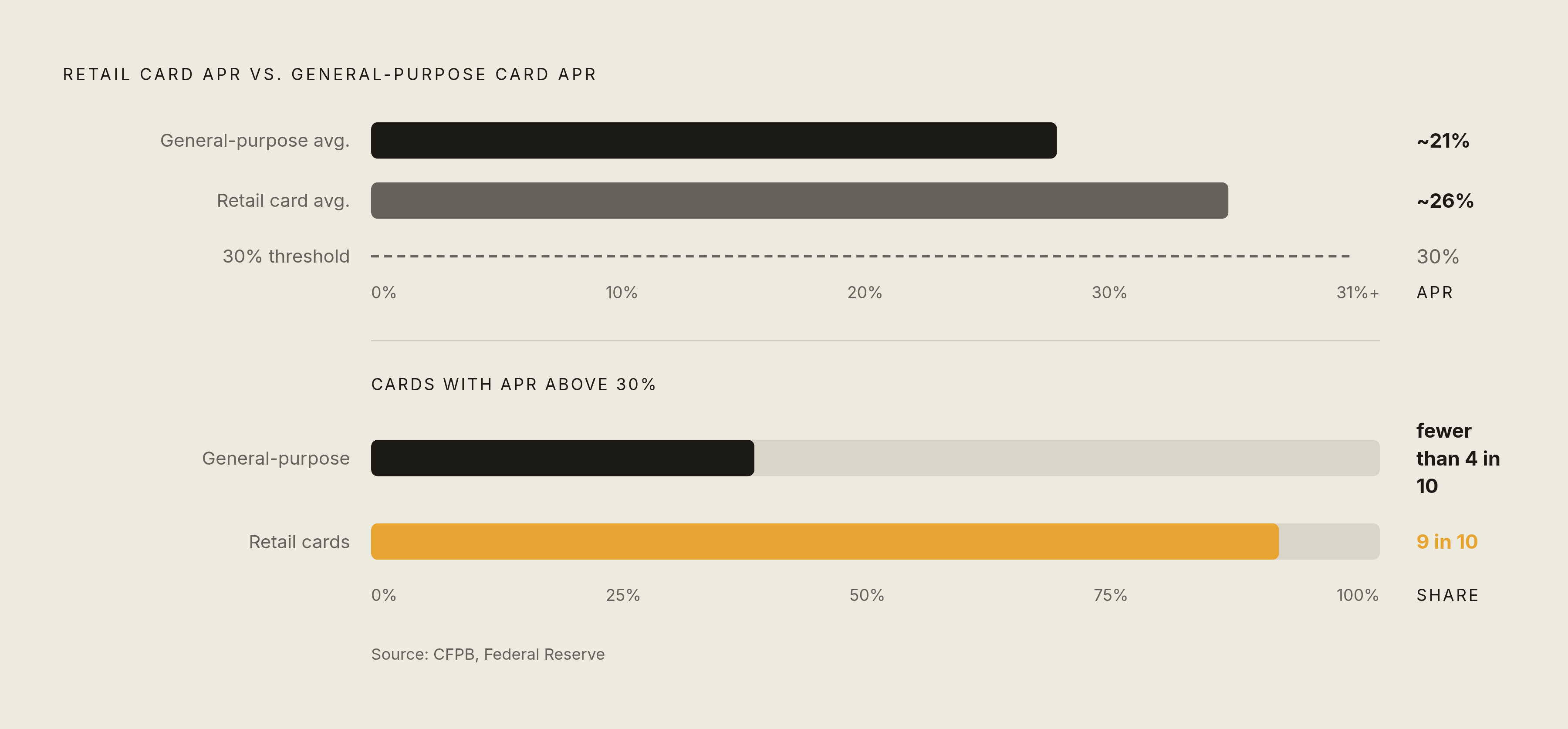
The cost built into these products is not incidental. CFPB and Federal Reserve data put the average retail card APR at roughly one and a quarter times the average general-purpose card APR, and it's nearly one and a half times the average APR across all credit card accounts. That gap reflects a deliberate pricing architecture built around the population these cards are sold to.
The CFPB's Issue Spotlight on retail credit cards found that nine in ten retail cards reported a maximum APR above 30%, compared to fewer than four in ten non-retail general-purpose cards. A rate most consumers would call high is the baseline, not the exception, on the product aimed at people with the thinnest margin for error.
Late fees eat up a larger share of total charges on private label cards than on general-purpose products, and a higher share of store cardholders make only the minimum payment each month, an early signal of financial strain. The fixed-rate structure makes all of this worse over time. A general-purpose card rewards demonstrated creditworthiness with a lower rate down the road. A private label card offers no such reward. Pay on time for three years and the rate sits exactly where it started.
Issuers argue that the higher rates reflect real delinquency risk in a thin-file population, and that without that pricing, the product wouldn't exist to serve anyone in this segment. There's a real answer to that argument: the fixed-rate model prices every borrower, including the ones who pay in full every month, as if they carried the risk profile of the riskiest account on the book. The structure protects the issuer's balance sheet. It does nothing to distinguish between the outcomes different borrowers actually produce.
Deferred interest: the promotion that punishes incomplete payoffs
Deferred interest promotions sit inside the standard design of many retail cards, not at the margins of it. The offer looks simple: a zero-interest window on a purchase. The offer looks simple, but the mechanism behind it works against the consumer: if any balance remains unpaid when that window closes, the issuer charges interest retroactively on the full original purchase amount, accrued from day one, not just on the balance still outstanding.
The CFPB illustrated the stakes with a consumer who had already paid off the large majority of an original balance but still ended up owing a substantial deferred interest charge at a typical retail card APR, because the small remaining balance triggered interest on the entire original purchase. Paying off 90% of a balance provides no partial credit under this structure.
Consumers have told regulators that sales representatives encouraged them to open these cards without walking them through the terms in full. The promotional language emphasizes "no interest," and leaves what happens on an incomplete payoff in the fine print. Thin-file consumers face the sharpest exposure here, since they're newer to credit mechanics generally and less likely to recognize that deferred interest behaves nothing like a true zero-interest offer. Beyond the high rates, paper statement fees and Change of Terms notices tied to fee structures have drawn a growing number of CFPB complaints, adding administrative friction to the product's structural risk. Deferred interest is the single mechanism most capable of converting a genuine credit-building intent into an unplanned debt load.
What store cards deliver for credit-building
Store cards do the one job they're asked to do. They report payment history to all three major bureaus, and that reporting is the raw input that generates a score where none existed before. If a thin-file consumer opens a store card, they can typically reach a scoreable file within a few months.
Payment history and credit utilization together make up the large majority of a FICO score, and a store card used lightly and paid in full every month feeds both inputs at once, even when the card carries a low limit and works at a single retailer. That's a real mechanism, and it works.
A store card carries real limits on that usefulness. A store card carries no built-in path to a lower rate as behavior improves. A private label card restricts spending to one retailer. A low credit limit can work against the consumer if utilization creeps up, which happens easily when the limit itself is small. None of this erases the credit-building function. It does mean that function and product quality are two separate questions, and a store card can answer the first honestly while remaining a bad long-term financial product. The store card's usefulness runs on a clock: it's most valuable as a short bridge, a single reporting account that starts the measurement process, not as a product meant to carry balances for years.
The discipline that separates credit-building from debt-accumulation on a store card
One rule carries the entire safety case for using a store card to build credit: pay the full statement balance before the due date, every month, without exception. Any balance that lingers turns the card's credit-building value into an interest cost that outweighs it, given the rate structure described above.
Utilization matters nearly as much as full payoff. Keeping reported utilization well below the credit limit, ideally in the single digits, controls the second major input to the score. The bureaus see the statement balance, so paying down the card before the statement cuts gives a quiet lever to manage that number without needing to run a zero balance all month.
Automatic payments set for at least the statement balance remove human error from the picture. A single 30-day late mark can undo months of accumulated progress, and since the late fee burden on private label cards runs disproportionately high compared to general-purpose cards, a missed payment costs you more on this product than on most others.
Deferred interest promotions deserve to be treated as off-limits. The only safe way to use one is with certainty that the balance will hit zero before the promotional window closes. Without that certainty, the promotion functions as a liability dressed up as a benefit. And the bridge shortens on its own terms: once a scoreable file exists and a run of on-time payments has accumulated, the next move is evaluating a graduated or general-purpose product, not extending reliance on the high-rate store card.
Alternatives that build credit without the same rate exposure
A store card is one entry point among several, and some of the others are structurally cleaner because they reduce or remove the high-APR risk while keeping the bureau reporting that makes any of this worthwhile.
Secured cards require a cash deposit that becomes the credit limit, which protects the issuer without resorting to a fixed high-rate structure. Gerald's 2026 guide to affordable thin-credit cards names secured cards from Discover and Capital One as options that report to all three bureaus. Discover's option carries no annual fee; Capital One's carries a low one. Both offer a path to upgrading to an unsecured card after a run of consistent use.
Some fintech products skip the credit file entirely at approval and look at cash flow instead. Petal 2 looks at income and banking history when it decides whether to approve an applicant. Tomo charges no interest and auto-pays the balance weekly. Both remove the risk of debt accumulation by design, rather than depending entirely on the cardholder's own discipline to avoid it.
Alternative data tools add another route that doesn't require a new account. Experian Boost lets consumers add utility, phone, insurance, rent, internet and cable, and certain streaming payments to their credit file, thickening a thin profile using bills they're already paying. This supplements a reporting tradeline; it does not replace the need for one.
The structural difference that matters most: secured cards and fintech credit-builders tend to offer a path-to-graduation model, rewarding consistent behavior with higher limits and lower rates over time. Most private label store cards don't offer that.
Deciding whether a store card is the right entry point
A store card earns consideration under a specific set of conditions: no other revolving account is available or approvable, the applicant can commit without exception to paying the full balance every month, and the retailer is one where regular spending already happens, so the card isn't creating new spending just to justify its own existence.
A store card is the wrong tool if there's any realistic chance you'll carry a balance, if a deferred interest promotion is involved and you aren't sure of the payoff timeline, or if you're already managing financial pressure that makes the high-rate exposure genuinely dangerous.
Timeline shapes the entire calculation. A thin-file consumer who opens any reporting account and sustains on-time payments with low utilization can typically reach a scoreable file within months, and can approach a score above 700 within one to two years. That means the store card's role as a bridge is genuinely short when managed well, and the high APR matters far less if no balance ever accrues on it.
Watching spending closely stays necessary through the whole credit-building period. The same consumer disciplined enough to pay every balance in full is also the one who notices a duplicate charge, a free trial that quietly converted to a paid plan, or a forgotten subscription, and those small leaks carry more weight when every dollar is doing work inside a credit-building plan.
A store card is a legitimate tool for one specific job: breaking into a credit system that otherwise locks a thin-file consumer out. It stays useful only for as long as that job takes, and it's only as safe as the discipline brought to it. Understanding the cost built into the structure in advance is what separates the consumer who uses the bridge to cross it from the one who gets stranded in the middle of it.
Sources
- Affordable Thin-Credit Cards: Best 2026 Picks
- How to Strengthen a Thin Credit File
- Issue Spotlight: The High Cost of Retail Credit Cards
- CONSUMER FINANCIAL PROTECTION BUREAU
- Consumer Financial Protection Bureau Encourages Retail Credit Card Companies to Consider More Transparent Promotions
- How to understand special promotional financing offers on credit cards
- Deceptive Bargain: The Hidden Time Bomb of Deferred Interest Credit Cards - NCLC