Expense Timing Mismatches and the Overdraft Trap
Banks' transaction sequencing turns small timing gaps into compounding overdraft fees.
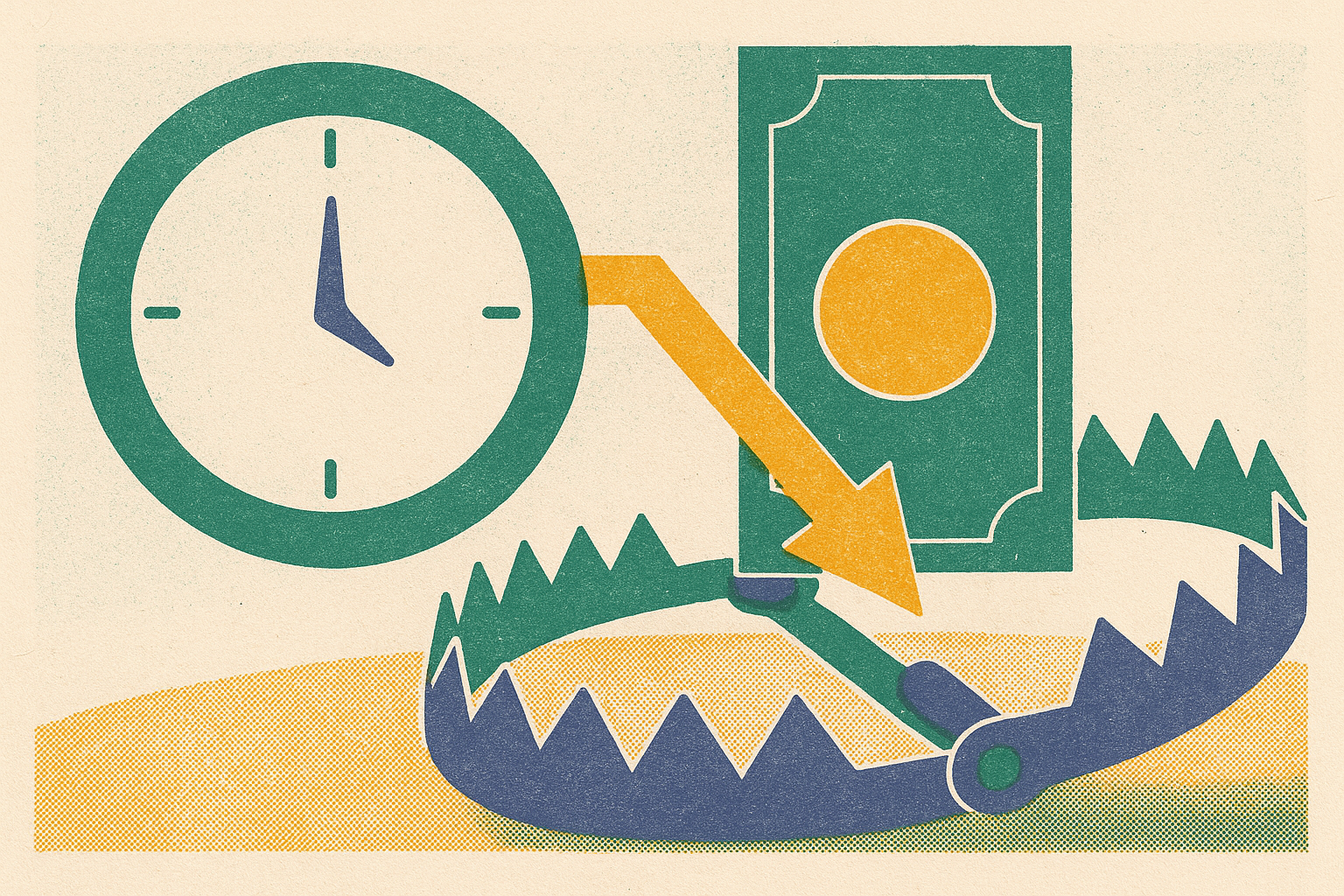
Most overdrafts don't start with a bad decision. Nebraska Banking and Finance says a simple miscalculation, one unexpected expense, or a few automatic charges hitting at the wrong moment is usually enough to push a balance negative. The spending itself is often unremarkable. What sinks people is sequence, plain and simple.
Transactions don't process in the order they happen in real life. A balance can sit positive at the exact moment of a purchase, and an automatic bill scheduled for that same day still clears first and wipes it out. The consumer did nothing wrong at the register. The bank's processing clock just didn't cooperate.
Picture a paycheck landing Friday morning. Wednesday and Thursday night, a couple of subscription renewals and a utility auto-pay hit the account first. By the time Friday's deposit posts, the balance already went negative overnight, and the fee already got charged. The money was coming. It just wasn't there yet, and that gap is the whole story.
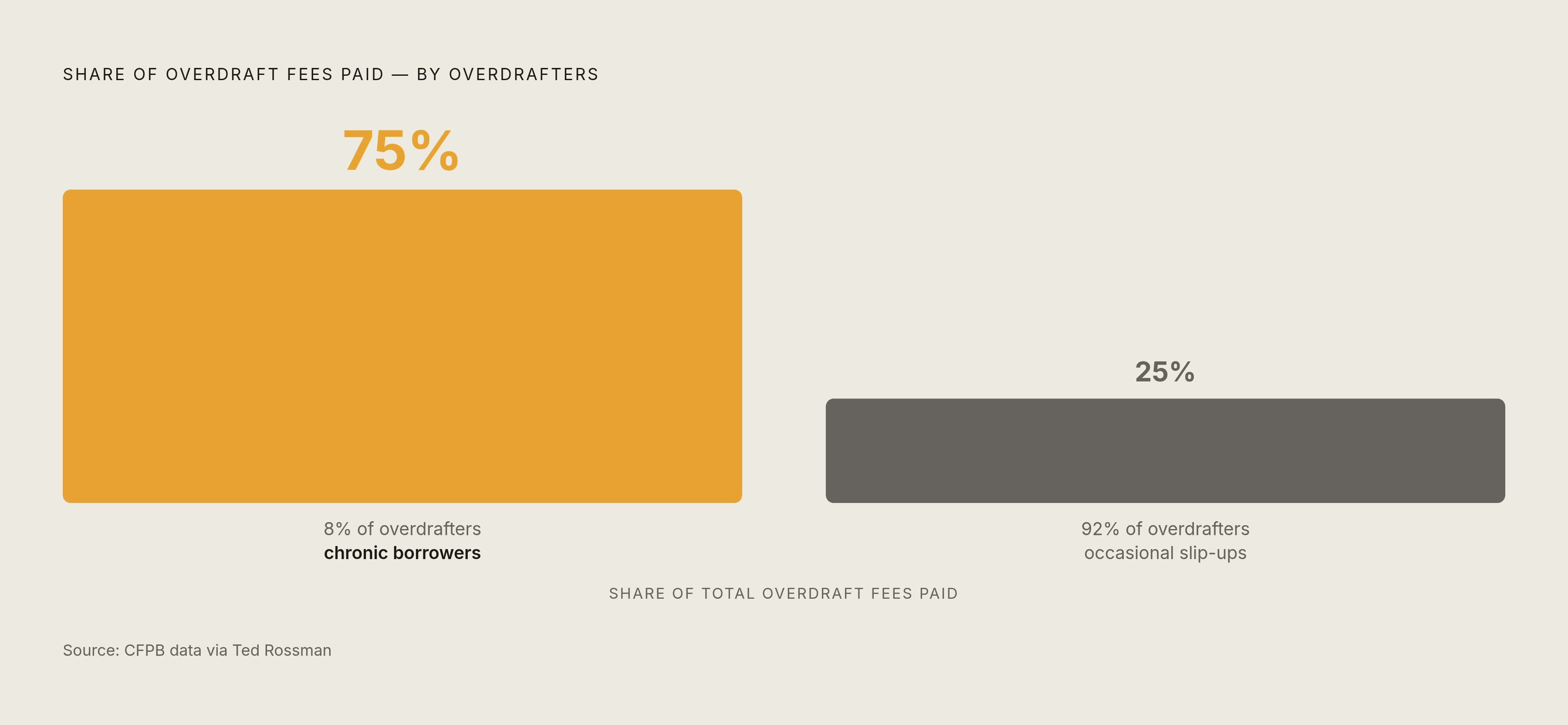
Ted Rossman, an analyst at Money Management International, points out via CBS News, citing CFPB data, that 8% of overdrafters account for 75% of all overdraft fees. That number draws a clean line between two very different groups, and treating them as one problem is the mistake. One group slips once or twice a year by accident. The other is bridging a gap to the next payday on a near-permanent basis, and for that group, fees don't happen once. They compound.
Why automatic charges are the most dangerous timing variable
Subscriptions cause more overdraft damage than one-time purchases ever could, and the reason is simple: each one fires on its own calendar, on a date the consumer usually isn't thinking about. A grocery bill announces itself. A renewal doesn't.
Most consumers underestimate their own subscription spending, and a meaningful share are off by more than $400 a month. That gap, between what someone thinks is leaving their account and what actually does, is exactly where overdrafts breed. It's a visibility problem, not a knowledge problem. It's a visibility problem.
Renewals are dangerous because they're invisible until the moment they hit. No invoice arrives beforehand, no text reminder pings, and the charge often processes at odd hours or mid-week, when nobody's looking at their banking app. A fair number of consumers say they've accidentally subscribed to something at some point, and once that charge sits in a transaction history, it looks identical to a subscription they meant to keep. The bank can't tell the difference. Neither can most people, until they scroll back through months of statements looking for it.
Free trials converting to paid plans concentrate this risk further. The FTC has flagged automatic post-trial billing as a dark pattern, and the mechanism explains why: the conversion charge can arrive as a substantial surprise on a day nobody flagged.
Then there's the newer layer. AI subscriptions barely existed two years ago, and now they're stacking on top of streaming and cloud storage, adding automatic charges most people aren't mentally budgeting for yet. A survey from Bango found Americans now pay for an average of four premium AI tools, adding up to around $66 a month combined. That's a new fixed cost most household budgets haven't caught up to, and it's growing while attention hasn't.
How banks sequence transactions to maximize fee exposure
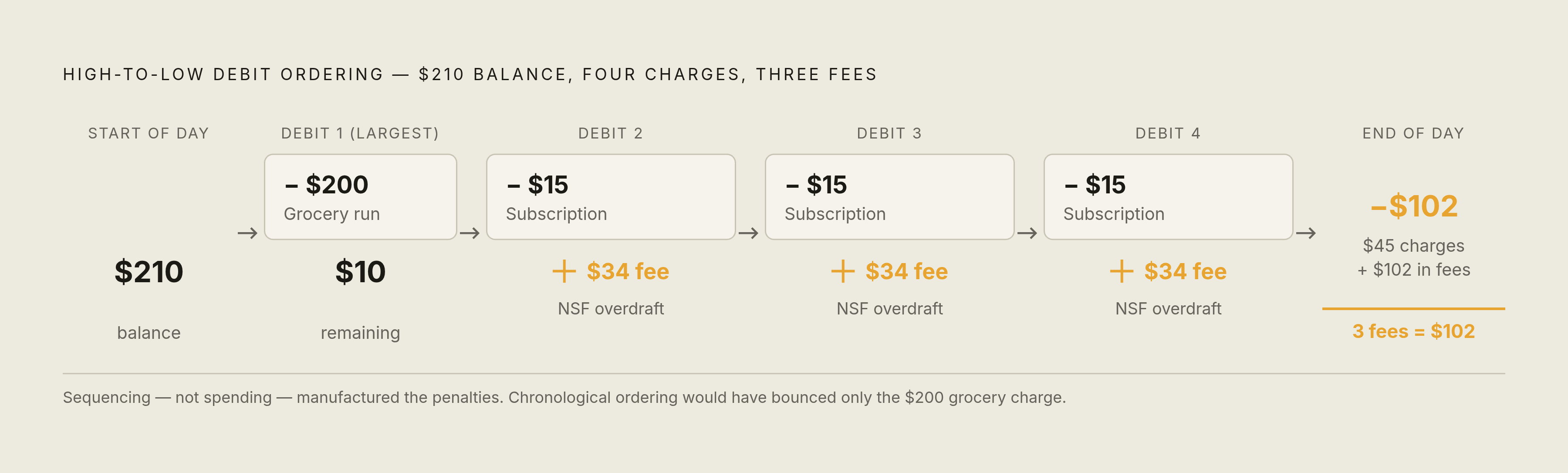
Say a $200 grocery run and three separate $15 subscription renewals all clear on the same day, and the account holds $210. On paper, that balance covers everything, barely. But according to Relay Fi, many banks post debits from highest dollar amount to lowest, not in the order they actually occurred. The $200 grocery charge processes first, drains the account, and each of the three $15 renewals that follow bounces. That's three overdraft fees out of a single day's transactions that should have technically fit, and the sequencing decision, not the spending, is what turned it into three separate penalties instead of zero.
It gets worse the longer it goes unresolved. Relay Fi notes that accounts sitting negative for multiple days often face daily extended-overdraft penalties stacked on top of the original fee. One timing collision turns into a sustained drain that keeps charging by the day, quietly, in the background, while the account holder assumes the damage is already done and fixed.
The dollar amounts vary a lot by bank, so it pays to know where the money actually sits. Relay Fi reports Bank of America charges $10 per overdraft, Chase charges $34, and Wells Fargo charges $35. Chase's Overdraft Assist program waives the fee if the account is overdrawn by $50 or less at end of business day, or brought back within $50 by 11 PM ET the following business day. If Chase is the bank in question, that's a real exception. It's also the exception and not the rule: most banks offer nothing close to it.
How Bills Grow Over Time
Bills don't usually jump overnight. They inch. Promotional pricing expires without a notice anyone actually reads, streaming tiers get renamed and repriced, and add-ons get switched on by default, none of it requiring a signature or even a second glance.
Netflix Premium runs $26.99 a month as of March 2026, a 238% increase over its 2011 launch price. Anyone who set a mental budget for that line item years ago is underestimating it now, possibly by a lot. Xfinity's Broadcast TV Fee is a carrier-imposed surcharge plenty of customers assume is a government tax simply because of how it's labeled on the bill. Add-on fees from wireless carriers, tacked onto multi-line family plans, can add meaningfully to the advertised price without appearing in the marketing copy.
Some regulatory movement addresses part of this. An FTC rule effective May 12, 2025 requires businesses in live-event ticketing and short-term lodging to display a "Total Price" including all mandatory fees whenever they advertise a price. That helps at the point of sale. It does nothing for a fee that quietly rises later, on an account someone already holds and stopped checking closely.
Research has found that the average American household unknowingly spends a significant sum each year on hidden junk fees. The damage isn't just the dollar figure. Every time a bill creeps upward without notice, it chips away at the accuracy of whatever mental model a person uses to predict their own cash flow, and the less accurate that model gets, the more likely a timing gap catches them off guard when they least expect it.
Why monitoring your own account doesn't reliably prevent overdrafts
Most consumers carry more than five active subscriptions, underestimate what they spend on all of them combined, and are frequently off by hundreds of dollars a month. That's a systemic gap between perception and reality, and it affects careful people just as often as careless ones. Diligence isn't the variable that predicts who gets hit.
Low-balance alerts, the fix most often recommended, carry a built-in flaw: they're reactive by design. The alert fires after the balance already dropped, not before the charge that caused the drop even lands. By the time the notification shows up on a phone, the fee has often already been assessed.
Behavior compounds the issue further. Bango's research found 53% of AI subscribers cancel and restart tools as needed, creating a start-stop billing calendar that shifts month to month. Tracking that by hand, alongside everything else auto-renewing on its own schedule, asks a lot of anyone, no matter how organized they think they are.
Linking a savings account as backup softens the blow but doesn't solve the actual problem. It cuts the dollar cost of any single incident, though the fee still gets absorbed instead of the gap getting prevented. Opting out of overdraft coverage entirely avoids the fee outright, and Rossman has noted that for many people, that trade-off works better. But a declined transaction is a bad outcome when the payment in question is rent or an insurance premium, so the "just opt out" advice only holds for some balance sheets, not all of them.
Alerts, linked accounts, manual tracking: all three share the same requirement. They need someone paying attention at the exact right moment, and the charges never wait for that moment. They land whenever they land, on their own schedule, not the account holder's, which is the entire reason manual defense keeps failing for people who are otherwise careful.
What Proactive, Automated Monitoring Catches
The mismatch calls for a tool built on the same schedule as the charges themselves, watching continuously instead of checking in once a week between other things.
Done right, automated monitoring flags a few specific things before they turn into a fee:
- Free trials approaching their conversion date, catching the exact moment a zero-cost signup is about to become a real charge someone forgot was ever scheduled.
- Subscription renewals clustered on the same day as a large recurring bill, the cascade scenario described earlier, identified days in advance instead of discovered after the fact.
- Charges that have quietly crept above their expected amount, flagged as a specific dollar delta instead of buried in a statement weeks later.
- Promised refunds that never actually posted, a gap in a balance someone may have already counted as available money.
Catching any of this requires read-only access across accounts, because timing collisions only become visible when a tool can see everything hitting an account at once. That's context, not exposure, and the distinction matters to anyone weighing whether to grant the access.
The value comes from what is attached to the visibility: a specific dollar figure tied to a specific finding, and a clear next step, so the reader isn't left with a dashboard full of numbers to interpret alone. Mastercard and Datos Insights research found that 77% of consumers already want to view and manage all their subscriptions inside their banking app. The appetite for consolidated visibility already exists. What's missing is a layer that goes past simply showing the data and actually catches the collision before it turns into a $34 charge.