Income Volatility Among Hourly and Gig Workers
Unpredictable paychecks make subscription creep and money leaks far costlier for gig workers.
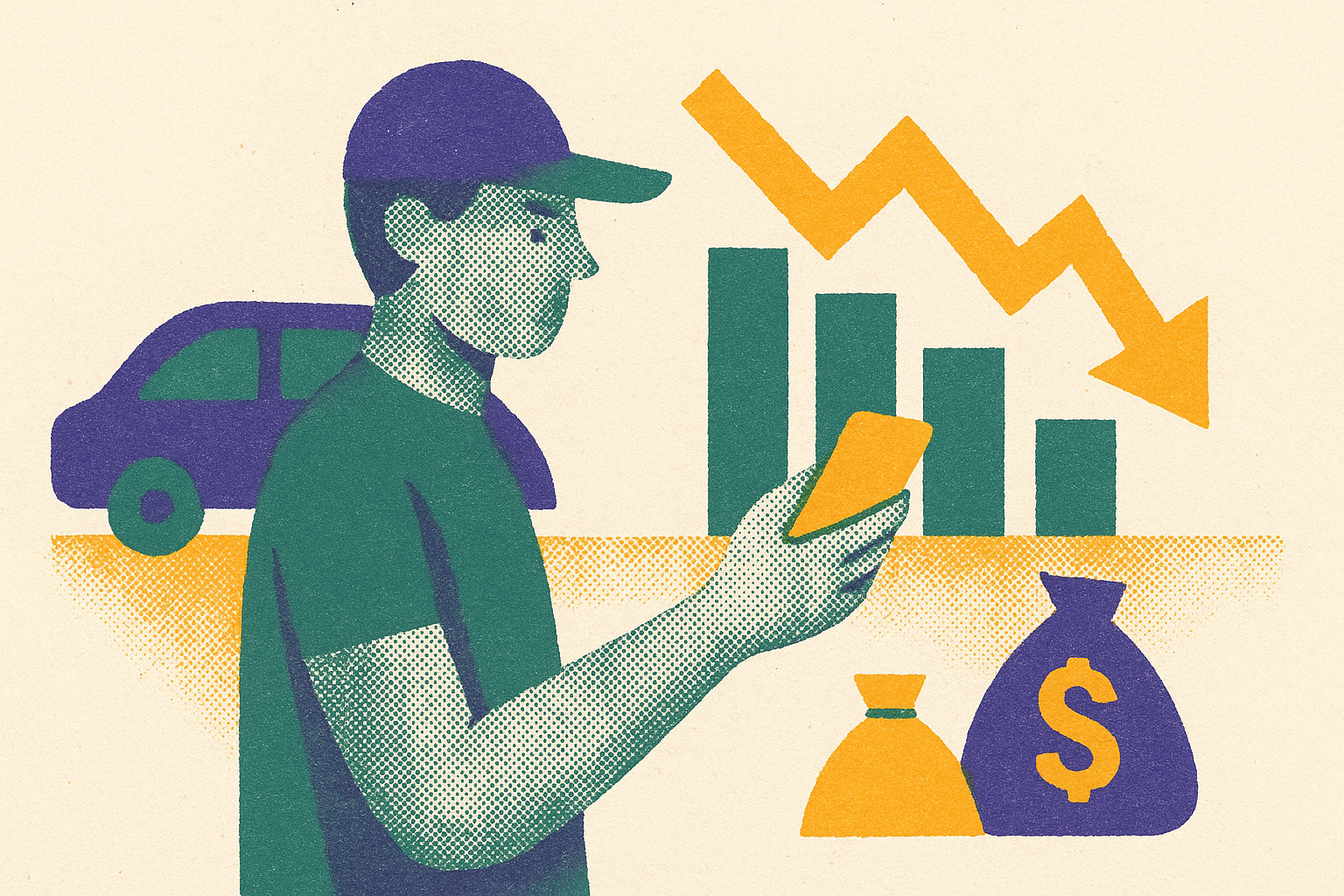
Research from The Interview Guys and Carry found roughly 36% of the workforce, more than 70 million people, does gig or freelance work in some form. Nobody talks about what unpredictable income does to money after it lands. Variable pay doesn't just make budgeting harder. It makes the ordinary leaks that hit everyone, the unused subscriptions, the missed refunds, the price drops nobody caught, cost this group more, at the exact moment they have the least attention free to catch them. The mistake most people make here is treating this as a discipline problem. The mistake most people make here is treating this as a discipline problem, but it's a structural one. It's a structural one, built into how pay arrives and how little room that leaves to watch for what's slipping out.
The gig population isn't one thing. Delivery couriers, rideshare drivers, tech freelancers, caregivers, creative workers: pay and hours swing wildly across those categories, and averaging them together hides more than it reveals. Jobbers.io puts average hourly pay across the gig economy around $16.67, ranging from $10.10 to $27.16 depending on the work. Gridwise's Annual Gig Mobility Report puts delivery pay specifically at $14.66 an hour in Q4 2025, up 3.2% year-over-year and ahead of the roughly $10 rate from 2019, but still short of the near-$16 pandemic peak. Pay varies by hour, day, season, platform algorithm, and how generous strangers feel about tipping on a given night. No employer quietly covers health insurance or retirement contributions here. Whatever comes in has to cover everything a salaried employee's company absorbs without anyone noticing.
What income volatility looks like week to week
Gig workers were asked what they'd change about the work, and the answer was consistent. 49% told a central bank's survey they wish pay was steadier, a consistent complaint across respondents. That's not a fringe complaint.
Hours are part of it. Fortunly found gig workers average 25 a week versus 40 for full-time employees. Fewer hours means less income, sure, but it also means less predictable income from one pay period to the next. There's no baseline to lean on.
Delivery work shows the squeeze in real time. Gridwise data shows delivery workers were logging meaningfully more hours in late 2025 than in prior periods. Workers are logging more hours because per-order and hourly rates stalled out, not because demand grew. Working more just to hold earnings flat is its own warning sign. It means margins are getting squeezed from somewhere upstream, and drivers are the ones absorbing it.
Tips make the picture messier still. They're the single largest piece of per-delivery pay, and tip rates have been trending down. One variable can swing a week's income hard with zero warning attached. A gig worker's January might look nothing like February, and neither one might resemble December. That instability is the whole starting point. Budgeting tools built for a steady paycheck don't translate to a life where the paycheck itself won't hold still.
How variable income complicates the standard budgeting toolkit
Most budgeting advice assumes a known number each month, something to divide into categories. Percentage-based budgets, envelope systems, the 50/30/20 rule: all of it depends on a stable input. Once that input is pulled out, the whole structure buckles at the first lean month it meets.
The real damage runs cognitive more than mathematical. A worker checking whether this week's earnings will cover rent isn't, at the same moment, checking whether a subscription auto-renewed or a refund never landed. Attention is finite. The stress of not knowing what's coming in eats up the exact attention that catching these leaks requires.
There's also no payroll department running quietly in the background. A salaried employee gets a pay stub with every deduction laid out. A gig worker doesn't get that. Every recurring charge just hits the bank account directly, with nobody flagging it. And the periods when this matters most, a slow January for a rideshare driver, a dead summer for a home-services contractor, are exactly when a $30-a-month unused subscription turns into real money. Those same periods carry the least bandwidth to go looking for it. The leaks that cost everyone something get worse for this group specifically, right as the odds of catching them get worse too.
How subscription creep hits harder when income is unpredictable
Subscription spending looks bad even for people with steady paychecks. U.S. consumers spend $273 a month on subscriptions across every category, up from $237 when West Monroe first measured it. 89% of people underestimate that total, and not by a little: 66% are off by more than $200, and 13% are off by more than $400.
Mastercard and FT Strategies data shows consumers spent more on subscriptions in 2025 than the year before, averaging $1,887 annually, up from $1,416 in 2024. AI tools are stacking a new layer on top of that. A Bango survey cited by readless.app found Americans now pay for an average of four premium AI subscriptions at around $66 a month, with 24% spending over $100 a month. 53% cope by canceling and restarting as needed, which sounds efficient but really just means remembering to do it every single time, forever.
If someone with a fixed paycheck can't name their own subscription total, someone juggling variable cash flow has even less chance of it. Subscriptions don't pause for a bad week. They charge on schedule no matter what the platform delivered that month. Most people can cut 30 to 50% of subscription spend without missing a single service they cancel, but only if they sit down and check, and that checking keeps not happening.
Canceling, meanwhile, keeps getting harder by design, not by accident. The FTC's click-to-cancel rule, which would have made canceling as easy as signing up, got vacated by the Eighth Circuit Court of Appeals in July 2025, shortly before it was set to take effect. So the friction stays legal. Only 37% of subscribers say they even have a pause option. The one middle-ground tool that would actually help during a lean month usually isn't on the table.
Price-drop windows and refunds that close before anyone notices
Price protection exists on paper for a lot of people and gets used by almost nobody. Retailers and card issuers will refund part of a purchase if the price drops within a set window afterward, typically somewhere between 7 and 60 days depending on the policy.
Target gives 14 days for members, with a shorter 7-day window for non-members. Amazon used to issue these refunds automatically. It no longer does for most cases: customers have to request them manually now, usually within 7 days, with better odds if Amazon itself sold and shipped the item. Credit card protection can stretch further, some issuers honor claims 90 to 120 days out, but only if the cardholder knows the benefit exists and actually files.
The failure point across every one of these programs is identical. Each requires someone to submit a claim before a deadline, and missed deadlines are the single most common reason claims get rejected. Most people give up before a retailer even says no, purely because of the effort involved. For a gig worker managing income that moves around, the math turns brutal fast. The refund is real money sitting there, but claiming it means checking every past purchase against today's prices, continuously, which competes directly with time spent earning the next dollar.
A few tools close that gap without requiring manual checking. CamelCamelCamel and Keepa track Amazon price history. Settlemate scans inbox receipts for post-purchase price drops and files the claims automatically. Whichever tool does it, the underlying fact stays the same: this is money already spent, recoverable within a window, and that window closes quietly whether anyone notices or not.
Late delivery credits and shipping guarantees that go unclaimed
A large share of orders arrive late, damaged, or at the wrong address, according to parcelpath.com. More than half of everything shipped, and the pool of people eligible for some kind of delivery compensation is enormous. Almost none of them ask for it.
Amazon's current compensation options vary by case and may include shipping fee refunds, promotional credits, partial refunds, or other remedies, all requiring the customer to ask. Each option requires the customer to already know enough to ask for it. The policy got stingier in 2025 too: Amazon used to offer a free Prime month for a single late delivery, and the default now is less generous and a lot less visible.
Carriers run their own versions. One major carrier reinstated its Money-Back Guarantee for domestic time-definite services on January 13, 2026, defining a service failure as delivery 60 seconds or more past the committed time, with claims due within 15 calendar days of the invoice date or ship date, depending on payment method. Another runs a narrower version, currently limited to Next Day Air and 2nd Day Air domestically. UPS Ground and standard 2nd Day Air guarantees have remained suspended, and UPS can pause the guarantee entirely, for any reason, peak season or network disruption included.
Manual auditing recovers only a fraction of eligible shipping refunds compared to automated tracking. That gap has nothing to do with eligibility and everything to do with whether someone's paying attention, which lands with a certain irony for delivery drivers. They know how often packages run late and why. As consumers, though, they're no more likely than anyone else to be tracking their own claim windows.
Why the financial inattention problem is structural, not personal
Lining up the categories above makes the pattern hard to miss. The default outcome favors the company every single time. The consumer has to opt in, actively, within a deadline, to get back what's owed to them. Auto-renewal on subscriptions. Price-drop windows with no alert system. Delivery credits that need a support request filed by hand. None of it happens automatically in the customer's favor, and none of it is an accident.
That 89% figure, people underestimating their own subscription spend by hundreds of dollars, is the predictable output of programs built to stay invisible until someone goes hunting for them. For a gig worker putting in 25 hours a week while managing income that swings month to month, there isn't spare time to hunt. The math doesn't fail because anyone's bad at arithmetic. It fails because hours and attention are both finite, and something more urgent is always demanding both.
Regulatory pressure exists in theory. The FTC's failed click-to-cancel rule shows that much, but it hasn't changed the friction consumers actually hit when they try to cancel something. Mastercard and Datos Insights data show the appetite for a better system is already there and already measured: 77% of consumers globally want to manage subscriptions from inside their banking app, and 39% say they'd switch banks for that feature. People know what they want. They want something to hold the whole picture for them instead of expecting them to rebuild it from memory every month. Gig workers aren't worse at managing money than anyone else. They just have less slack to absorb what falls through the cracks, and less time to go looking for the cracks.
Ongoing, automated monitoring versus periodic audits
A one-time subscription cleanup catches only what exists on the day it happens. Next month's new sign-up, the price drop on next month's purchase, the delivery promised next week: none of that falls inside the scope of an audit that's already finished. The whole flaw in treating this as a spring-cleaning task rather than a standing one is that the problem starts rebuilding itself the moment the audit ends.
Subscription sprawl needs constant watching, not a single cleanup, because the mechanisms behind it never stop running. Free trials keep converting. Annual renewals keep renewing. Prices keep creeping up a dollar or two at a time. CNBC Select points to subscription-tracking services built around exactly this model, detecting unwanted charges and sending alerts, sometimes with an option to cancel on the user's behalf, typically for a small monthly fee after a short free trial.
Price-tracking tools handle a narrower slice the same way: CamelCamelCamel and Keepa for Amazon price history, Settlemate for catching post-purchase price drops without anyone having to remember to check. None of it requires a person to hold a deadline in their head.
A broader approach connects to bank accounts, email, calendar, and Amazon, watching continuously across every category at once: unused subscriptions, price-drop windows, unclaimed refunds, and other recurring charges. Compass+ works this way, surfacing findings and flagging what needs attention, no ongoing effort required once it's set up. Read-only access matters here too. The watching stays separate from any risk of acting without permission.
For gig and hourly workers specifically, that separation is the whole point. Nobody managing variable income week to week can reasonably add "audit my finances" to an already full plate. The monitoring has to run in the background, without them, and surface only when there's something worth acting on. The finding comes to the person. That's the entire design principle, and it's the only one that holds up for anyone whose attention is already stretched thin before the money even arrives.
Sources
- The State of the Gig Economy in 2025: A Comprehensive Research Report: The Gig Economy Reaches Critical Mass - 70 Million Americans Now Freelancing - The Interview Guys
- 2026 Gig Mobility Report Shows Trends Shaping The Gig Economy | Food On Demand
- Gig Economy Statistics 2026: Workforce & Earnings
- jobbers.io
- 20+ Gig Economy Statistics and Facts for 2026 | Fortunly