Insurance Redlining and Premium Disparities by ZIP Code
Research shows insurers charge 16% more in majority-Black neighborhoods.

The article explains how this mechanism works, what the latest research confirms, and what consumers in affected ZIP codes can do to audit and push back on their own premiums.
What insurance redlining means in 2026
Insurance redlining used to mean something simple and blunt: an insurer drew a line on a map and refused to write policies inside it, or an insurer denied a mortgage to anyone in a certain neighborhood, no exceptions. The Fair Housing Act of 1968, then the Equal Credit Opportunity Act of 1974, then the Community Reinvestment Act of 1977, made that kind of explicit geographic denial illegal. That version of redlining is gone.
What replaced it is quieter and, in some ways, harder to fight. Instead, the discrimination lives inside the rating algorithm itself, in variables that look neutral on paper: ZIP code, credit score, the age of the home, whether the applicant rents or owns. None of those variables says "race." None of them has to.
ZIP code alone does the work that an explicit racial classification used to do. Because American neighborhoods remain heavily segregated by race and income, a ZIP code carries a demographic signature almost as reliable as a name on a census form. Feed that ZIP code into a pricing model alongside a few other seemingly neutral variables, and the model will sort applicants by race even in states where using race as a rating factor is flatly prohibited.
The Consumer Federation of America's report makes a point of separating intent from harm. The discrimination in its data may be inadvertent, a byproduct of how territorial pricing works rather than a decision anyone made on purpose. But the dollar cost to a homeowner in an affected ZIP code doesn't change based on whether anyone meant to charge them more.
The industry's response deserves a fair hearing here. Mark Friedlander, a spokesman for the Insurance Information Institute, has said that using race or any proxy for race to set insurance rates is illegal in every U.S. jurisdiction, and that state regulators review and approve the rating factors insurers use precisely to prevent that outcome. That's the legal backstop as designed. The question this article works through is whether the backstop actually catches what it's supposed to catch, given what the newest research found when it went looking.
What the July 2026 CFA study measured (and what it rules out)
The Consumer Federation of America published its report, titled Redlined: The Persistence of Racial Inequality in the Cost of Homeowners Insurance. It is, by scale alone, one of the more rigorous attempts to isolate ZIP code's effect on premium pricing. Researchers ran 216,151 test quotes across nearly 32,978 residential ZIP codes, drawing on proprietary pricing data from Quadrant Information Services.
The design is what makes the study hold up. The only thing that changed from quote to quote was the ZIP code, producing premium gaps of 16% higher for majority-Black areas and 30% higher for majority-Hispanic areas. That single design choice knocks out the most obvious counterargument before it can even be raised, since none of the premium difference can be blamed on who the homeowner is, what their credit looks like, or what kind of house they own.
Researchers then classified each ZIP code using Census Bureau American Community Survey data, sorting them into majority Black, majority Hispanic, or majority white based on which group held the largest household share. From there, they layered in controls for environmental risk, housing age, housing density, claims frequency, claims severity, and state-level regulatory differences. The premium gap did not disappear. It shrank in places, but it held.
This matters because it's the direct rebuttal to the standard insurer defense, the one that says disparities in pricing just reflect older homes, riskier construction, or worse claims history in certain neighborhoods. Those variables were held constant or statistically controlled for in this study. When you strip all of that out and a gap remains, the remaining gap has to be explained by something else, and geography (or what geography stands in for) is the leading candidate.
What the study cannot do, and doesn't claim to do, is prove that any specific insurer set out to discriminate. This is a market-level finding, built from aggregate quote data across thousands of ZIP codes and (presumably) many carriers, not an audit of one company's internal underwriting decisions. It shows a pattern. It does not name a culprit.
The premium gaps the study found, state by state
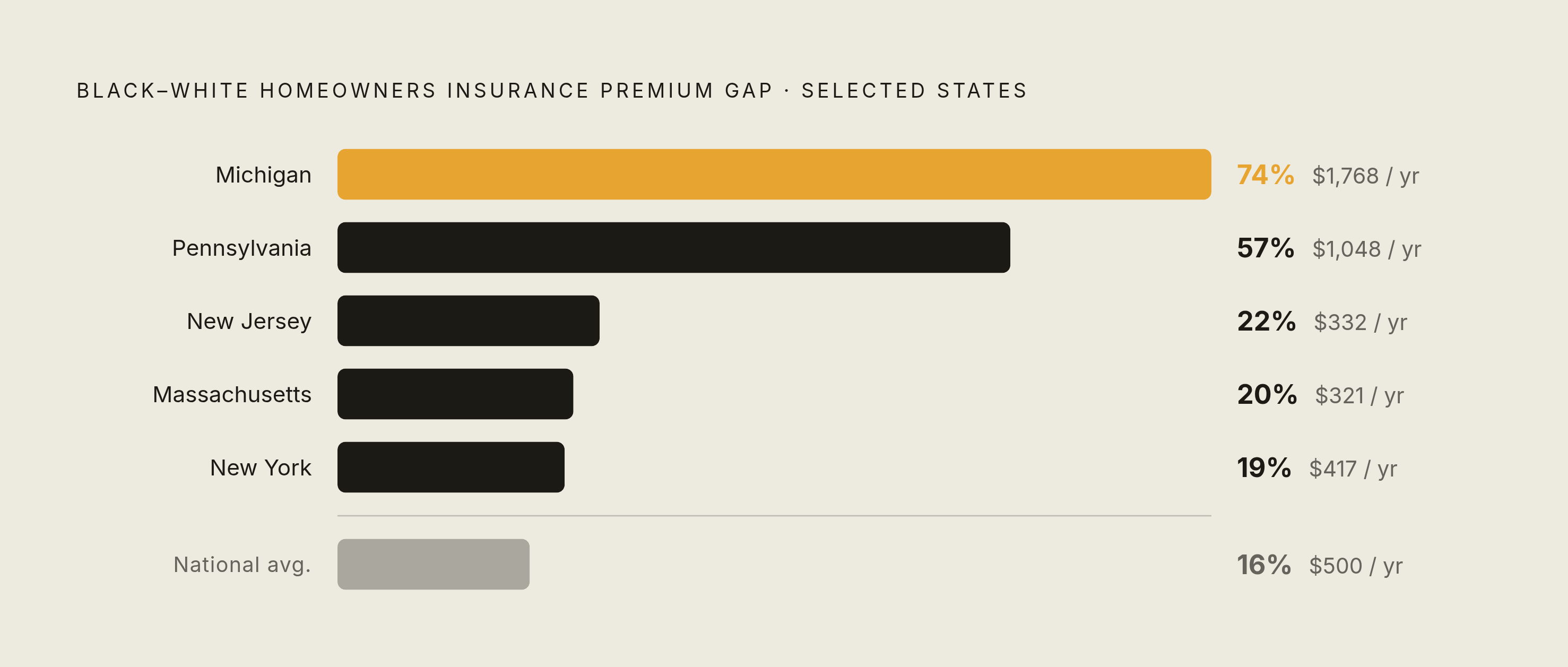
Nationally, the CFA report found that homeowners in majority Black ZIP codes pay 16% more, on average, than homeowners in majority white ZIP codes, which works out to roughly $500 more every year. In majority Hispanic ZIP codes, premiums run 30% higher, or about $950 more annually. Even after every risk factor available to the researchers was controlled for, homeowners in predominantly Black communities still paid a 10% premium on average, a residual gap that has nothing to do with the age of the home, the local flood risk, or claims history.
State-by-state, the Black-white gap swings wildly depending on where you live. Michigan tops the list at 74% higher premiums, or $1,768 more per year, the largest racial premium gap found anywhere in the country. Pennsylvania follows at 57% higher, or $1,048 annually. New Jersey is 22% higher ($332 a year), Massachusetts is 20% higher ($321 a year), and New York is 19% higher ($417 a year) Insurance Pro Agencies.
The Hispanic-white gap tells a similarly uneven story, with Florida as the outlier that's hard to overstate. Moira Birss of the Climate and Community Institute called that figure "an enormous amount of money," which undersells it if anything. New York shows a 20% gap ($431 annually), Washington 18% ($278), Massachusetts 16% ($244), and Kansas 15% ($633, a large dollar figure despite the smaller percentage, since baseline premiums in Kansas run high) Insurance Pro Agencies.
That consistency is itself evidence that something structural is happening, something that doesn't depend on any one state's particular wildfire risk or hurricane exposure.
None of this is happening against a flat baseline, either. Between 2021 and 2024, premiums rose in 95% of ZIP codes nationwide Insurance Pro Agencies. So the racial gap isn't just persistent, it's compounding on top of an already-rising cost of homeownership insurance for everyone. Whatever the disparity is doing to Black and Hispanic homeowners today, it's happening on top of a baseline that keeps climbing for the whole country. The gap is not a Sunbelt or rust-belt anomaly: it shows up in every region of the country, in states with very different insurance regulatory environments.
What these annual gaps compound to over a mortgage lifetime
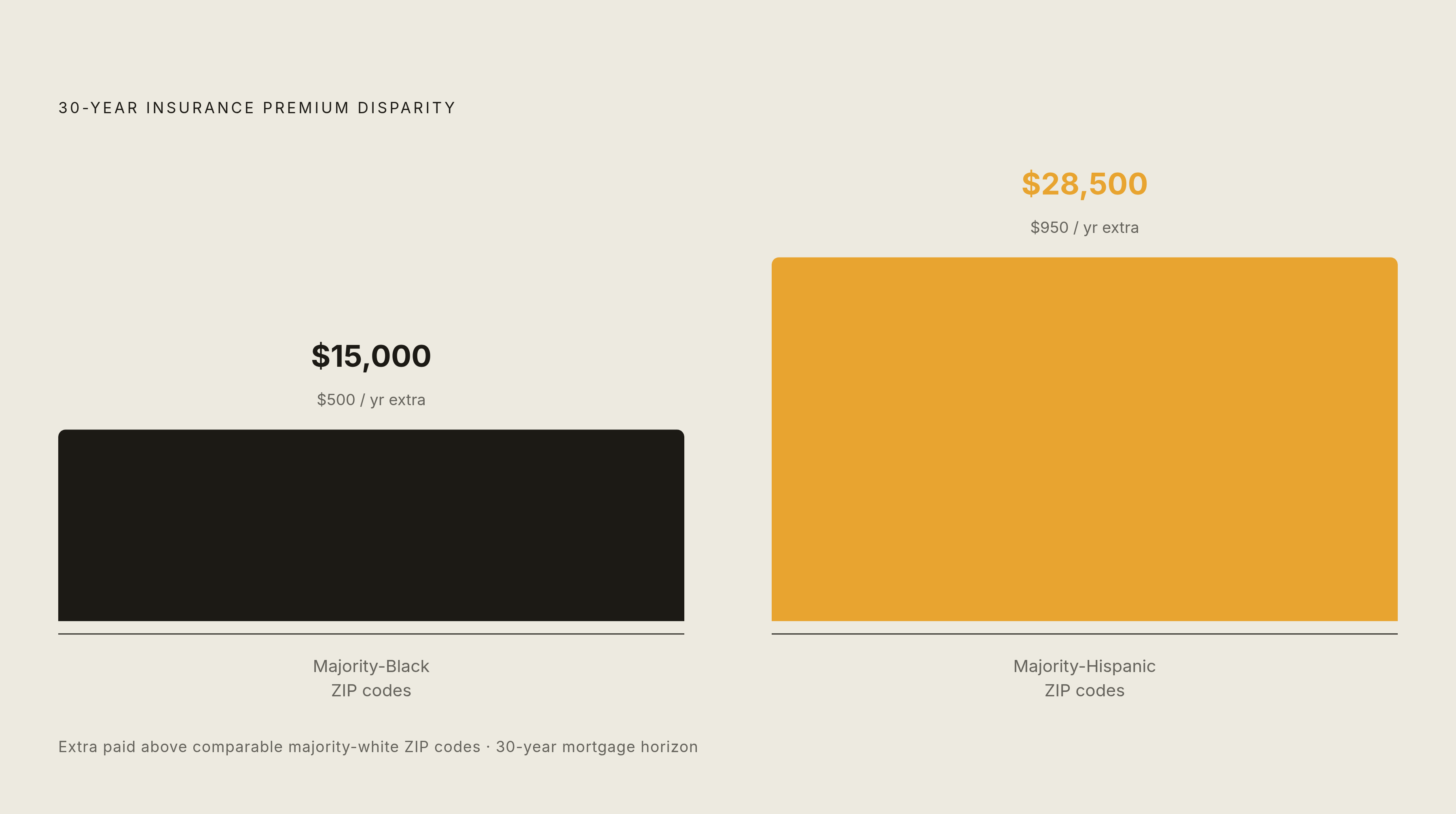
An extra $500 or $950 a year sounds almost survivable when you say it out loud https://www.motherjones.com/politics/2026/09/soaring-insurance-prices-racism-redlining-black-hispanic-homeowners-communities-pay-hight-premiums/. Stretch it across a 30-year mortgage and the number stops sounding survivable at all. The CFA's lifetime framing puts homeowners in majority Black ZIP codes at $15,000 more over the life of a standard 30-year mortgage, and homeowners in majority Hispanic ZIP codes at $28,500 more.
That number needs context to land. Homeownership remains the single biggest wealth-building tool available to most American households, the asset that gets passed down, borrowed against, and used to fund the next generation's education or first down payment. It compounds the racial wealth gap at the level of ownership itself, not just at the point of purchase where a lot of the existing research on housing discrimination tends to focus.
For some households, the premium eventually becomes unaffordable enough that they simply stop paying it and go without coverage. The uninsurance rates split along exactly the lines you'd expect from everything above. 22% of Native American homeowners carry no insurance at all. 14% of Hispanic homeowners are uninsured, 11% of Black homeowners are uninsured, compared to 6% of white homeowners.
Same car. It's a bet, and a bad one, because a fire or a flood doesn't just wipe out the safety net, it can wipe out the home entirely when repair costs come due with no coverage behind them. That turns a premium disparity into something closer to a foreclosure risk, not just a budgeting inconvenience.
There's a regulatory wrinkle layered on top of all this. Updated FHFA guidance now allows federally backed loans to carry less protective insurance coverage than before, and the CFA's read on that change is straightforward: it will likely leave low-income homeowners and homeowners of color disproportionately underinsured going forward. A policy meant to ease affordability pressure risks widening the exact gap this section is describing. Connecting to wealth-building, homeownership is the primary vehicle for generational wealth in most American households, and a $15,000–$28,500 drain on the mandatory cost of holding that asset compounds the racial wealth gap at the ownership level, not just the purchasing level.
How the same location-based mechanism operates in auto insurance
Auto insurance runs on the same territorial logic, and the CFA's research on it produces a finding that's almost easier to grasp than the homeowners data, because it isolates geography down to a single line on a map. A good driver, meaning someone with a clean record, can be charged as much as 62% more than an identical good driver who lives literally across the ZIP code boundary. The driving history is identical. Same car. Same insurer, in many cases. Different ZIP code, different price.
A history of redlining and residential segregation produces that line, and the demographic pattern behind it is stark. Good drivers tested in lower-income ZIP codes paid $410 more per year, on average, than their counterparts in higher-income ZIP codes. The lower-priced ZIP codes were 72% white on average. The costlier ZIP codes were only 29% white on average. That's not a subtle correlation, it's close to an inversion.
Every city the CFA tested had at least one insurer charging a minimum of $200 more for identical coverage to someone unlucky enough to live on the wrong side of a ZIP code line. Maryland offers a documented case study: research from the Maryland Consumer Rights Coalition and the CFA found that auto insurers there use ZIP code, not driving record, as the operative pricing input. Maryland bans using race or income directly to set rates, but it still permits non-driving rating factors that end up serving the exact same function.
The racial residual holds up even after controlling for individual driving behavior. Drivers in mostly Black neighborhoods pay about $154 more per year than drivers in mostly white neighborhoods, controlling for driving profile 4AutoInsuranceQuote.com. Going without insurance is a bet, and a bad one, because a fire or a flood doesn't just wipe out the safety net, it can wipe out the home entirely when repair costs come due with no coverage behind them. It's a load-bearing variable across the entire industry. The connecting thread is that the same territorial-pricing logic that produces homeowner disparities produces auto disparities, with ZIP code doing identical work in both markets.
How credit scores amplify the location-based penalty
If ZIP code is one lever, credit score is the other, and it might be the bigger one. A CFA report found that consumers with lower credit scores pay 99% more for homeowners insurance than those with higher scores.
Auto insurance runs a similar penalty. Drivers with poor credit pay 40% more nationally, and in some states that gap reaches 60%. Iowa is the extreme case: drivers with poor credit there pay 140% more than drivers with excellent credit, well above the national average Insurify via Money.com Live Insurance News. Averaged across the country, the poor-credit penalty in auto insurance is around 69%, and in some documented instances, having bad credit costs a driver more than a recent DUI conviction does Live Insurance News.
Sit with that for a second. A DUI is a documented, adjudicated instance of dangerous driving Live Insurance News. A low credit score is, in most cases, a reflection of income, medical debt, or access to credit, none of which has anything to do with how carefully someone drives. Yet the DUI can cost less Live Insurance News.
Black and Hispanic consumers on average carry lower credit scores than white consumers as a direct result of long-term racial wealth gaps and structural barriers, not individual financial behavior in isolation. When an insurer prices on credit score, it's pricing on the downstream residue of decades of discrimination in lending, employment, and housing. ZIP code is a load-bearing variable across the entire industry. It's a mechanical description of what the variable actually captures.
Credit score can swing a premium 20% to 50% in either direction, which makes it one of the single largest rating variables an insurer controls. Insurers and most state regulators defend the practice on actuarial grounds, arguing credit history predicts claims behavior. That argument is about correlation. It says nothing about causation, and it says nothing at all about the racial disparity the correlation produces once you trace it back to its source.
What these annual gaps compound to over a mortgage lifetime
The CFA has a name for what's happening now: "Redlining 2.0," discrimination running in "a much more technocratic and opaque manner than the map-based strategies of old". The red lines didn't disappear. They moved inside the model, where nobody can see them drawn.
Insurance carriers increasingly rely on AI-driven models to set home insurance rates and make coverage decisions generally, and state regulators only started rolling out tools to oversee that AI use as of March 2026. That's a wide gap in time between adoption and oversight. And the tools carriers are using haven't been systematically checked, at an industry-wide level, for unintentional racial bias. Some individual carriers may audit their own models. Plenty may not. There's no requirement forcing the question either way in most states.
This isn't a new pattern dressed up in new technology, either. In the 1990s, Nationwide paid a $17.5 million settlement over allegations that it discouraged agents from selling in Black neighborhoods and used racial profiling to deny coverage. American Family Mutual Insurance Company paid more than $16 million in a separate settlement after providing Black homeowners inferior policies and, in some cases, denying them coverage outright. The algorithm is new. The underlying behavior it's now capable of reproducing at scale is not.
Climate pressure is pushing this in a worse direction, not a better one. Global insured losses from natural catastrophes topped $100 billion for the sixth straight year in 2025, according to LexisNexis. As losses climb, insurers build more granular risk models to chase precision, and those finer-grained models can introduce new proxy variables at a resolution even smaller than ZIP code. The industry is trying to solve a real and growing risk problem. The tools it's reaching for carry the same proxy risk as the ones already documented, just at a sharper resolution.
Where regulatory enforcement falls short
That is a mechanical description of what the variable actually captures. California, Hawaii, Massachusetts, and Michigan prohibit its use in auto insurance. California, Massachusetts, and Maryland ban it in homeowners insurance. Everywhere else, in 45-plus states, credit remains a significant, legal rating factor in both lines.
Momentum is building elsewhere. Iowa, New York, Oklahoma, and Pennsylvania all have active 2026 bills that would bar insurers from using credit-based insurance scores to price auto or homeowners policies, or both. None of those have become law yet, but the legislative attention itself signals the issue has crossed from advocacy circles into statehouses.
Colorado has moved furthest on the algorithmic side specifically. Its rule governing external consumer data and information sources took effect October 15, 2025, with full compliance and proof required by July 1, 2026, and it forces auto insurers using outside data to actually prove their tools avoid unfair discrimination, rather than simply asserting it. That's described as the first state requirement of its kind: measurable evidence instead of insurer self-attestation. Colorado's older SB21-169 law extends similar authority across life, auto, homeowners, and health insurance, letting the state's Division of Insurance demand proof that pricing models don't produce disparate impacts. It's a genuinely strong tool on paper. Whether it changes anything depends entirely on how aggressively regulators choose to use it.
Florida introduced HB 527 on November 24, 2025, sponsored by State Representative Hillary Cassel, which would bar AI or machine learning systems from being the sole basis for denying a claim and require a qualified human to make every denial decision. Colorado's broader AI Act, SB 24-205, requires developers and deployers of high-risk AI systems to use reasonable care against algorithmic discrimination; its original February 1, 2026 start date got pushed to June 30, 2026 after negotiations broke down during an August 2025 special session.
At the national level, the NAIC's model law chart, updated in summer 2025, confirms that refusing to insure, refusing to renew, or charging different rates based solely on geographic area is an unfair practice in some states, unless the pricing is tied to sound actuarial principles or actual loss experience. Coverage and enforcement of that principle vary enormously by state. More than 24 states, over half the country, have adopted the NAIC's AI bulletin, though a federal executive order has created friction with state regulatory authority, and regulators are still piloting the examination tools they'd need to actually enforce it. A model law on third-party data and AI vendors is expected later in 2026, potentially with registration requirements for the vendors themselves.
The CFA's own policy ask is direct: stop insurers from using ZIP codes, or any geographic territory smaller than that, to set premiums, and require insurers to disclose transaction-level pricing data annually, the same way mortgage lenders already have to under the Home Mortgage Disclosure Act. That last comparison shows why the disclosure requirement matters here in the same way. Mortgage lending got this kind of transparency requirement decades ago specifically because redlining became visible in loan data once someone forced lenders to disclose it. Insurance pricing has no equivalent requirement yet, in most states. The gap between a model law existing on paper and a regulator choosing to enforce it aggressively is exactly where reform keeps stalling, and until that changes, the ZIP code on a policy will keep doing quiet work that the price on the page never admits to.
Regulatory enforcement gaps
A wide spread across quotes for the same coverage signals a problem that warrants further investigation.
Ask directly, in writing, whether your ZIP code or a smaller geographic territory factored into your premium, and ask the same question about your credit score. Insurers in most states are required to disclose rating factors on request, even where they aren't required to disclose the weight given to each one.
Check whether your state is one of the ones that bans credit history as a rating factor (California, Massachusetts, and Maryland for homeowners; California, Hawaii, Massachusetts, and Michigan for auto).
File a complaint with the state insurance commissioner's office if a quote seems disconnected from your actual claims history and credit profile. Complaints create a paper trail regulators use when deciding where to focus examination resources, and they're free to file.
Compare your premium against a neighbor's, if the relationship allows for that kind of conversation, particularly if that neighbor lives just across a ZIP code boundary. The CFA's auto insurance findings show a good driver in one ZIP code can be charged as much as 62% more than an identical good driver living literally across a ZIP code line. A gap that large, for otherwise comparable properties and profiles, should be raised directly with the carrier and, if unanswered, with the state regulator.
Sources
- Homeowners insurance ‘redlining’ demands scrutiny, report says
- As extreme weather worsens, Black and Hispanic homeowners are paying more for insurance • Michigan Advance
- Homeowners in Black, Hispanic Neighborhoods Pay Significantly More for Home Insurance: Consumer Report — RISMedia
- Redlining 2.0: The Hidden Cost of Owning a Home While Black - Word In Black
- Article - Maryland Consumer Rights Coalition and Consumer Federation of America Release Report Showing the New Redlining – How Zip Codes Unfairly Affect Auto Insurance Premiums in Maryland | Consumer Federation of America
- Soaring Insurance Prices Are Hitting Black and Hispanic Homeowners Hardest – Mother Jones
- Auto Insurers Often Charge Identical Neighbors Considerably Higher Premiums Because of ZIP Code Differences · Consumer Federation of America
- Article - Redlined | Consumer Federation of America