The Dollar Cost of Being Unbanked in America
Unbanked Americans pay thousands in fees that wealthier households never encounter.
Being unbanked costs money. Real money, tracked in fees paid to check cashers, payday lenders, and banks themselves, plus protections and refunds that go unclaimed because there's no account, no dashboard, no paper trail to catch them. The FDIC's survey found 4.2% of households, 5.6 million of them, fully unbanked, with another 14.2%, or 19 million households, underbanked. The cost isn't evenly spread: 21% of adults earning under $25,000 a year are unbanked, compared to just 1% of those earning $100,000 or more, and that gap is the whole story in two numbers.
That 4.2% figure is the lowest the FDIC has recorded since it started tracking this in 2011, when the rate sat at 8.2%. Progress happened, but it flattened, and the income split explains why: this is a widespread problem reaching well beyond a small, marginal slice of the population. It's a structural cost collected almost entirely from people who can least afford to carry it, through mechanisms most coverage skips past. Here's how that collection actually works.
The lifetime price tag that check-cashing fees quietly build
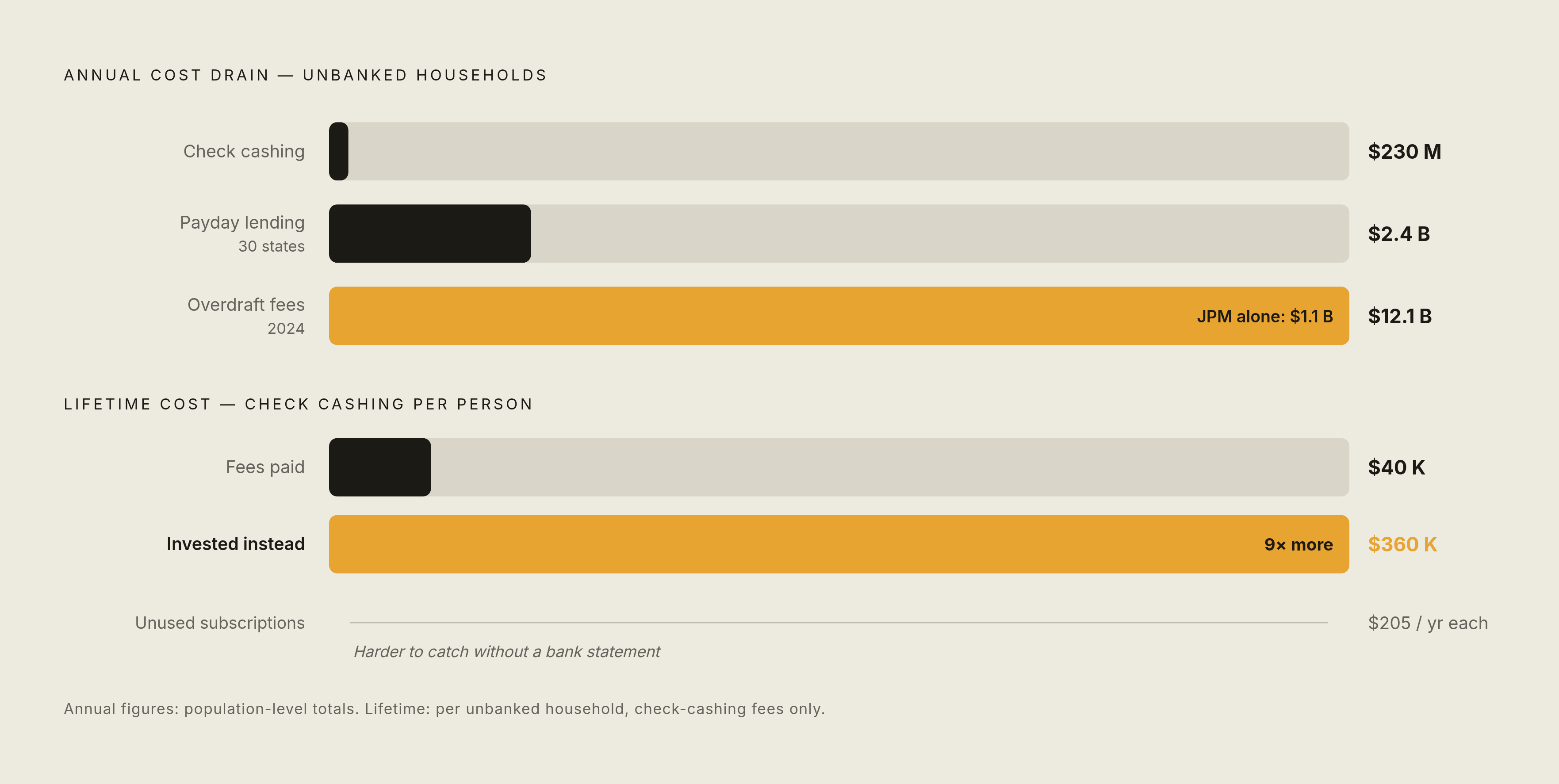
Start with the number that should stop anyone reading this. The Brookings Institution estimates an unbanked person could spend as much as $40,000 over a lifetime just cashing checks. Not on debt, not on interest. On the simple act of turning a paycheck into usable cash.
Check-cashing fees average 2.34% of the check's face value, and California permits up to 3%. On a bi-weekly paycheck, that's a toll paid every time money comes in, and someone earning $40,000 a year loses a real chunk of that income before a single bill gets paid.
This isn't a fringe industry propped up by a handful of storefronts on a bad block. The check-cashing business processed about $893 billion in transactions in 2022, a mature, well-capitalized sector built almost entirely on customers who have no other way to touch their own money without paying for the privilege. Adding money orders and similar services brings unbanked household spending to an estimated $230 million a year combined on these three services alone.
How payday lending turns a short-term gap into a long-running fee
Payday loans work off a simple structure: a finance charge, typically a substantial share of the amount borrowed, comes due in full within two weeks. Framed as an annual percentage rate, that works out to nearly 400%, which sounds absurd. Framed as "$15 to cover me until Friday," it sounds manageable. That gap between framing and reality is the business model, and it's built by design, not by accident.
The scale backs it up. In the 30 states that permit payday lending, these loans drained more than $2.4 billion in fees from low-income borrowers in a single year. Borrowers took out over 20 million loans totaling nearly $8.6 billion in 2022 alone, the Center for Responsible Lending found.
The mechanical failure is the cause: without a bank account, there's no savings buffer, overdraft line, or credit card to absorb a bad week, so the missing infrastructure itself forces a payday loan. Without a bank account, there's no savings buffer behind a shortfall, no overdraft line, no credit card to absorb a bad week, so a cash gap forces a payday loan. The fee owed on repayment day then eats into the next paycheck, leaving the borrower short again almost immediately. One loan becomes two, and two becomes a cycle. Wells Fargo, working with Operation HOPE, said: "People wind up paying those fees over and over and over again." Steps get taken, payments get made, and the position never actually improves.
How overdraft fees fall hardest on the households least able to absorb them
Overdraft fees aren't just an unbanked problem. They're a pipeline into becoming one. In 2024, consumers paid $12.1 billion in overdraft and NSF fees combined, up from $11.8 billion the year before, with the total on track to cross $12.4 billion in 2025. That number keeps climbing even as public pressure on the practice keeps growing, which says something about how central these fees are to bank revenue.
The average overdraft fee runs about $27, which sounds almost survivable until you look at who pays it. These fees concentrate overwhelmingly among households with lower incomes and lower credit scores, the same group that racks up several in a short window rather than just one, and the same group that cycles in and out of banking access altogether, sometimes closing an account specifically because overdraft charges made it too expensive to keep.
Banks aren't quietly phasing this revenue line out. JPMorgan Chase earned $1.1 billion from overdraft fees. Wells Fargo brought in $924 million. PNC Bank collected $279 million. Those numbers sit on the balance sheet as core line items, not accidents of policy.
Subscription creep as a secondary drain that compounds the unbanked cost story
Subscriptions add a quieter layer on top of everything above. A survey covering April 2024 to April 2025 found 80% of American adults paid for at least one subscription, spending an average of $1,080 a year. Of that, $205 went toward subscriptions the person wasn't even using anymore.
The real story here is a perception gap. The average American pays for roughly five active subscriptions but believes they only have three. Forty-two percent say they've forgotten about a recurring payment at least once, and most people meaningfully underestimate their monthly subscription spend.
For unbanked and underbanked households, this doesn't sit off to the side. It compounds. Prepaid cards and cash-based payment habits make recurring charges harder to catch, since there's no single statement pulling everything into view. Many rely on mobile payment apps instead (71% of unbanked users used one to receive income, pay bills, or store money), and those apps carry fewer built-in protections against auto-renewal than a bank-linked debit card does. Small per-service price increases, a dollar here, three dollars there, push totals up in a way that's invisible month to month but sizable by year's end.
The missed protections and unclaimed money that no one is watching for
Bank accounts come with a safety net people mostly notice only when they need it: dispute resolution, FDIC insurance, fraud recovery. Unbanked and underbanked households running on cash or fee-based services get none of it. No ledger, no transaction history, no institution obligated to investigate when something goes wrong. If the money's gone, it's gone.
Amazon's price-adjustment practices show the same blind spot on a smaller scale. Amazon has no official policy for refunding a price drop on something already purchased. Getting money back means canceling and reordering before the item ships, if that window is still open, or returning it and repurchasing within the return period. Tools like Keepa and camelcamelcamel track price drops before a purchase happens, but once the order's placed, watching for a drop becomes a separate chore that only works if somebody remembers to do it.
Delivery guarantees follow the same pattern. Retailers and carriers offer service credits for late deliveries as a standard, legitimate right, and almost nobody claims them, because claiming one requires noticing the delivery was late and then taking the extra step of asking. Nobody tracks it by default, so the money just sits there, unclaimed, forever.
What the full annual and lifetime cost looks like when added together
No single number captures the total cost of being unbanked in America, but the pieces add up to something concrete enough to argue with.
Brookings put lifetime check-cashing costs alone as high as $40,000. Invested instead of spent, that same money could grow to roughly $360,000, which reframes the whole conversation from fees paid to wealth never built. Across the unbanked population, check cashing, money orders, and related services combined account for an estimated $230 million a year. Payday lending adds another $2.4 billion drained annually from low-income borrowers in states where it's legal, with 20 million loans worth nearly $8.6 billion issued in 2022 alone.
Overdraft fees, subscription creep, and unclaimed credits stack on top of those figures. These costs aren't independent: each one drains the buffer that would have prevented the next one, which is what produces the escalation, and the stacking pattern is how you know it. Each one drains the buffer that would have prevented the next one, which makes the next mistake more likely, not less.
Why passive, automatic monitoring changes the math for households that can't afford manual vigilance
Every cost mapped here survives for the same reason: tracking it manually takes time, attention, and financial slack that the people paying it don't have. Catching a subscription price hike, disputing an overdraft, claiming a late-delivery credit, none of that is complicated on its own. Doing all of it, every month, on top of working, caregiving, and running a cash-based budget, amounts to a second job nobody's paying for.
That's the real argument for systems that watch by default instead of counting on someone to remember. A household with a checking account and a credit card gets a monthly statement that puts the whole picture in one place, even if nobody reads it closely. A household without one doesn't get that baseline, so the fees, the missed refunds, and the forgotten subscriptions never land on a single page. Nothing forces them into view, and that absence is the actual mechanism driving every number in this piece.
The gap between manual vigilance and automatic tracking isn't a convenience question. For households already stretched thin, money either gets reclaimed through a system built to catch it, or it disappears quietly, one small fee at a time, until it adds up to a number too large to ignore.