Why Mainstream Banks Screen Out Low-Income Applicants
Banks use multiple screening tools that stack to exclude the same low-income families repeatedly.
Millions of Americans get shut out of basic banking, and the exclusion isn't random. According to a survey by a national deposit insurance agency, 4.2% of households in one country's banking system are fully unbanked. households, about 5.6 million of them, are fully unbanked. Another 14.2%, or 19.0 million households, count as underbanked. That second number matters just as much as the first, maybe more.
Underbanked means a household has a checking or savings account and still turns to check cashers, payday lenders, or pawn shops to get by. The account exists, but it isn't doing the job. A 2025 Federal Reserve working paper pushes this further, splitting the unbanked into two groups: people who want an account but can't get one, and a growing "out of banking" population that stopped trying. The second group isn't locked out so much as it's walked away, and the paper ties that shift to mistrust as much as to access.
None of this falls evenly. Low-income households, Black and Hispanic households, and immigrant families show up repeatedly in these numbers. It's what happens when the eligibility rules for an account are drawn around the financial habits of people who already have stable income and cushion, which is not most people.
The first gate: ChexSystems and the cost of a bad banking history
Before a bank looks at income or credit, it checks ChexSystems. Think of it as the credit bureau of checking accounts, the same role Experian or TransUnion plays for loans, except this one tracks how people have handled deposit accounts, not debt. Almost every bank pulls a ChexSystems report before opening a new account, and a bad mark there can end the conversation before it starts.
What lands someone in ChexSystems is usually an ordinary money problem, not fraud or bad intent. It's an unpaid overdraft balance, a bounced check, or an account that got closed while still owing money, which then gets logged as a debt. These are ordinary money problems, the kind that happen to anyone dealing with an irregular paycheck or a surprise expense.
The record sticks around for up to five years. One rough stretch, a layoff, a medical bill, a bank error that took too long to sort out, can lock someone out of a checking account for half a decade. An estimated 6% of U.S. adults lack a bank account primarily because of a negative ChexSystems file, and that group leans heavily toward low-income, disabled, and minority Americans. The system just remembers that someone ended up with a negative balance, without asking how. It just remembers that they did.
The fee structure that functions as a second screening layer
Even people who clear the ChexSystems gate run into a second filter: fees. Surveyed unbanked consumers most often cite fees as the reason they don't have an account, and 40% said they'd open one if it came with no fees or penalties attached. That's a huge share of the unbanked population saying that price is the barrier, not desire.
Monthly maintenance fees average $13.95, close to $170 a year. More than 37% of checking accounts actually carry no maintenance fee at all, so fee-free banking exists. But finding it takes research, comparison shopping, and enough financial literacy to know which questions to ask a banker, none of which is evenly distributed across income levels.
Overdraft fees are where the real damage sits. The average bank overdraft fee hit $26.77 in 2025, and many major banks charge well above that average. Collectively, consumers paid an estimated $12.1 billion in overdraft and NSF fees in 2024. JPMorgan Chase alone brought in $1.028 billion from overdrafts that year; Wells Fargo collected roughly $1.0 billion. Some banks allow multiple overdrafts in a single day, so one bad morning of timing can rack up $175 or more in charges. Some institutions process transactions in an order that increases the odds smaller purchases also bounce, each one triggering its own fee.
The CFPB tried to rein this in. Its 2024 rule gave large banks, those over $10 billion in assets, three paths: cap the overdraft fee at $5, charge a fee tied to actual cost, or treat overdraft as a regulated loan with disclosure requirements. Congress killed the rule in 2025. Banks can now charge whatever they want, and most have kept doing what they were doing before.
Income thresholds and credit score floors that close the door on loans and mortgages
Getting an account is one gate. Getting credit is another, and it filters even harder. Insufficient income is the second most common reason lenders give for denying a personal loan, showing up in about 21% of all rejections. Most mainstream lenders won't even consider an applicant earning less than $20,000 to $30,000 a year, regardless of how that person manages the money they do have.
Mortgages tell the same story with sharper numbers. From 2013 to 2025, about 14% of all mortgage applicants were denied overall. Break that down by credit score and the gap turns severe: applicants with a sub-620 score got denied 65% of the time. Scores between 620 and 679 saw a 38% denial rate. Even the 680 to 719 range, solidly "good" by most standards, still faced a 20% denial rate.
Pew has traced this back to underwriting standards that tightened sharply after the 2007-09 recession and never loosened back down to match the borrowers applying today. The intent was risk reduction. The effect is that financially ready buyers, people who could handle a mortgage responsibly, get turned away because they fall under a bar set for a different economic moment.
Debt-to-income floors add another layer on top. A DTI minimum measures a ratio at a point in time, which can work against applicants whose income is irregular or variable, even when their actual ability to repay the loan is perfectly reasonable.
Compounding Effects of Screening Tools on the Same Population
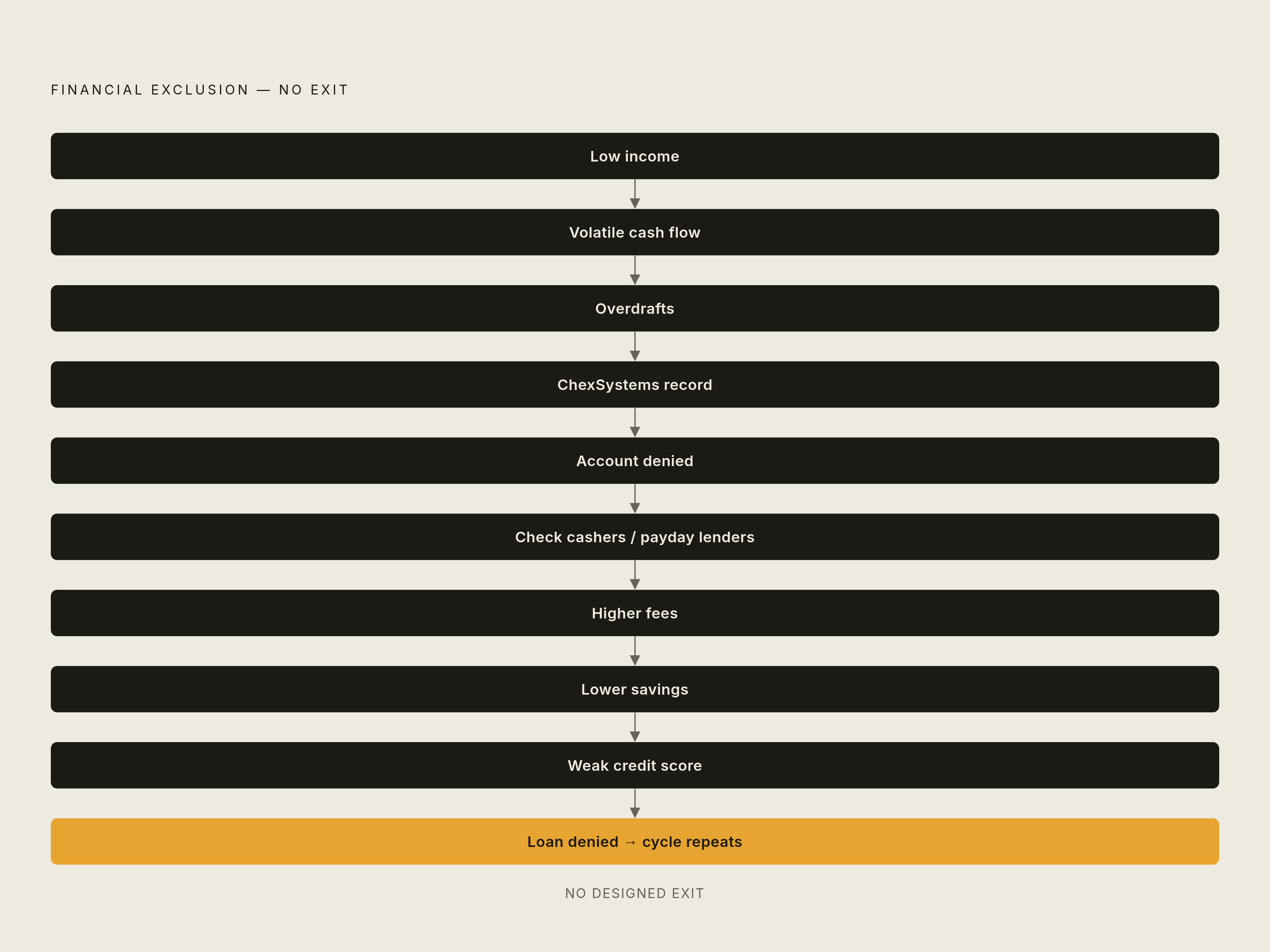
None of these gates work in isolation. They stack, and they stack on the same people every time.
Trace the chain: low income creates volatile cash flow. Volatile cash flow leads to overdrafts. Overdrafts create a ChexSystems record. That record gets an account application denied. Denial pushes someone into check cashers and payday lenders, alternative financial services that cost more per transaction. Higher costs mean less left over to save. Lower savings and inconsistent payment history drag down a credit score. A weak credit score gets the next loan denied too. There's no clean exit ramp built into any of these tools, because each one was designed to solve a risk problem for the bank, not a stability problem for the customer.
A St. Louis Fed roundtable found something just as telling: technical jargon, paperwork requirements, and the sheer pace of service at traditional banks push low-income people away well before a formal denial ever happens. The friction isn't one bad moment at a teller window. It piles up, form after form, until walking away feels easier than finishing the application.
That accumulation appears directly in trust numbers. Among banked respondents, 88% said they trust banks. Among unbanked respondents, only 55% did. And 46% of unbanked respondents said banks don't give clear, honest information, versus just 11% of banked respondents who felt that way. That gap is a rational read on a system that fees and denies people, then wonders why they stopped showing up. It's a rational read on a system that fees and denies people, then wonders why they stopped showing up.
Destinations and Costs Borne by Excluded Consumers
Getting screened out of mainstream banking means paying more for worse versions of financial services. It means paying more for worse versions of them. The Brookings Institution has calculated that an unbanked person could spend as much as $40,000 over a lifetime on check-cashing fees alone, just to access money that was theirs to begin with.
Payday lending absorbed $2.4 billion in fees from consumers in 2022, with California, Texas, and Florida accounting for 73% of that total. Some states have gone the other direction and widened the door for high-cost credit rather than closing it. Mississippi's Credit Availability Act permits APRs over 300% on installment loans, and the state recently pushed its sunset date out to July 1, 2030, while also raising the maximum loan size to $3,250. That's one expanding to meet demand that mainstream banks refuse to serve. It's one expanding to meet demand that mainstream banks refuse to serve.
Research from SPPI drove the point home in a direct test. Researchers posed as loan applicants, some well-qualified, some less so, seeking small-dollar emergency credit from banks and credit unions. The result was close to uniform denial across the board. Even when researchers actively tried to access the mainstream system for a legitimate small emergency loan, the system didn't open. The gap isn't theoretical. It held up under a live test.
What the screening system leaves unmonitored inside existing accounts
The 19.0 million underbanked households prove that having an account isn't the same as having security. Their accounts tend to run thin, sitting close to zero balance for stretches at a time, which makes them especially exposed to fee cascades that a fatter cushion would absorb without notice.
Recurring charges are a quiet part of that exposure. The average adult spends $1,080 a year on subscriptions, with 61% paying for video streaming alone, and unused subscriptions account for roughly $205 of that annual total. For someone keeping a balance near the minimum threshold, a forgotten $15 charge is the trigger for an overdraft, and the fee that follows it. It's the trigger for an overdraft, and the fee that follows it.
Banks watch closely for behavior that creates risk to the bank itself, low balances, overdraft patterns, anything that signals default risk. But there's no equivalent proactive alert for the customer's side of that risk. Nobody flags the duplicate subscription, the forgotten free trial that converted to a charge, or the recurring fee draining an account before it crosses into overdraft territory. The monitoring runs one direction only, and it's the direction that protects the bank's ledger, not the customer's balance.
Policy and Market Responses to Screening Exclusion
Some of this is getting addressed, unevenly. Bank On, a national initiative built to certify low-cost, no-overdraft checking accounts, is the clearest attempt to build a fix directly into the banking system rather than around it. A capstone study out of Merrimack College found the program works as an intervention, but only within limits: the program reaches part of the excluded population, not all of it.
Federal regulation moved in the opposite direction in 2025. The CFPB's $5 overdraft cap, finalized in 2024, got killed by Congress the following year. That's an active rollback, and it means large banks are free to charge whatever overdraft fee they choose going forward. It's an active rollback, and it means large banks are free to charge whatever overdraft fee they choose going forward.
State regulators have picked up some of the slack, but only some. One state's financial regulator proposed rules in January 2025 aimed at exploitative overdraft fees and requiring clearer consumer notifications. That helps New York residents. It does nothing for the other 49 states, and state-by-state action of this kind is patchwork by definition: protection depends entirely on which state someone happens to live in.
Congress has at least started paying attention to ChexSystems specifically. A Senate letter sent in March 2025 to ChexSystems President Ronald Whyte, paired with a February 2025 Banking Committee hearing on debanking, shows political interest building. But interest isn't legislation. The five-year record, the overdraft-driven denials, and the compounding exclusion described throughout this piece remain exactly as they are: structural, not accidental, and still standing.
Sources
- Financial Inclusion: Access to Basic Banking
- Report: Application Pending
- How Low- and Moderate-Income Individuals Interact with Institutions to Access Financial Services
- Unbanked - Wikipedia
- Mortgage Lending Standards Are Too Tight | The Pew Charitable Trusts
- urban.org
- Income Requirements for a Personal Loan: How Much Do You Need in 2026?
- dfs.ny.gov