How Lending Circles Work and What They Actually Cost
Lending circles offer interest-free loans but come with hidden costs based on your position.

Picture ten people agreeing to put $50 into a shared pool every month. After one month, the pool holds $500, and one member takes the whole amount home. After month two, another member collects $500. The cycle repeats until all ten people have had their turn, at which point the group has either finished or started over. That is the entire mechanism. No bank sits in the middle, no interest gets charged, and no credit check happens before the first dollar changes hands.
This arrangement has a formal name: a ROSCA, short for Rotating Savings and Credit Association. The practice shows up under different names across the world, and each version follows close to the same rotation. Mexico has tandas and cundinas. Parts of Asia call it hui. West Africa and the Caribbean know it as susus. The West Indies use partnerhands, pardna, or pardner. Korea has practiced a version called Kye for generations. The variation in name reflects how many cultures independently arrived at the same solution to the same problem: how to get a lump sum of cash without a bank.
The structure only makes sense once you notice that every member plays two roles at once: lender and borrower. The person who collects the pool in month one has effectively borrowed from everyone else in the group, since they've only put in $50 of the $500 they just received. The last person to collect has done the opposite. By the time their turn arrives, they've contributed the full amount across every prior month, and all they get back is the money they already put in. Same mechanism, same monthly payment, completely different financial position depending on where in the order a member lands. That asymmetry is the thread the rest of this piece follows, because it shapes every cost and risk a lending circle carries.
Why people use lending circles when banks exist
Lending circles exist because conventional banking leaves a gap open: access to a lump sum without a credit history, without collateral, and without paying interest. Certified financial planner Jacob Bayer told Moneywise that lending circles "have existed among immigrant populations and underserved communities to address the issues created when traditional banking fails." That framing matters. Lending circles function as a structural response to exclusion from mainstream financial products, built by communities that banks weren't serving.
The people best served by this tool have a specific profile. Schuiteboer notes that lending circles work best for people with a reliable but low-paying job and little or no savings. For that group, a lending circle beats payday loans and other high-interest credit options by a wide margin, since there's no interest rate compounding against them and no fee schedule eating into the loan.
The scale of informal, peer-to-peer lending has grown large enough that nonprofit organizations and financial platforms have built formal programs around it. That shift matters for this piece's central question. Once an outside organization enters the picture to manage contributions, track payments, or report activity to credit bureaus, the lending circle takes on a structure closer to a financial product than a community practice. That structure brings real benefits, which later sections cover in detail. It also brings costs that an informal circle among neighbors never had to charge.
The monetary cost, usually zero
An informal lending circle run among friends or family typically costs nothing in the conventional sense. No interest accrues. No fee gets charged to join, apply, or participate. No credit check filters anyone out. Measured against a personal loan or a credit card cash advance, the price tag reads as zero.
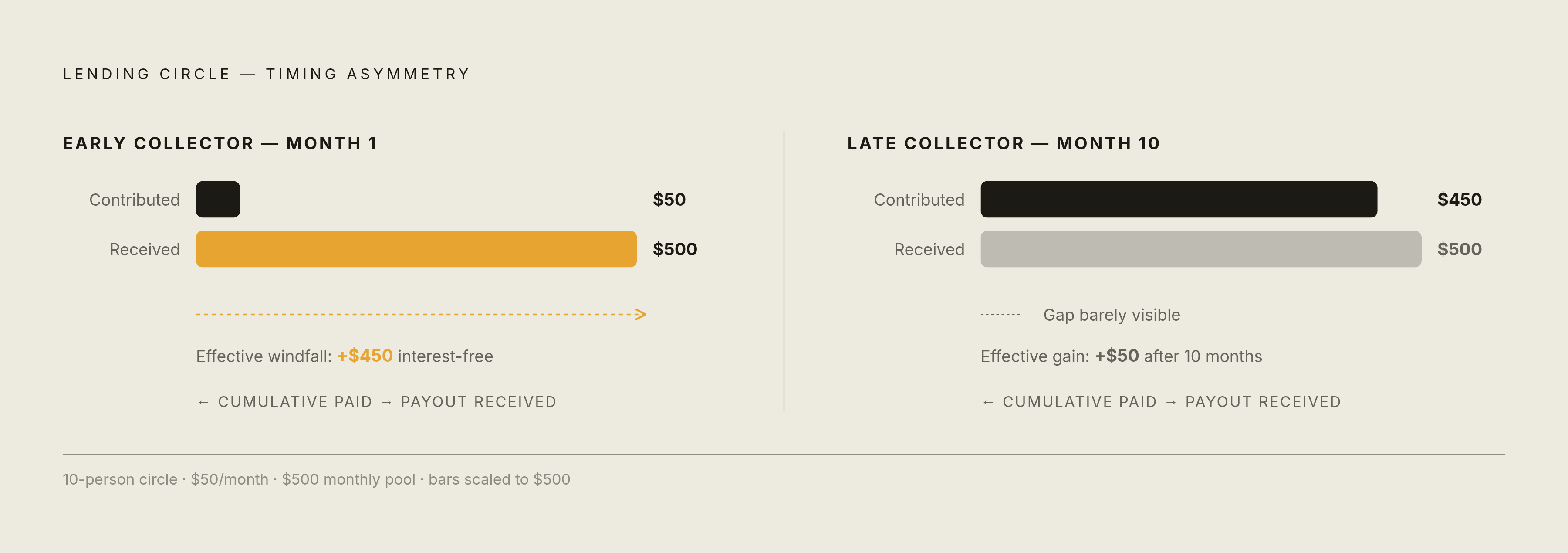
That "free" label hides an opportunity cost tied directly to rotation position. The member who collects early receives what amounts to an interest-free loan: they get the full lump sum before they've contributed anywhere close to the equivalent in monthly installments. Compare that to a personal loan from a bank, where interest charges start accruing immediately: the early recipient in a lending circle comes out ahead by a wide margin.
The member who collects late experiences the opposite. By the time their payout arrives, they've already paid in the full amount across the preceding months. What they receive is their own money, returned to them with no interest and no return on the time it sat with the group. A bank savings account would have paid them something for that patience, even if only a small amount. The lending circle pays them nothing beyond the return of their own contributions.
This asymmetry is built into the structure itself. Ten people contributing to a shared pool and taking turns collecting it will always produce this split between early recipients and late recipients, regardless of how carefully the group sets its rules. Anyone joining a lending circle should understand which end of that asymmetry they're likely to land on, and factor that into whether the arrangement serves their actual financial need. A person who needs cash now benefits enormously from an early draw. A person who's mainly trying to build a savings habit may prefer a late draw, or may not notice the difference at all until they do the math.
The formalized version: how MAF and nonprofit partners changed the structure
Mission Asset Fund took the informal ROSCA and built a structured, credit-reporting loan program around it. MAF, a San Francisco-based nonprofit, has offered its Lending Circles program since 2008. The organization sits in the role an informal circle never has: it collects payments, distributes funds, and reports monthly payment activity to all three major credit bureaus, Equifax, Experian, and TransUnion.
The program follows defined parameters rather than whatever terms a given friend group happens to agree on. Circles form with 6 to 12 participants. Loan amounts and monthly payments both fall within set ranges that MAF and partner organizations like Peninsula Family Service have established. The loan carries zero percent interest, and there are no fees to apply, join, or participate. There's no hard credit check standing between an applicant and the program.
Qualifying for the program takes more than showing up with cash each month, though. Peninsula Family Service lists the requirements: an active email address and checking account, a government-issued ID, a Social Security Number or ITIN, two months of pay stubs, and three months of recent bank statements. None of those requirements is unreasonable on its own, but stacked together they form a bar that excludes some of the people an informal circle would have welcomed without question, including those without a bank account or without recent pay stubs because their income comes from informal work.
The payoff for clearing that bar is substantial. MAF participants have increased their credit scores by an average of 168 points. That figure stands out as the strongest outcome claim connected to any version of the lending circle model, formal or informal, and it reflects something an informal circle structurally cannot offer: a credit history that a bank, landlord, or lender can actually see.
What formalization adds and costs
Formalizing a lending circle trades one set of risks for another. Informal circles carry the risk of social default, no legal protection if someone stops paying, and no credit-building benefit no matter how reliably the group performs. Formal programs reduce those risks but introduce platform fees, penalty structures, and credit-reporting consequences that most participants don't fully understand before they sign up.
Formalizing lending circles has, in some cases, brought back the same kind of fee opacity that pushed people away from banks. Whether that fee opacity exists depends entirely on which program a person joins. MAF's Lending Circles program charges zero interest and zero fees, full stop on both counts. Other platform-based products built around the same rotating-pool concept, like Esusu, do carry fees as part of their business model. Both approaches can serve a participant well, but they are not interchangeable, and treating "lending circle" as a single cost structure will mislead anyone comparing their options.
Fee transparency gets worse at smaller loan amounts. Informal circles among friends or family carry no fees because there's no intermediary taking a cut. The moment a platform or organization enters the picture to manage the circle, some version of a fee structure typically follows, and that fee represents a larger percentage of the loan the smaller the loan amount is. A fixed fee on a large loan is a rounding error. The same fee on a $300 loan is a meaningfully different proposition.
None of this means formalized lending circles are the wrong choice. For many participants, the credit-building benefit alone, a 168-point average increase among MAF participants, justifies the added paperwork and the qualification requirements. Read the specific terms of whatever program is on offer before joining it. "Lending circle" no longer describes one cost structure: it describes a category that includes a zero-fee nonprofit program alongside fee-charging platform products, and knowing which one is on offer is exactly the detail that gets lost when people assume all versions work the same way.
The trust risk: why social capital is both the mechanism and the vulnerability
An informal lending circle runs on social reputation. That single fact explains both why the model works as well as it does and why it can fail in ways no fee schedule or credit check would ever catch. There's no loan agreement enforceable in court, no collections department, and no credit bureau tracking who paid on time. The entire system depends on people honoring an obligation to their neighbors, family members, or community.
That dependency holds up well within tight, well-known groups and breaks down once a circle extends past them. Trouble tends to appear when a circle grows too large for every member to really know every other member, or when the person organizing the rotation mismanages the funds or disappears with them. A circle of ten close relatives carries a different risk profile than a circle of thirty acquaintances assembled through a workplace or a mutual contact, even though the mechanics look identical on paper.
The deterrent that keeps most informal circles functioning is social. Facing a neighbor, a family member, or a longtime friend after skipping a payment can weigh on someone more heavily than a ding to a credit score would. But that same social enforcement cuts the other way when it fails: there's no structured resolution process to fall back on, no dispute mechanism, no recovery process. The consequence of a default in an informal circle is relational damage, full stop, not a fee or a collections call.
Anyone considering joining a circle organized by someone outside their closest circle of trust should ask about the facilitator's track record before contributing a single payment. How many circles has this person run? How many of those cycles finished with every participant receiving their payout in full? Those two questions do more to protect a prospective member than any amount of reading the fine print, because the fine print in an informal circle usually doesn't exist.
The timing constraint: what it means to wait months for your payout
A lending circle is not a liquid financial product. Joining one means committing to contribute for the full length of the rotation, regardless of where in the order a payout lands. A ten-person circle with monthly contributions runs for ten months minimum, and a participant who draws a late position has effectively locked up their access to that money for most of a year.
That constraint matters most for someone who needs cash immediately. A lending circle has no built-in mechanism for accelerating a payout. Changing the payout order, or moving someone up the list because their need is more urgent, typically requires the whole group to agree, and getting unanimous consent from ten people is its own kind of obstacle. A participant who joins expecting flexibility and then discovers they can't move up the list has misjudged what the tool is built to do.
Early withdrawal also compounds the timing risk. If a participant's financial situation changes partway through the cycle and they can no longer make their contribution, the shortfall doesn't just affect that one person. It reduces what every remaining member can expect to collect, since the monthly pool depends on everyone paying in full. One person's financial setback becomes a shared loss across the entire group, which is a cost structure no bank loan carries.
The commitment at the center of a lending circle runs to the whole group for the whole term, and that's a heavier obligation than most borrowing options impose on a single individual. A credit card or a personal loan ties a borrower to a lender. A lending circle ties every member to every other member, for as many months as the rotation takes to complete. Anyone weighing whether to join should ask the same starting question a personal-finance guide might raise: what happens, specifically, if a payout needs to move or a contribution gets missed, and does the group have any real way to answer that before the first payment goes in.