What Credit-Invisible Life Actually Costs
Millions of unscored Americans pay hidden surcharges on rent, insurance, and loans.
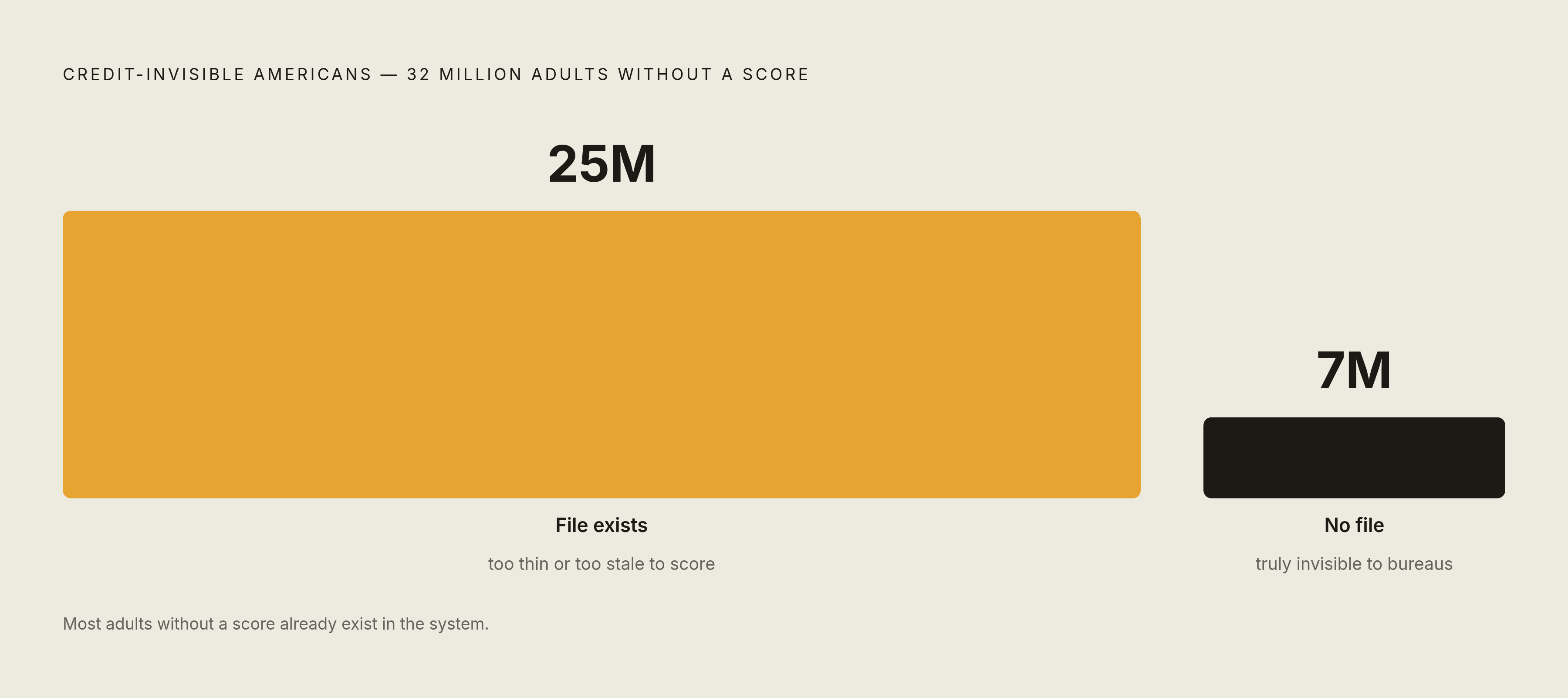
The number most people cite for credit invisibility, 26 million Americans, is wrong. The real figure is larger and shaped differently: a much bigger problem than the old legend described.
Why 32 million adults still cannot be scored, and why the old headline number obscured the real problem
The corrected count breaks into two groups. About 7 million adults are truly credit invisible: no file exists for them at any bureau. Another 25 million have a file, but it's too thin or too old to generate a score. Add them together and about 32 million adults in the United States cannot be scored at all.
That split matters more than the total. For years, the story was about people who had never touched the credit system, as if the fix were simply getting them a first account. But most of the 32 million already have a file. Their problem is that the system isn't currently collecting enough fresh, reported activity to render a judgment. The frontier has moved from file creation to file maintenance, yet most commentary on credit access still treats file creation as the whole problem.
A missing score is not a verdict that someone is a bad risk; it's a statement that the system cannot see them. In lending, an applicant who can't be seen gets treated the same as one who's been judged and found wanting. Unseen defaults to declined. Every cost described in the rest of this piece flows from that one mechanical fact: a legibility failure that gets priced as if it were a risk assessment.
Who lives outside the score
Credit invisibility concentrates along predictable lines, and none of them are accidental.
Age is one. Experian reports that 40% of credit invisibles in the U.S. are under 25, and most 18- and 19-year-olds have no score at all, which is expected at the start of adult financial life. What's not evenly distributed is the exit speed: a young adult from a wealthier household can often get a parent or relative to cosign a card or add them as an authorized user, building a file within months. A young adult without that backstop stays invisible far longer, simply for lack of someone to vouch for them.
Immigration status is another. Credit history doesn't travel across borders. A 45-year-old arriving in the U.S. with 20 years of flawless repayment history somewhere else starts at zero here, indistinguishable on paper from someone who has never held an account anywhere. Foreign-born noncitizen households are far more likely than U.S.-born households to use no mainstream credit product at all, because the infrastructure that would record their financial discipline doesn't exist for them yet.
A self-reinforcing loop sits under both patterns: no history means no score, no score means no credit, and no credit means no new history ever gets built. One government report adds a sharper detail: underrepresented Americans are about twice as likely as white households to simply never apply for a credit card or personal loan, out of fear of being turned down. The cycle doesn't just produce rejections. It talks people out of applying before a rejection is even possible.
None of this is random. Every surcharge, deposit, and premium described from here forward lands on people who can least afford to pay it.
How a missing score reprices everyday life
A credit score functions as infrastructure for daily life long before anyone applies for a loan, and living without one triggers costs immediately, in places that have nothing to do with borrowing.
Rental housing is the clearest example. Landlords use credit checks as a standard screening tool. Without a score to review, a prospective tenant is commonly asked for a larger security deposit, told to find a co-signer, or turned away outright, before a single lease is ever signed.
Utilities work the same way. Electric, gas, and telecom providers routinely run credit checks on new applicants and require deposits from anyone who can't be scored. A scored customer might pay nothing upfront to start service. An unscored customer ties up cash in a deposit that can sit locked for months or years, money that's simply unavailable for anything else in the meantime.
Auto insurance adds a recurring version of the same tax. Most states allow insurers to factor credit-based insurance scores into pricing. A driver with no score can pay a meaningfully higher premium than someone with an equivalent driving record and a merely thin file, and because insurance renews annually, this isn't a one-time charge. It resets every year.
Employment closes the loop. Background checks for roles involving financial responsibility often include a credit check. That can shut someone out of exactly the kind of job that would give them the income to build the credit history they're missing in the first place.
What makes these costs so corrosive is that they're recurring. Every lease renewal, every policy renewal, every utility reconnection reprices the absence of a score all over again. A tax gets collected repeatedly, for as long as the file stays empty.
What credit invisibility costs when borrowing becomes unavoidable
Some financial needs can't be delayed or avoided, and when invisibility collides with an unavoidable need, the same product costs much more.
Auto loans make the arithmetic visible. A subprime borrower paying 23% on a five-year auto loan for a mid-range vehicle pays thousands of dollars more over the life of that loan than a borrower who qualifies for a prime rate, for the identical car. The vehicle doesn't change. The price of accessing it does.
Homeownership carries the largest version of this cost, because it compounds over decades instead of years. Credit invisibility is one of the mechanisms that keeps that gap from closing, because it denies people the entry point, a mortgage approval, before the long-term asset appreciation that homeownership produces can even begin.
One government report quantifies a related piece of this: lending discrimination currently costs Black and Hispanic borrowers hundreds of millions of dollars in extra interest annually. Credit invisibility is the mechanism that sorts people into the pricing tier where that discrimination gets applied. Without a score, a lender has nothing objective to override a subjective, often biased, judgment call. Invisibility doesn't just delay access to credit. It removes the one tool that would otherwise argue on the borrower's behalf.
The obvious objection, that someone could simply avoid borrowing altogether, fails against the facts of ordinary life. A reliable car to get to work, a home to build equity in, and cash reserves for an emergency are the basic inputs of economic stability, and credit invisibility taxes every one of them.
The subscription economy and bill creep add a hidden cost for financially fragile households
For a household already absorbing a credit-invisibility surcharge on rent, insurance, and loans, subscription sprawl is a second, parallel drain on a budget that has no slack left to give.
The gap between what people think they spend on subscriptions and what they actually spend is large. C+R Research found that people estimate paying roughly $86 a month, while the real, itemized total averages $219. That gap doesn't open all at once. It widens quietly, through stealth price increases: a service raises its price by a few dollars, the notice gets buried in an email nobody opens, and the new charge looks close enough to the old one that it never triggers a second look on a bank statement. Six months later, the subscriber is paying noticeably more than they ever agreed to.
The most serious consequence of this pattern is the credit feedback loop it can create. If a forgotten subscription keeps charging a card or account that no longer has the funds to cover it, a bounced payment can eventually land in collections. A collections entry does far more damage to a thin credit file than the identical entry does to a thick one, because there's less positive history around it to dilute the impact. Many people never connect the dots between a subscription they forgot to cancel and a collections mark that shows up on their credit report months later.
Drip pricing compounds the problem across nearly every category of spending: airfare, hotels, concert tickets, food delivery. Service fees, convenience fees, resort fees, and handling charges get advertised separately from the sticker price, so the real cost of a purchase only becomes clear at checkout.
Regulatory protection against these practices is currently thin. One federal regulator finalized a "Click to Cancel" rule in October 2024 meant to make subscription cancellation as easy as sign-up. A court struck that rule down in July 2025, and it's no longer in force. The FTC opened a new rulemaking process on negative-option practices in March 2026, but that process takes years to produce an enforceable rule. For now, the burden of catching stealth increases and unwanted renewals sits entirely with the consumer.
Price-drop windows and delivery credits go unclaimed when they are most needed
Price-protection policies and delivery guarantees are legitimate consumer rights. A price drops after a purchase, and a refund is owed. A delivery arrives late, and a credit is owed. The money is real and already earned. Claiming it is a different matter entirely.
These policies tend to be obscure, the windows to claim them are short, and claiming requires noticing a price drop before that window closes. That's a form of active, ongoing financial monitoring, and for a household already managing a credit-invisibility surcharge across rent, insurance, and loan payments, it's one more task sitting on top of a stack that's already too tall. Watching for these protections competes with everything else that's already demanding a consumer's attention.
The practical cost is dollars already owed that simply disappear because nobody was watching the clock. That's the kind of passive leak that's almost impossible to catch through willpower alone, and it's exactly the kind of leak that some form of automated monitoring is built to catch.
Connecting financial accounts to a monitoring tool with read-only access
Every cost documented so far traces back to the same root cause: financial inattention spread across too many fronts at once. No single person can watch rent terms, insurance renewals, subscription statements, delivery windows, and price-drop deadlines simultaneously, every month, without fail. The fix is using a tool that does the watching automatically, without being able to touch the money itself.
The security concern around connecting financial accounts to any third-party tool is legitimate. A recent industry audit found that a majority of expense-tracking apps share user data with third parties. That risk can be managed with the right safeguards. The standard to check for: a reputable account-aggregation provider behind the connection, permissions that are genuinely read-only, multi-factor authentication turned on, and a clear, working way to revoke access and delete stored data whenever a user wants.
Read-only access is a structural safeguard, and regulators are starting to treat it that way. The Federal Reserve's Consumer & Community Context highlights cash-flow data drawn from deposit accounts as a reliable, accurate, and explainable source for consumer financial analysis, consistent with safe and transparent practice.
Banking is already building toward this model. In July 2026, First Internet Bank announced that customers could connect eligible accounts to AI assistants on a permissioned, read-only basis using the Model Context Protocol. The assistant can review balances and transaction history. It cannot move money. That line, between seeing and touching, is the whole safety model, and it's the same line any monitoring tool should hold.
Applied to the costs in this piece, that kind of monitoring catches what a person managing five other financial pressures is likely to miss: subscriptions nobody uses anymore, stealth price increases, free trials about to convert into paid plans, duplicate charges, late delivery credits, price-drop windows before they close, and refunds that were promised but never arrived. For a credit-invisible household specifically, catching these isn't only about saving money. Avoiding a collections entry from a forgotten subscription, and recovering refunds that were already owed, is protection against the exact kind of derogatory mark that does the most damage to a file that's already thin.
What it takes to move from unscored to scored
Credit invisibility feels like a permanent condition to the people living inside it. Mechanically, it's one of the more fixable problems in consumer finance, and the tools for fixing it are getting better.
There are four rungs on this ladder. Truly invisible means no record exists at any bureau. Insufficient unscored means a file exists but is too new or too sparse to produce a score. Stale unscored means a history exists but hasn't seen recent activity. Scored is the top rung. Each step up has a distinct mechanical cause, and a specific action that moves a person from one rung to the next.
Alternative data is widening what counts as "visible." The Federal Reserve's October 2025 Consumer & Community Context identifies cash-flow data, the income and expense patterns drawn from a person's own deposit accounts, as the most promising category of alternative data for responsibly expanding credit access, especially for people with thin files. The New York Fed's September 2025 Economic Policy Review adds a broader confirmation: digital financial services have genuinely opened the system to more households, the share of adults who are scored has stayed relatively stable over the past decade, and unbanked rates have declined. Progress has happened, even as real obstacles remain for people with low financial security.
That progress deserves a fair caveat. Alternative data and fintech lending have been promised as a fix before without eliminating discrimination. One government report found that fintech algorithms show less bias than face-to-face lenders, but they don't eliminate discrimination. The path to getting scored exists, but structural barriers remain, and getting scored is a necessary step toward financial equity, not a guarantee of it.
For anyone reading this from inside the 32 million, the most immediate action available isn't exotic. Stopping the leakage of money through forgotten subscriptions, stealth fee increases, and unclaimed refunds preserves the financial margin needed to keep up the steady account activity that builds a file in the first place. The two problems, invisibility and leakage, aren't separate. Solving one makes the other easier to solve.