Wage Theft Among Low-Wage Workers and Its Compounding Effect
Stolen wages trigger cascading costs that low-wage workers can't absorb without spiraling debt.
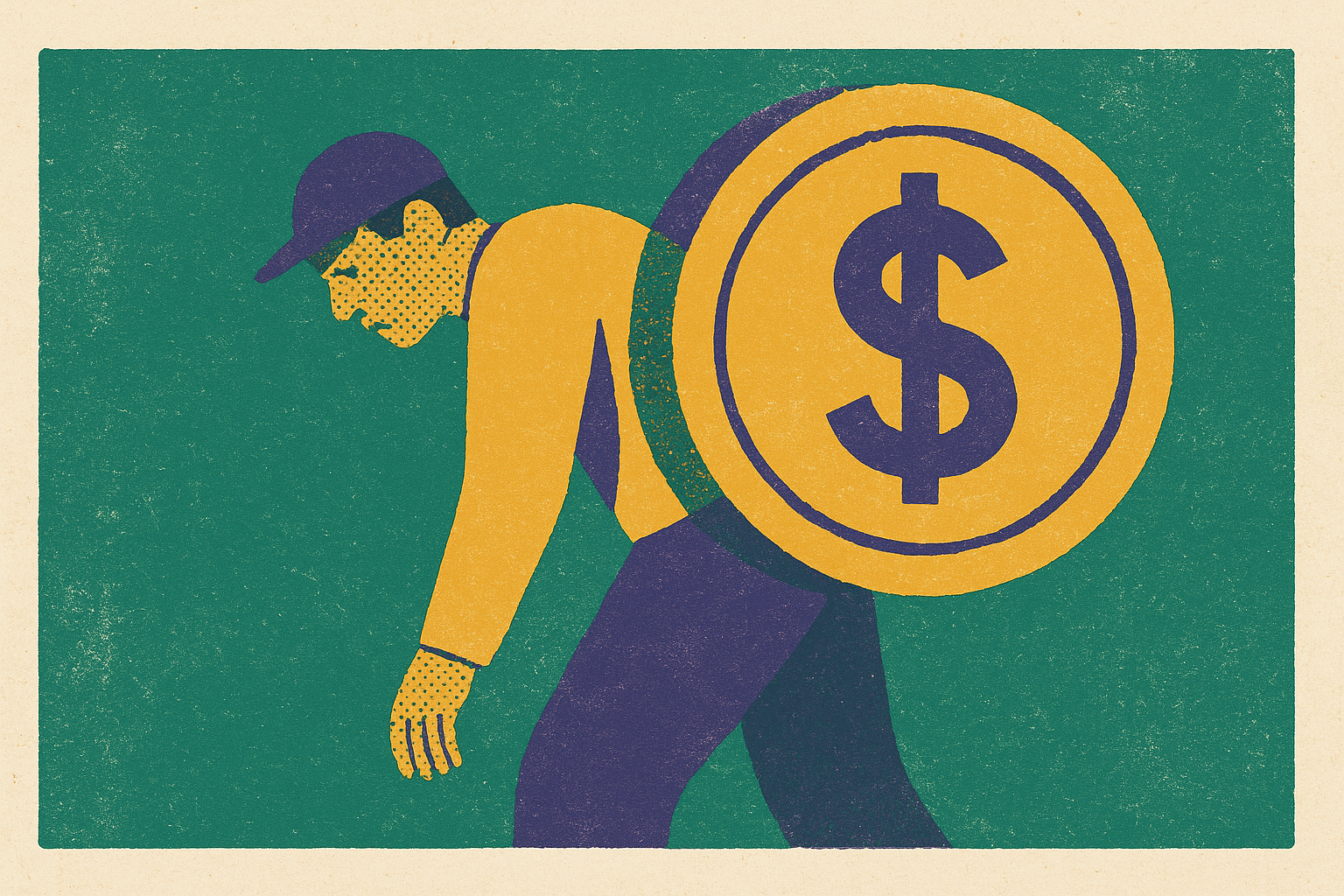
Wage theft doesn't hit once and stop. When an employer pays below minimum wage, skips overtime, demands off-the-clock work, or mislabels an employee as a contractor to dodge payroll taxes, that stolen paycheck sets off a chain reaction that can take months to unwind, especially for a worker with no savings behind them. The Cleveland Fed puts the number at around 5.8 million workers shortchanged, with 5% of non-exempt workers across the 10 most populous states paid below minimum wage, a record high. Among low-wage workers specifically, this kind of theft touches 17% of the workforce, and the ones it touches almost never see the money again. That last part is the real story here: not that theft happens, but that almost nothing brings the money back once it's gone.
Why low-wage workers have no cushion to absorb a missing paycheck
The math turns grim fast. EPI data shows workers who experience minimum wage violations end up with roughly $10,500 a year in wages after the shortfall. A worker losing $95 a week to underpaid wages, facing recurring costs that don't pause when a paycheck falls short, is facing a single compounding squeeze wearing multiple masks. It's landing on ground that was already sinking.
For low-wage workers, wages lost to theft can eat up close to 10% of annual earnings, a share large enough to decide whether rent gets paid. That's not a rounding error on a pay stub. It means the worker either makes rent or doesn't. Workers hit by minimum wage violations lose about $95 a week on average, and for someone earning just above minimum wage, $95 covers groceries, a transit pass, or a real chunk of the electric bill. That money disappears before it ever reaches a bank account.
Higher earners who get shorted on a paycheck usually have savings, a credit card with room on it, or a spouse's income to lean on. Low-wage workers typically have none of that. The missing money has to come from somewhere, and for a worker with no savings, the options are all costly ones. Missing how income floors work means missing the point entirely: there's no float left to absorb the hit.
How a single missing paycheck triggers a chain of downstream financial damage
Trace the sequence and it plays out the same way, over and over. A worker doesn't get paid what they're owed. Rent comes due anyway. Utilities come due anyway. The worker ends up choosing between three bad options: pay late, pay part of it, or skip it, and every one of those choices costs something extra on top of the wages already lost.
Pay rent late, and penalties follow. The longer the shortfall continues, the more precarious that housing situation becomes.
If automatic payments are set up and a paycheck is missed, the bank doesn't wait around for the employer to catch up. When an expected deposit doesn't land, banks don't wait, and the worker ends up owing the original stolen wages plus whatever charges follow from coming up short.
Workers who can't cover the gap through savings have few good options. Any path forward costs something extra on top of the wages already lost, and no amount of budgeting on the worker's end changes that math.
The enforcement gap behind why most victims never recover the stolen wages
As of May 14, 2025, the federal labor agency's wage enforcement division had just 611 investigators covering 165 million workers nationwide. That's the lowest staffing level in 52 years, and it's not close.
Break that ratio down and the scale of the problem stops being abstract: one investigator per tens of thousands of workplaces. A team that size can't go looking for violations. The system depends almost entirely on workers coming forward on their own, and that's exactly where it falls apart.
Among low-wage, private-sector, nonunion workers bound by mandatory arbitration clauses, 98% never file a claim when their wages get stolen. Fear of getting fired, or of quiet retaliation that's nearly impossible to prove, keeps most people silent. Of the small fraction of cases that do get filed, only 2% end with any financial penalty for the employer. Calling that a deterrent means the word stops meaning anything. At a 2% penalty rate, an employer stealing wages is making a rational bet, not taking a risk.
The geography and industry patterns that concentrate wage theft in specific communities
Wage theft clusters hardest in states where the minimum wage sits well above the federal floor: California at $16.90, New York at $16, Illinois at $15, Florida at $14. The wider the gap between what the law requires and what an employer is willing to pay, the more room there is for theft to hide in.
New York alone loses workers an estimated $965 million a year to wage theft, concentrated in construction, hospitality, and retail. The federal minimum wage has sat frozen at $7.25 for close to 20 years, the longest stretch without an increase in the country's history, which pushes the real fight over wages down to the state level, right where enforcement is thinnest.
Industry matters as much as geography. Construction, food service, health care, and retail carry the highest rates of wage theft, and that's not random: these are the sectors where low-wage labor, informal hiring, and long subcontractor chains all overlap. A general contractor three layers removed from the crew doing the work can plausibly claim ignorance. That distance is the whole mechanism. It makes theft easy to commit and hard to trace back to anyone in particular.
What enforcement and community-level recovery looks like in practice
Some cities have stopped waiting on federal capacity and built their own systems instead. Seattle, Minneapolis, and Philadelphia all use a co-enforcement model, pairing city labor agencies with community organizations that already have workers' trust. Seattle puts more than $1.5 million toward funding worker organizing and outreach groups doing this work on the ground.
San Diego took a different angle with its Workplace Justice Fund, built for a specific failure mode: what happens when a worker wins a wage claim and the employer just refuses to pay. The fund gives workers immediate relief, and paid out roughly $100,000 in its first months running. A 2024 survey from CPI and San Diego State University found nearly 90% of hourly workers interviewed had experienced wage theft, which shows how much need a fund like that is up against, even a well-run one.
Unions change the equation in a way nothing else here does. Unionized workers are half as likely to experience minimum wage violations in the first place, and union members report violations to enforcement agencies at higher rates than non-union workers do. Collective bargaining doesn't just raise pay. It makes theft much harder to get away with, because someone's watching who isn't afraid to report it. Of every intervention on this list, that's the one addressing the actual cause: an employer who knows nobody's watching.
The parallel drain that compounds the problem: money leaking from workers' accounts that no one is watching
Wage theft doesn't happen in isolation. A worker already absorbing a $95-a-week shortfall is often losing money from the other direction too: charges agreed to once and forgotten, price drops owed but never claimed, subscriptions quietly renewing on a debit card month after month.
The average household spends over $900 a year on subscriptions. For a low-wage worker already stretched thin, that's a real slice of annual income leaking out in small charges nobody remembers agreeing to. And 42% of consumers admit they've kept paying for a service they'd stopped using without realizing it. Zombie subscriptions aren't a middle-class quirk. They drain money at every income level, they just hurt more the less someone has to spare.
Retailers add another layer on top of that. Most offer a price protection window after a purchase, where a shopper can get refunded the difference if the price drops. Almost nobody uses it, mostly because almost no retailer mentions it at checkout. That's money legally owed sitting unclaimed, simply because nobody's watching the clock on it. Call this the same failure as the enforcement gap above, just moved from the labor department to the checkout page: the money is owed, the mechanism to claim it exists on paper, and almost nobody uses it.
What it takes to climb out of compounding financial hardship over months
Recovery from wage theft rarely moves in a straight line. Two out of three workers who experience a pay-related violation deal with it every single week, so most victims aren't recovering from one bad incident. They're managing an ongoing drain while still trying to dig out from the debt and fees the last incident caused.
Adding it up brings the picture into focus fast. That sits under the poverty line for most household sizes before a single dollar gets stolen, so the theft lands on ground that was already sinking. It's one problem, compounding on itself, week after week.
The cost doesn't stop with the individual either. EPI points out that wage theft pushes workers onto public assistance programs, shifting the burden onto taxpayers who had no hand in the original theft. An AFL-CIO survey found 71% of low-wage workers earning under $15 an hour had experienced wage theft. Set that next to the finding that stolen wages can eat up close to 10% of a worker's annual earnings, and the scope stops being a statistic. It becomes the ordinary, weekly experience of a huge share of America's lowest-paid workforce.
Sources
- Fighting Wage Theft From the Ground Up - The American Prospect
- Federal job cuts and deportations could worsen the wage theft problem
- Wage Theft, The $50 Billion Crime Against Workers
- Employers steal billions from workers’ paychecks each year: Survey data show millions of workers are paid less than the minimum wage, at significant cost to taxpayers and state economies
- keevee.com
- Wage Theft Statistics: 2026 Market Report
- Minimum Wage Theft Hit Record High Last Year—Here Are The Key Numbers