Why Emergency Fund Advice Fails Below Median Income
Most Americans earn too little after fixed costs to build the emergency fund experts recommend.
The three-to-six-month emergency fund rule assumes something most American households don't have: a stable income with room left over after fixed costs. That gap, between what the rule requires and what people actually earn, is the real story here. Before anyone below median income can start stacking savings, they need to plug the leaks already draining whatever cash they've got, and recovering money that's already owed turns out to be faster than trying to save from a paycheck that doesn't stretch.
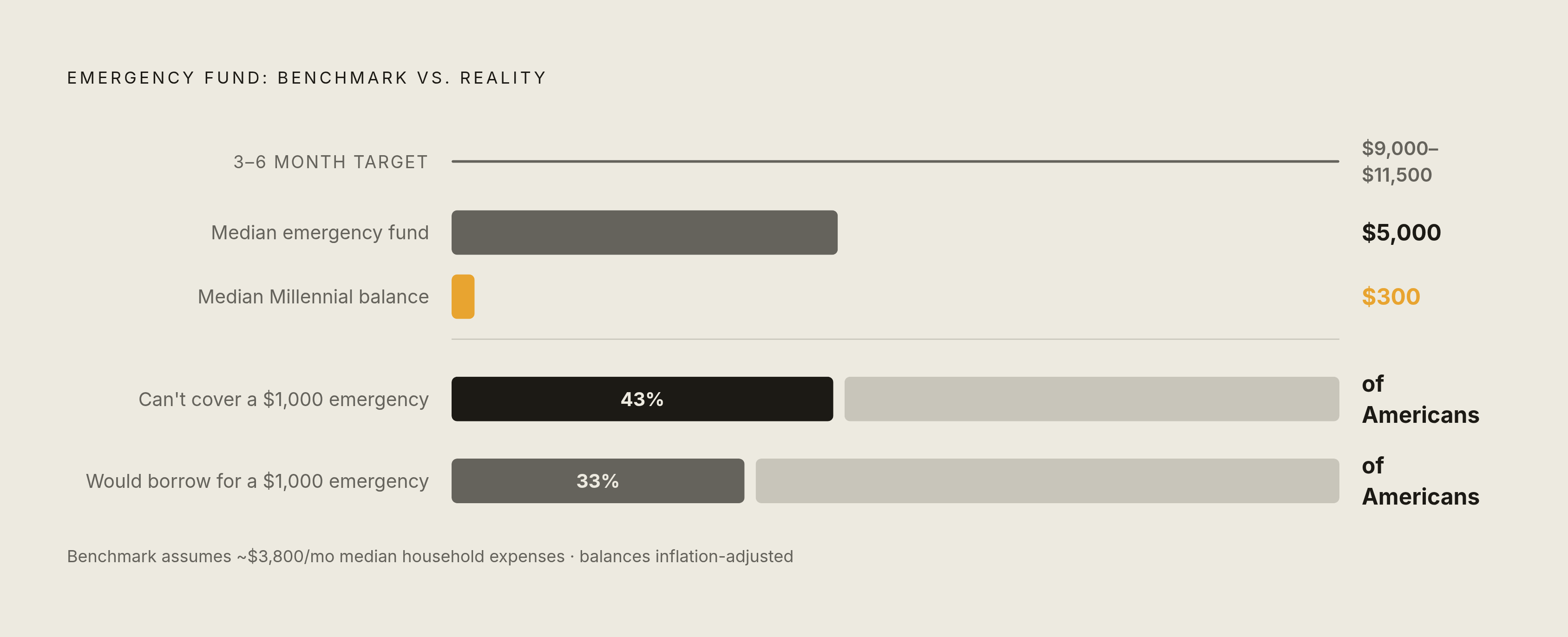
How far below the standard benchmark most American households sit
Start with the median, not the average, because the average lies. A survey outlet found that among people who actually have an emergency fund, the median balance is $5,000, half of the $10,000 figure respondents reported the year before. News survey of 1,216 adults.
Zoom in further and the picture gets worse. Forty-three percent of Americans surveyed by that outlet News couldn't cover a $1,000 emergency from savings at all. A separate Bankrate figure cited by myfinancialfreedomtracker puts the share who'd need debt to cover that same $1,000 at 59%. Fortunly's 2026 numbers are in similar territory: 33% would need to borrow or go into debt for a $1,000 emergency, and 29% carry more credit card debt than they hold in savings.
WalletHub found something starker still. Eighteen percent of respondents, nearly one in five people, said they couldn't pull together $1,000 in cash within 24 hours even to save a loved one's life. That's not a hypothetical stress test. That's not a hypothetical stress test; it's the floor.
The gap isn't evenly spread, either. U.S. News found 48% of women have no emergency fund at all, compared to roughly a third of men. And the generational number from Empower, cited by Carry, might be the most telling of all: the median emergency fund balance for Millennials is $300. Nowhere near what would be considered a comfortable cushion. Three hundred dollars. At that starting point, telling someone to "save incrementally toward three months of expenses" isn't advice, it's noise.
None of this is a tail-end horror story pulled from the worst-off segment of savers. This is the median experience.
Why income and rising costs explain the gap more than financial habits do
WalletHub's nationally representative survey found that sixty-four percent of Americans say income itself is what's stopping them from saving for emergencies. That number beats inflation (36%) and debt (36%) by a wide margin. Income is the barrier. It's the barrier.
WalletHub found that two in three Americans say the affordability crisis has hit their emergency savings.
Inflation raises the savings target and shrinks the surplus available to fund it, at the same time. The finish line moves further away while the amount of ground a household can cover each month gets smaller. As an illustrative example, a household that needed $9,000 to cover three months of expenses in 2020 may need closer to $11,500 in 2026 after cumulative inflation. Even a household that kept its savings balance perfectly flat has watched that money's real protective value shrink underneath it.
Medical debt makes this worse in one stroke. Myfinancialfreedomtracker found that a hundred million Americans owe $220 billion in medical debt combined, and a single hospitalization can turn an emergency fund from a cushion into a bill payment overnight.
The consequence compounds from there. Fortunly found that workers without emergency savings are 13 times more likely to take a hardship withdrawal from their 401(k). No buffer means one bad month can turn into a retirement-account decision with tax penalties attached. If income is the wall, then advice that just says "spend less, save more" walks a household straight back into it. A more useful focus is not how to save harder. It's whether money already leaving the household could be pulled back in.
Subscription creep as a recurring, invisible drain on household cash
West Monroe research found that households spend roughly $273 a month on subscription services, and 89% of consumers underestimate that total. That underestimation is the whole mechanism. Nobody budgets against a number they don't believe.
Research found that nearly 29% of consumers say they've accidentally subscribed to at least one service, and free trials that quietly convert into paid subscriptions are a well-documented pattern. The conversion works precisely because nobody's watching the calendar on day 29 of a 30-day trial.
Research found that many households can free up $80 to $150 a month by canceling unused subscriptions and tightening recurring charges. At the low end, that's close to $1,000 a year that was already walking out the door. The same source found that for households that want to keep services rather than cut them, shared or bundled plans can cut costs 30% to 50% without losing access to anything.
Asking a company to pause a subscription, rather than cancel it outright, is sometimes an available option. It's a smaller ask, and companies are often more willing to grant it.
The regulatory backdrop is messy right now, too. The FTC's "click to cancel" rule got vacated by the Eighth Circuit in July 2025 on procedural grounds, and a new rulemaking process has only just started. That means the rules protecting consumers from subscription traps are in flux, not settled, which makes tracking these charges yourself more necessary, not less.
Price-drop refunds and the money retailers owe after a purchase
Plenty of retailers will refund the difference when an item's price drops after purchase. But the money doesn't come automatically. Someone has to notice the drop and file the claim inside a specific window, and no retailer does that work for you.
The policies vary a lot by retailer:
Target offers a 14-day price adjustment window for Target Circle members and 7 days for non-members, and during the 2025 holiday season (November 1 through December 24), anything bought in that window that later goes on sale is refundable. Best Buy offers partial refunds if an item drops in price at Best Buy itself or at select named competitors, including Costco, Walmart, Amazon, and Home Depot, within the standard return window. Best Buy's official Holiday FAQ states that for holiday purchases made October 31 through December 31, 2025, Best Buy extends price matching through January 15, 2026.
Consumer Reports found that Costco gives 30 days to request a partial refund if it drops the price on a Costco.com item, though in-store drops require an in-store customer service visit, and Costco won't cross-match its online prices against its in-store prices. Microsoft Store offers a one-time price adjustment on physical products within 60 days of delivery, if the price drops at Microsoft or an eligible competitor.
Amazon is the notable exception. As of 2026, Amazon does not offer a broad price-drop refund policy, and its own site confirms it doesn't price-match on most items.
Credit card price protection, once a common perk, has mostly disappeared too. Chase no longer offers it on most cards. Kudos found that a handful of issuers, including Capital One and some credit unions, still do, so it's worth checking a card's benefits page before assuming the perk is gone.
None of this money is a gray area or a favor from customer service. It's owed, under policies the retailers themselves wrote. It goes unclaimed because tracking receipts and counting down 14-day or 60-day windows by hand isn't something most people have the bandwidth to do.
Late delivery credits that carriers and retailers guarantee but rarely pay unprompted
FreightAmigo found that three in four online shoppers experienced at least one late delivery in the past year. Despite that frequency, most people never file for the compensation they're entitled to.
Amazon changed its approach significantly in 2025 and 2026. ParcelPath found that the old practice of automatically crediting a free Prime month for a single late delivery has ended, replaced by case-by-case compensation. Current options include shipping fee refunds, promotional credits, Prime membership extensions, partial refunds on the order's value, and in some cases a full refund where the customer keeps the item. Amazon's Prime delivery guarantee automatically refunds shipping fees when a guaranteed delivery date (not just an estimated window) is missed, for eligible orders. Non-Prime customers typically get a full shipping refund when a package arrives three or more days late.
UPS runs on a stricter, less forgiving clock. Darrigo Consulting found that it refunds 100% of shipping charges if a guaranteed package arrives even one minute late, but the customer has to file a GSR claim within 15 days, and UPS never issues that refund on its own. As of early 2026, UPS has brought the guarantee back for most domestic services, though it still suspends it selectively during peak shipping periods and on certain international routes.
Fifteen days sounds like plenty of time. It isn't, not when the average person has no system tracking which packages arrived late in the first place. The package shows up, the frustration fades, and the window closes unnoticed.
These credits are small on their own. Five dollars here, a shipping refund there. But they're guaranteed by written policy, not up for negotiation. The only real barrier standing between a household and that money is whether anyone was watching closely enough, and soon enough, to ask for it.
Why these recovery tactics require ongoing surveillance, not a one-time audit
Subscription creep doesn't get solved once. Average household subscription counts fell from 4.1 to 2.8 in recent tracking, but that drop doesn't hold. A new free trial, a bundled offer at checkout, an annual renewal buried in an email: the list refills itself constantly.
Price-drop windows run anywhere from 7 to 60 days depending on the retailer. That's genuinely time-limited. A manual check a week after buying something is already too late at some stores. Delivery credit windows are tighter still. UPS gives 15 days to file a claim, and once that window shuts, there's no reopening it.
Subsummit found that fifty-five percent of Americans say they plan to cut subscription spending in 2026. The intent is everywhere. What fails is the follow-through, because keeping track of dozens of recurring charges, purchase receipts, and delivery promises by memory is functionally a part-time job nobody signed up for.
A one-time audit catches what's happening today. It says nothing about the free trial that converts into a charge next Tuesday, or the price drop that happens two weeks after checkout. Without something watching continuously, every one of these recovery opportunities has an expiration date that arrives quietly.
What connecting accounts means for security, and why read-only access changes the risk profile
Astra found that before open banking, financial apps used something called screen scraping: users handed over their actual banking username and password so a third-party app could log in and pull data directly. That model deserved the skepticism it got. Handing over real credentials to a third party is a legitimate security risk, full stop.
The modern model works differently. Banksync found that a bank generates a secure token that grants limited, read-only access, and the user controls what gets shared and can revoke it anytime. It's regulated, encrypted, and structurally nothing like handing someone your password.
Read-only means exactly what it says. A read-only connection can see transaction history, balances, account activity. It cannot move money, initiate a transfer, or change anything inside the account. A read-only connection can see transaction history, balances, and account activity, but it cannot move money, initiate a transfer, or change anything inside the account, and that distinction is the whole security model.
The regulatory picture in the country is unsettled at the moment. Spark Money and Quiltt found that the CFPB's Personal Financial Data Rights rule, finalized in October 2024, got enjoined by a federal court in October 2025 after a legal challenge, and enforcement has stalled since. Open banking in the country is mid-transition, not finished, and not every institution offers the same level of API-based access yet.
None of that makes connecting more accounts a risk to avoid. It's the opposite: connecting accounts is the context that makes any of this recovery work possible in the first place. A tool that only sees one checking account will miss the duplicate charge sitting in a second one, or the subscription billed to a card that's rarely checked.
What a realistic first move looks like for a below-median household trying to build a buffer
Saving from an income that doesn't stretch is slow, sometimes glacially so. Recovering money that's already owed, under policies retailers and carriers wrote themselves, is faster, and it doesn't require a single extra dollar of income.
Vanguard's research, cited by Fortunly, found that having $2,000 in savings links to a 21% increase in financial well-being. Not $10,000. Not six months of expenses. Two thousand dollars.
That's the number to treat as a real, near-term target, not the distant three-to-six-month benchmark that assumes a financial life most households below median income simply don't have yet. Getting there doesn't start with cutting deeper into a budget that's already stretched thin. It starts with finding the subscription nobody remembers signing up for, the price drop nobody claimed, the shipping refund that expired unfiled. Small amounts, recovered consistently, build toward a number that changes how stable a household actually feels. That's a more honest starting line than a savings rule built for a household that isn't the median one.
Sources
- Survey: 43% of Americans Don't Have Savings to Pay for a $1,000 Emergency | Banking Advice | U.S. News
- Emergency Savings Survey (2026)
- 15+ Emergency Fund Statistics for 2026 | Fortunly
- Average Emergency Fund in the United States by Age - Carry
- Emergency Fund 2026: 59% Can't Cover a $1,000 Emergency
- Bankrate's 2026 Emergency Savings Report | Bankrate
- readless.app