What Subscription Finder Apps Actually Surface When Your Bank History Runs on Fumes
These apps can only find subscriptions that appear in the payment history they access.
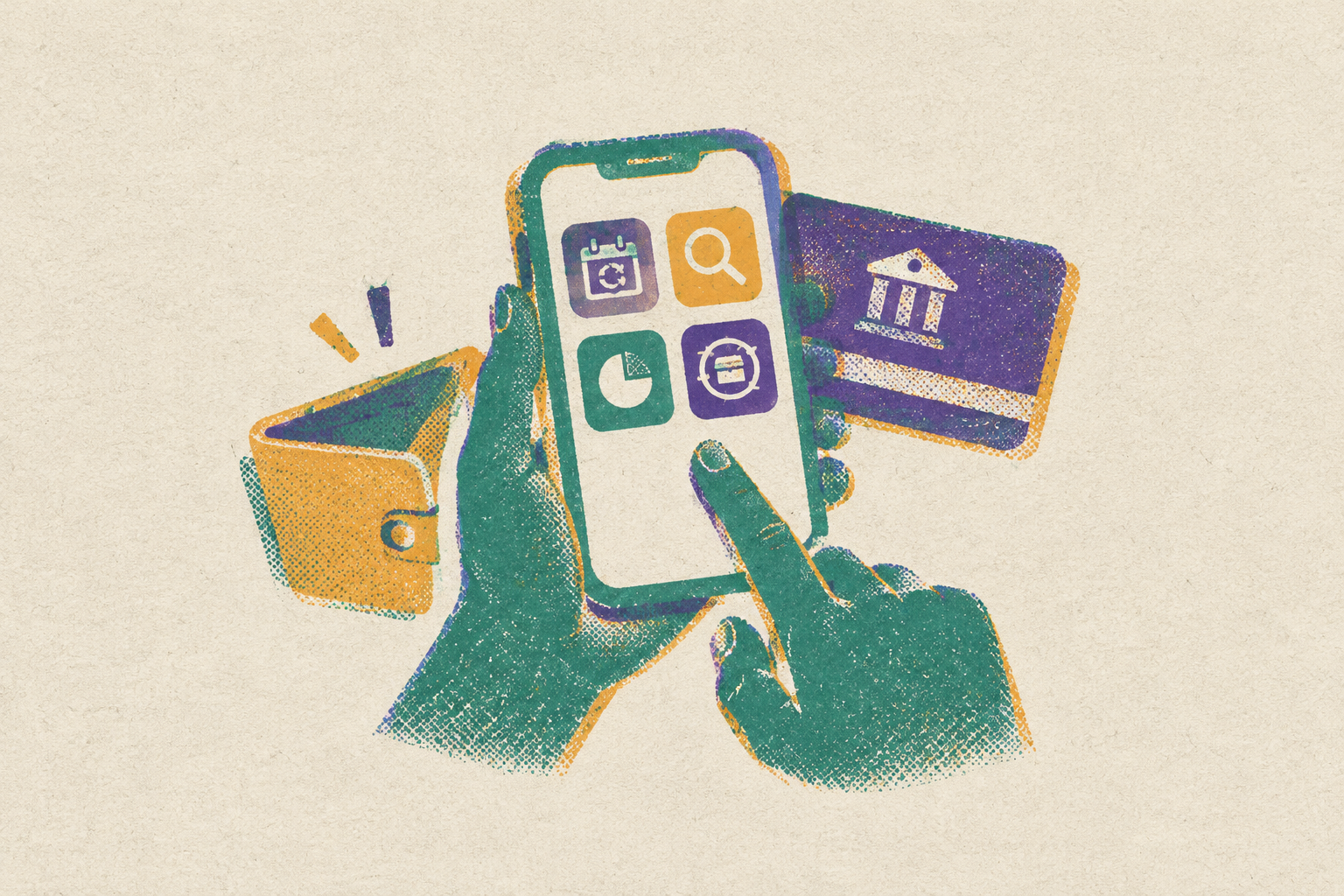
An app to cancel subscriptions cannot promise a complete list if it can read only part of your payment history. Bank-linked finders show recurring charges in the accounts they connect to, while receipt tools, manual trackers and statement imports help fill other gaps. Finding forgotten subscriptions takes enough history, records from all payment methods and ongoing monitoring, even when the list looks complete.
Why subscription finder apps produce an incomplete picture even when they work correctly
Small recurring charges are easy to miss one by one and hard to keep track of as a whole. Subscription finder apps offer to do that tracking, but their results depend on the records available to them. A correctly identified monthly payment says nothing about an annual renewal outside the scan. The missing charge stays off the list.
A finder can work correctly and still leave expensive commitments undiscovered because the evidence never reached it. For bank-linked detection, data depth determines how complete the result can be.
What "limited bank history" actually means for an app trying to find recurring charges
A bank-linked finder connects through an aggregator such as Plaid and scans transaction history for recurring payments. It looks for merchant names and amounts that repeat at daily, weekly, monthly or annual intervals. Repetition gives the app evidence of a continuing commitment. Without enough records, that evidence gets thin. A charge can be visible without its billing cycle being clear.
Plaid’s Transactions API reference says it can retrieve and refresh up to 24 months of historical transaction data, though that maximum is not guaranteed. An account must have the history to supply, and a recently opened card cannot provide records of payments made before it existed. For example, monthly billing by a streaming service to a card opened six months ago can produce repeated charges in the card’s transaction history over those months. An annual service whose next payment has not arrived leaves no charge for the app to find.
Thin history can also follow a card replacement, a bank switch or a scan whose records begin after a subscription started. These situations do not all erase the same information, but each can leave the finder without the relevant payment history. Annual billing exposes the problem most clearly because its interval stretches across a year. At least 12 months of clean history on the correct card is needed to assess that cycle, and a single annual charge still provides less evidence of repetition than several monthly payments. Access to older records is useful only if those records belong to the account that paid.
The categories of subscription most likely to stay hidden when history is shallow
Annual subscriptions are the clearest blind spot because they spend most of the year generating no bank activity. A shallow scan can cover months of normal spending without encountering the renewal at all. Silence is not proof that nothing is due. The cost remains outside the app’s view until the relevant charge enters its history, even though the commitment already exists. That makes annual billing a poor match for a finder working from a recently opened account.
Converted free trials create a different gap. A trial charges nothing before conversion, so there is no paid transaction for the bank-linked app to identify during that period. Once billing starts, the app can see the payment but may lack the context that it began as a trial. Finding the charge is not the same as identifying an unwanted conversion. A receipt or trial record can supply context that transaction history alone does not contain.
Records from before an increase may lead the app to identify the old amount, while the new amount may be missed or treated as a separate pattern. Price-hike alerts are a separate feature, so an app that finds recurring charges may still miss a price rise.
Payments through app stores and intermediaries add ambiguity to the record. The bank may label the underlying service as Apple, Google or PayPal. Repeated merchant names can then produce merged or unclear results, leaving the user with evidence of a recurring payment but not a clear account of what it buys. More months of the same ambiguous label do not necessarily resolve that identity.
How fragmented accounts compound the detection gap
History depth answers how far back an app can see. Account coverage answers where it can look at all. A streaming service on a credit card, a gym membership on a debit card and a news subscription billed through PayPal sit in separate payment records. A software license paid for with a card used only for work expenses leaves a record on yet another card. Connecting one account does not bring the others into view.
Fragmentation creates false confidence because the result can look complete. The app reports the subscriptions it found, but that list cannot reveal charges on a card it never read. An unconnected account has no transactions in the evidence, while an unidentified merchant has a record waiting to be sorted. The user may never see that spending unless they know to check beyond the connected account.
People who have switched banks, opened accounts or replaced lost or stolen cards face both problems at once. Their new accounts may have little history, while their older payments are on other accounts. Adding history from the new account alone will not necessarily recover the old account’s subscriptions. That is where methods that do not depend on a live bank connection can help, though each has limits of its own.
What alternative detection methods recover — and what they still miss
SubDupes builds its subscription list from billing receipts forwarded to a private address, without accessing the user’s inbox or bank. That lets a tool find services from receipts no matter which card paid. What the tool can find depends on whether a service sends a billing email and whether that email reaches the tool. Silent debits, bank-to-bank transfers and services that send no receipt remain outside its view.
A converted trial can also escape receipt detection if its billing email is never forwarded. The existence of an email somewhere in an inbox is not enough for a forwarding-based tool. For a forwarding-based tool, missing forwarded receipts create a data gap distinct from missing bank history. Receipt detection can recover the service identity or billing context that a bank record lacks, but only from the messages supplied.
Bobby and Subby use manual entry, require no bank connection and store data locally. Their coverage is exact in a narrower sense. They track what the user adds, which makes them useful for logging a new subscription at signup. They cannot independently uncover a service the user has already forgotten.
LowerMySubs accepts a CSV bank statement, with PDF as a secondary option, and scans it in the browser without a login. This avoids an aggregator connection but still depends on the payment history supplied. A short file still offers a short view, and a statement from one account still excludes other accounts. The trade-off is control over which records are supplied, with responsibility for their completeness resting on the user. None of these detection methods, by itself, establishes that every subscription has been found or that finding it also provides a way to cancel it.
The privacy cost of the bank-linked approach and how read-only access changes the calculation
An aggregator connection can pull the full transaction history, including salary, rent, medical co-pays and other purchases, because recurring-charge detection starts by examining the wider record. The app needs evidence before it can separate subscriptions from everything else. That creates a real privacy trade-off. The information shared is broader than the list the user wants back.
For major US banks, OAuth flows let users enter credentials directly on the bank’s own site rather than passing them through the aggregator’s systems. That separation makes the connection safer. Smaller banks, credit unions and community institutions may still use credential-based connections, so users do not get the same protection at every institution. The connection method belongs in the decision alongside the app’s advertised features.
Read-only access also needs a precise meaning. Banno’s integration page describes API-based tokenization that limits access to reading data. With credential-based connections, the API may not enforce that limit, leaving it up to the aggregator’s policy. Even when read-only access is enforced, a lot of information can still be collected. Security concerns how data is protected, while privacy also concerns how much is shared in the first place.
Persistent access adds a separate consideration because deleting an app does not automatically revoke its aggregator connection. A connection can stay active after the user has forgotten the app, letting it keep reading data after they have stopped using it. Connecting more accounts can help find more subscriptions, but it takes care to decide which accounts to share. The practical response is to understand the access being granted and explicitly revoke connections that are no longer used.
What a proactive, multi-signal approach catches that any single-method tool misses
Bank history can show that money left an account, a billing receipt can identify the service, and a signup record can preserve a trial conversion date. Together, those signals can tell more about a subscription than any one can on its own. They still need adequate coverage. Combining incomplete inputs can close gaps caused by relying on only one kind of evidence.
Time adds another requirement because a setup scan is a snapshot. A subscription that starts, converts or increases afterward will remain outside that snapshot until the records are refreshed. Ongoing monitoring checks what has changed since the last check. With the relevant signals available, a new paid charge can be connected to a trial, a changed amount can draw attention to an increase, and payments across accounts can expose duplicates.
The useful output is a finding that pairs a spending pattern with a specific dollar amount and a clear next action. That distinction is especially important when choosing an app to manage and cancel unwanted recurring charges. Discovery, change monitoring and help acting on a finding are separate criteria.
How do you stop paying for subscriptions you forgot about before the next charge?
List every card, bank account, PayPal account, digital wallet and App Store billing account that could fund a subscription, so the scope of the search does not depend on whichever account was easiest to connect.
Next, match the available history to the billing cycles. For each account connected to a bank-linked tool, check that the history goes back at least 13 months, and search your email yourself for annual billing receipts from newer accounts.
Then check for bank connections that have outlived their purpose. Plaid Portal lists many, but not necessarily all, connections made through Plaid, and access for apps no longer in use should be explicitly revoked even after deletion.
Finally, keep watching for future charges. Put trial conversion dates in a calendar at signup and set reminders well before annual renewals, so you can see what is coming before the next payment.