Automatic Subscription Renewal Disclosure Laws by State
State automatic renewal protections now replace a vacated federal rule.
Automatic subscription renewal disclosure laws determine what a company must tell you before it keeps charging you, when it must send reminders, and how easily it must let you cancel. With the federal subscription cancellation rule vacated in 2025, state law supplies most of the detailed protections. Your rights depend on where you live, and using them starts with knowing which duty a business failed to meet.
Why state automatic renewal laws now carry the full weight of subscription consumer protection
The Eighth Circuit vacated the federal subscription cancellation rule in its entirety on July 8, 2025, in Custom Communications, Inc. v. FTC. The rule would have imposed disclosure, consent, and easy-cancellation requirements on virtually every recurring-billing relationship in the US. The court’s reason was procedural. The FTC estimated that the rule’s annual economic impact would exceed $100 million but declined to prepare the preliminary regulatory analysis that estimate required.
The ruling did not erase the Restore Online Shoppers’ Confidence Act, or ROSCA, which Congress enacted in 2010. That law still says online negative-option offers must have clear terms, informed consent, and a simple way to cancel. But it does not supply the detailed reminders and same-medium cancellation duties the vacated rule would have imposed. State laws now provide most of those specific rights. Where you live is now the controlling variable.
How automatic renewal laws work and what the three core duties require
A “negative option” is an arrangement that keeps billing unless you take an active step to cancel. Silence lets the subscription continue, which makes the terms at sign-up especially important. Most automatic renewal laws build protection around three duties, namely clear disclosure, affirmative consent, and easy cancellation with advance notice. The details differ, but those duties provide a useful way to read any state’s rules.
Clear disclosure means the business has to show you the material terms before you agree to pay. Those terms include the product, charge amount, billing frequency, cancellation deadline, and cancellation method. Affirmative consent means you must actively agree to renewal, rather than have agreement inferred from a pre-checked box or buried language. Easy cancellation means a usable way out, often online if you enrolled online. Advance notice means a reminder must arrive before certain renewals or trial conversions, within the time the law allows.
Some states also require a post-sale acknowledgment stating the cancellation deadline and notice before material changes. A violation can be treated as an unfair or deceptive act under state consumer protection law. Depending on the state, consequences can include actual damages, statutory damages, attorney’s fees, or treble damages. State attorneys general can enforce these laws, and in some states consumers can also sue.
The 2025–2026 legislative wave that reshaped the state-law map
Arkansas’s first automatic renewal law, HB1820, took effect August 3, 2025, largely mirroring California’s updated approach. Massachusetts’s Final Regulations followed on September 2, 2025. New York’s omnibus bill S-3008, Part W, made its law stronger as of November 5, 2025. These changes added to what businesses must do when people enroll, renew, cancel, or face a price change.
The changes extend into 2026. Maine’s SP 650 took effect January 1, 2026, and Maryland’s first automatic renewal statute, Ch. 204, takes effect in June 2026. Connecticut adds an annual renewal reminder requirement in July 2026. New York City’s separate subscription cancellation rule takes effect October 1, 2026, barring mandatory reason surveys before cancellation.
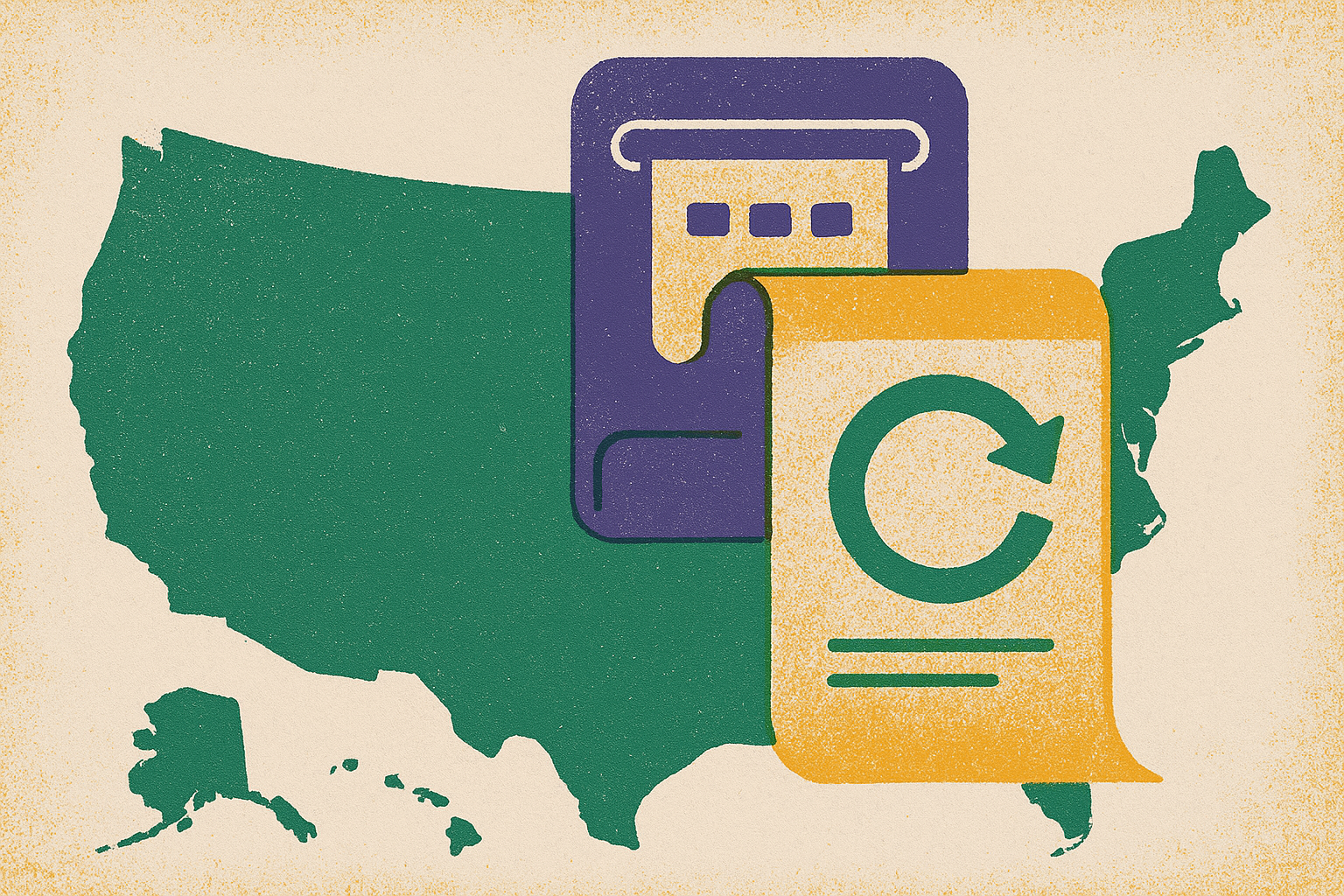
The 2026 state-law map shows that 25 states have automatic renewal laws. The direction is toward cancellation through the same medium used to enroll, advance price-change notice, and stronger remedies. An older description of a state’s rules may miss protections added during this concentrated legislative wave.
California’s automatic renewal law sets the national benchmark for consumer rights
California’s Automatic Renewal Law, Business and Professions Code §§ 17600 et seq., is one of the most detailed laws of its kind in the country. AB-2863 added provisions effective July 1, 2025. Businesses must clearly show the material terms near the place where you give consent, before you agree. They must obtain express affirmative consent before charging and retain proof of that consent. An implied agreement or pre-checked box does not meet that standard.
The law also requires reminders for annual renewals and notices before free or discounted trials lasting more than a month end. When people enroll online, they must be able to cancel entirely online through the same medium. The cancellation mechanism must be a single click. A business may offer a discount or retention benefit on that page, but it must also prominently display a button that immediately cancels.
These are duties owed to the subscriber. A failure can make an unauthorized charge an unfair or deceptive act, allowing the consumer to demand cancellation and a refund. The HelloFresh settlement discussed below illustrates how missing disclosures, consent, and cancellation access can become enforcement claims.
New York, Vermont, Oregon, and the other states with meaningful automatic renewal protections
New York’s General Business Law §§ 527 and 527-a requires clear terms near the consent request and cancellation as easy to use as sign-up, through the same medium. The business must show point-of-sale disclosures before it asks for billing information. Renewal notices apply to initial terms of a year or more that renew for six months or longer. Free gifts or trials lasting more than a month also trigger advance notices.
Vermont’s 9 V.S.A. § 2454a requires renewal terms in plain, unambiguous language and bold-face type. The contract must expressly state that it renews automatically, and advance renewal notice is required. Oregon’s ORS 646A.295 supplies a different remedy. If a merchant ships a product under an automatic renewal arrangement created without affirmative consent, the product is an “unconditional gift.” The consumer need not pay for it or return it.
Massachusetts requires clear disclosures, reminders, and same-medium cancellation, and has its own rules for point-of-sale disclosures and subscriptions with shorter terms. Colorado also requires an online cancellation path when enrollment was online. Maine requires separate consent to the renewal provision, rather than consent only to the subscription generally, and now covers health memberships. Its remedy can require a refund or credit of three times the unauthorized amount billed.
Maryland’s new law requires clear terms, reminders, and same-medium cancellation. Arkansas includes annual reminders, same-medium cancellation, and price-increase notice, while Connecticut’s new provision adds annual reminders. Illinois and Washington, DC, also have automatic renewal statutes with their own combinations of disclosure, consent, notice, and cancellation duties. These examples are not an exhaustive list of covered jurisdictions. The next distinction matters just as much, which is whether your state has no general automatic renewal law at all.
States with no automatic renewal law and what protections remain available to residents
Texas, Washington, Ohio, South Dakota, Rhode Island, and New Jersey have no general automatic renewal statute. People in these states have no specific state automatic renewal rules that require reminders, renewal disclosures, or ways to cancel. That is a meaningful gap. General consumer protection law is not a substitute for a specific notice deadline or an express right to cancel online.
Federal protections still apply. ROSCA governs online negative-option offers, and Section 5 of the FTC Act prohibits unfair or deceptive practices in commerce. Every state also has a general Unfair and Deceptive Acts and Practices statute that its attorney general can use against deceptive subscription billing. The FTC has brought roughly 50 ROSCA actions since 2010 and continues to use it after the vacatur.
Those tools are real, but their limits matter. These tools lack the rules in stronger state laws that set when renewal notices must arrive, what businesses must do when prices change, and how to offer same-medium cancellation. Residents can report conduct and seek regulatory enforcement without having those precise state rights to invoke directly. The ongoing Uber case shows that federal and multistate enforcement remains possible even without a dedicated state statute.
Price increases and the consumer’s right to a penalty-free exit
California requires businesses to give notice within a set window of business days before the price goes up. That notice must state the new price and explain how to cancel. The duty applies even if the original contract already said the price could rise.
New York gives businesses two routes when raising the price. They can obtain affirmative consent before charging the higher amount. Otherwise, they must allow penalty-free cancellation within at least 14 days after the first higher charge and provide a pro-rated refund for the remaining term.
These rules address “bill creep,” including expired promotional prices, renamed service tiers, and automatically enabled add-ons. When these changes raise the price, the business may have to give notice. Without the required notice or cancellation window, a charge may be unauthorized under an applicable state law. Consumers can dispute it with their card issuer and complain to the state attorney general. But the protection starts with noticing that the amount changed.
Enforcement cases that show what these laws mean in practice
HelloFresh paid a substantial sum in August 2025 to settle a lawsuit brought by two California district attorney’s offices. The lawsuit alleged that people were enrolled without proper disclosure or consent, were not given post-transaction acknowledgments, and had no easy way to cancel. Chegg’s September 2025 FTC settlement required millions in consumer redress. That case alleged failure to provide simple cancellation under ROSCA and Section 5 of the FTC Act, showing federal enforcement continuing after the rule’s vacatur.
Adobe settled a DOJ and FTC action on March 13, 2026, for $150 million. The case dealt with hidden Early Termination Fees and cancel buttons made hard to find on purpose. A substantial portion was allocated to consumer relief. Affected subscribers were potentially eligible for one to two months of free Creative Cloud or refunds of paid termination fees.
NordVPN faces a class-action complaint filed in June 2025 alleging obscured renewal terms and exceedingly difficult cancellation. The pending complaint invokes Illinois’s Automatic Contract Renewal Act and the Illinois Consumer Fraud Act. Uber also faces ongoing FTC litigation alleging that UberOne membership is too hard to cancel. The Commission added a civil penalty claim and 21 state co-plaintiffs. These pending allegations show private litigation and coordinated enforcement operating beside settlements.
How to invoke your state’s automatic renewal rights when a company resists
Start by preserving the enrollment record. Save the sign-up confirmation, checkout terms, acknowledgment emails, and any price-change notices. Then attempt cancellation through the stated mechanism and document the process. Screenshots of missing buttons, required surveys, or loops back to the subscription page can support the dispute.
Next, send a short written demand identifying the subscription, applicable law, unmet duty, and requested remedy. That remedy can be immediate cancellation and a refund of charges made after the failure. Save the email and use a read receipt to establish the demand date. If the business refuses or does not respond, dispute the charge with your card issuer under Regulation Z for credit or Regulation E for debit. Include the cancellation record and written demand as supporting evidence.
A complaint to the state attorney general is another available step. In states without a specific automatic renewal law, complaints can cite ROSCA and the FTC Act. FTC complaints also contribute to enforcement targeting. These routes require evidence, but first they require attention across subscriptions, notices, and accounts.
Compass is one option for that monitoring work, using an AI-powered financial watchdog to monitor email, bank accounts, and subscription services for possible breaches such as unannounced increases or charges after cancellation. It can surface specific changes and relevant details so the consumer has a concrete issue to act on.
What the continuing state-law trend means for consumers watching in 2026 and beyond
State legislators and attorneys general continue to treat subscription billing as an enforcement priority. Consumers in states without a general automatic renewal law have particular reason to watch their legislatures. Those with older laws may also see their protections strengthened.
The FTC’s advance notice of proposed rulemaking in early 2026 signals that a revised federal rule is possible. But a replacement would take years to finalize and would need to clear the procedural requirement that sank the last one. State law remains the operative framework for the foreseeable future.
Many consumers still cannot keep track of renewal dates, trial conversions, and small price increases across all their accounts. Automatic monitoring can help show what those changes are, so people have specific findings to act on as well as raw data. The rights are becoming stronger, but using them still begins with spotting the charge that should not have happened.
Sources
- Automatic Renewal Mid-Year Update: Legal Landscape Imposes Increasingly Complex Obligations on Subscription Businesses
- Evolving State Law Patchwork Imposes New Obligations on Subscription Businesses
- FTC and State AGs Continue To Scrutinize Subscription Practices Amidst a Possible Click-To-Cancel Rule Revival