Consumer Financial Protection Rules That Cover Low-Income Households
Federal and state laws still protect low-income households from subscription traps and hidden fees.
Consumer financial protection rules still cover low-income households despite the federal rollbacks since 2025. Surviving laws, state rules, and retailer promises offer different kinds of protection. Knowing which protection applies, what it guarantees, and how to claim it helps households recover money.
How the federal consumer protection floor shifted after 2025
Overdraft fees, subscription traps, and hidden charges fall hardest on households with the least room in their budgets. For those households, a lost protection can mean a charge that no longer has a clear remedy. But losing a rule is not always the same as losing the law behind it.
The Dodd-Frank Act set up the Consumer Financial Protection Bureau as an independent bureau within the Federal Reserve System. The Congressional Research Service describes how it brought together powers to regulate consumer finance that other agencies had held. After more than a decade as the primary federal enforcer of consumer financial law, the CFPB began operating under a deregulatory mandate in early 2025. The CFPB’s regulations page states that it withdrew 67 guidance documents, interpretive rules, advisory opinions, and policy statements in May 2025, with other rules separately rescinded or vacated.
The overdraft rule was a direct loss for households exposed to overdraft fees. Finalized in December 2024, it was repealed by Congress through the Congressional Review Act before taking effect. President Trump signed that repeal into law in May 2025. That reform is gone, but the repeal did not erase the wider body of consumer law.
The federal laws that were never touched and still carry legal force
The Restore Online Shoppers’ Confidence Act, known as ROSCA, is among the federal laws still in force. It requires online subscription and free-trial sellers to disclose material terms, obtain express informed consent, and provide a simple way to stop recurring charges. The FTC Act’s Section 5 also remains available to regulators. Its general ban on deceptive practices covers false representations about subscriptions, shipping dates, and fees.
The Truth in Lending Act and its implementing regulation, Regulation Z, remain in force. The CFPB and Federal Reserve announced updated 2026 thresholds for Regulation Z and the consumer leasing regulation, Regulation M. Consumer credit transactions and leases are covered if they fall below the threshold that applies, which is adjusted each year. Private education loans and mortgages are covered regardless of amount.
The Equal Credit Opportunity Act, or ECOA, also remains law. It still bans intentional credit discrimination after changes to Regulation B, the regulation that puts the law into effect. The CFPB narrowed that regulation in April and May 2026, including its approach to discrimination claims and small-business lending data.
What ROSCA actually guarantees about subscriptions and free trials — and where it stops
ROSCA gives consumers three guarantees for online negative-option offers, which include subscriptions that keep billing unless canceled. Sellers must spell out all material terms clearly before they collect billing information. They must get express informed consent before they make recurring charges. They must also provide a simple mechanism to stop those charges.
The FTC’s 2025 Amazon settlement totaled a multi-billion-dollar sum, with part going to civil penalties and part to refunds. The alleged hurdles to canceling included four pages, six clicks, and many options. The DOJ’s 2026 Adobe settlement produced a proposed order split between a civil penalty and free services to customers. Those actions show that enforcement did not depend on the stronger click-to-cancel rule surviving.
The U.S. Court of Appeals for the Eighth Circuit vacated that rule in July 2025 because the FTC failed to publish a required preliminary regulatory analysis. The FTC restarted rulemaking in March 2026, but no replacement was in force as of late 2026. ROSCA does not itself require cancellation through the same medium used to sign up, so a phone-cancellation requirement is not automatically unlawful. A consumer charged after believing they canceled may have grounds for a complaint if they can document a disclosure or consent failure, but that evidence takes effort to gather.
State cancellation laws that have filled part of the federal gap
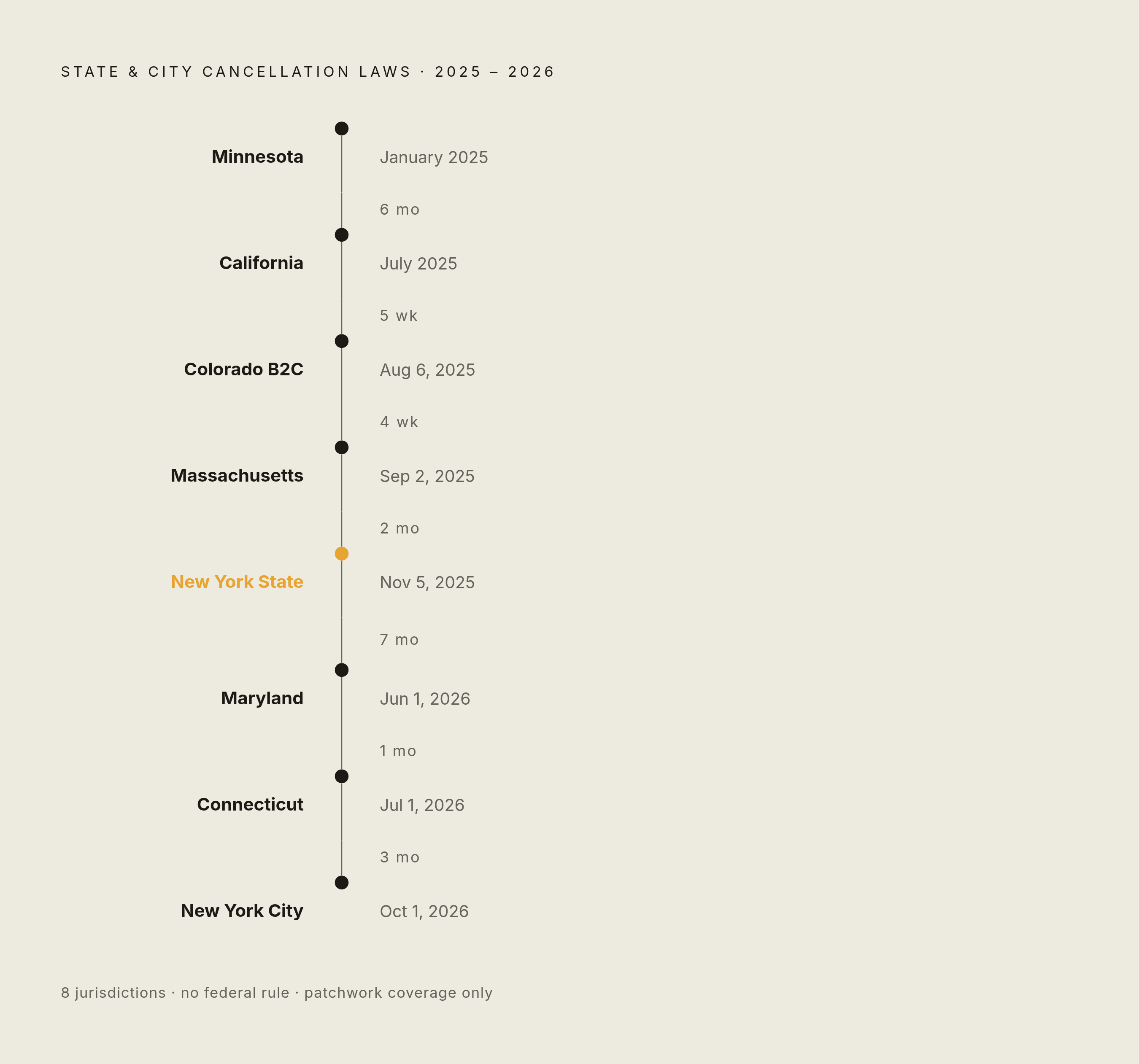
State laws have supplied some of the easier-cancellation protections missing from federal law. Their reach and enforcement differ, however, so they do not amount to one national guarantee. Minnesota’s cancellation law took effect in January 2025, followed by California’s in July 2025. Massachusetts followed on September 2, 2025. Colorado’s business-to-consumer provisions took effect on August 6, 2025, with a business-to-business expansion on February 16, 2026.
New York State’s law came into force on November 5, 2025. Maryland’s followed on June 1, 2026, and Connecticut’s on July 1, 2026. The New York City Department of Consumer and Worker Protection rule took effect on October 1, 2026. That city rule carries escalating penalties per violation, giving cancellation requirements a concrete enforcement consequence.
The difference matters when a merchant makes leaving harder than joining. A consumer covered by a stronger state or city rule may have a protection that ROSCA alone does not supply. Elsewhere, the federal fallback remains ROSCA and the FTC Act’s general authority. The Unsubscribe Act was reintroduced in Congress in 2026 in response to the court setback, but it has not become law.
Price-drop rights after purchase: what retailers guarantee and what they don't
A lower price after purchase does not create a federal right to get the difference back. Recovery depends on the retailer’s policy and its deadline. Target allows price adjustments for 14 days after purchase, while Costco allows them for 30 days. Home Depot typically allows them within 30 days. Best Buy has a shorter window for most products, with longer windows for My Best Buy Plus and Total members.
Walmart has no policy for price adjustments after a purchase. Its in-store match to a Walmart.com price is available at checkout only. Amazon, where low-income households do most of their online shopping, has no formal price protection for regular in-stock purchases. A customer-service refund after a price drop is a discretionary courtesy.
Amazon’s price-guarantee message for pre-ordered items offers a narrow exception. Qualifying items displaying that message on the product detail page receive the lowest price offered between order placement and the end of release day. For eligible regular purchases, the most reliable route is instead to return the item within the standard return window and repurchase it at the lower price. But shipping costs, scheduling limits, or a lack of nearby alternatives can make that route impractical. A lower advertised price is therefore not the same as money a household can easily recover.
Late delivery credits and shipping guarantees: legitimate consumer rights that go unclaimed
Retailer shipping guarantees can provide a legitimate basis for a claim, but they vary by merchant. The FTC Act’s Section 5 covers false representations about shipping dates. It does not create a federal requirement for automatic credits whenever a delivery is late.
Instead, the consumer must know the guarantee, compare the promised delivery date with the actual date, and contact customer service. The guarantee is not triggered automatically. Someone who does not know to ask receives nothing through that process. Navigating customer service adds another hurdle for households short on time or digital fluency.
This puts shipping credits in the same practical category as price-adjustment windows and free-trial deadlines. A benefit may be available only if someone notices the problem and acts in time. Its value on paper can be clear while its value to a busy household remains unrealized. The missing step is often not a legal protection but a successful claim.
The open-banking rule's paralysis and what it means for free financial tools
Access to financial data affects the cost of providing free budgeting and monitoring tools. Under the CFPB’s October 2024 Section 1033 rule, banks and financial service providers had to share account data securely and reliably with consumers and authorized third parties when asked. Compliance dates were staggered from April 2026 through April 2030 by institution size. But the rule is blocked, leaving that framework unsettled.
The CFPB sent a new Section 1033 proposal to the Office of Information and Regulatory Affairs on August 4, 2026. That review comes before publication, so the revised proposal was not yet available for public comment at that point. A central affordability question is whether banks will be allowed to charge per-access fees. Such fees would fall on the aggregators and fintechs behind free tools, with small charges multiplied across billions of data requests.
Data sharing still operates through private bank-aggregator agreements and the FDX standard that predate the rule. But whether tools can stay free remains unclear without a federal ban on fees that can be enforced. The CFPB’s rule text also acknowledged that account holders typically authorize read-only access. That means permission limited to viewing data, which is the access monitoring tools use.
The ECOA changes and what remains of fair-credit protections for low-income borrowers
For borrowers, the key point is that intentional credit discrimination remains illegal. ECOA still prohibits explicitly refusing credit based on race, color, religion, national origin, sex, marital status, or age. A lender cannot state or document that discriminatory intent without violating the statute. Congress has not removed that protection.
The CFPB’s April 2026 Regulation B rule removed disparate-impact liability and narrowed Special Purpose Credit Program eligibility. Its May 2026 rule narrowed small-business lending data collection. The CFPB’s Fair Lending Report for 2025 states that enforcement now focuses on “proven, intentional racial discrimination with actual identifiable victims”. The agency has stopped using disparate impact in supervision and enforcement.
For a denied applicant, this means a pattern linked to protected characteristics is harder to challenge without evidence of discriminatory intent. That is a narrower route than before 2025, even though the core prohibition survives. The distinction is between proving intentional discrimination and showing unequal effects. Low-income borrowers retain the first protection, but the changed enforcement approach makes the second route harder.
How subscription sprawl and bill creep drain low-income households despite legal protections
The surviving protections share a practical weakness. Consumers generally have to notice a charge, recognize a possible violation or available benefit, and act. Modern subscription billing makes that hard by spreading changes across services and billing periods. A household can have enforceable rights and still miss the moment when those rights could save money.
Bill creep is a pricing mechanism. Promotional prices end, regulatory recovery fees go up, service tiers get new names, and add-ons are turned on automatically. Each change may seem too small to pay attention to. But over several services and many months, those increases add up to a sizable loss over the year.
A bundle of five major streaming services cost substantially more by 2026 than in 2020, with increases far outpacing cumulative US inflation over that period. But those increases arrived incrementally. Spotting recoverable charges among ordinary price changes takes sustained attention.
For low-income households, that attention competes with every other demand on limited time. Recovering money depends on constant vigilance in this system. Legal coverage alone cannot close that gap.
How to actually claim the protections that still exist — and where automated monitoring helps
Consumers charged after a free trial without clear prior disclosure, or charged after cancellation, can complain to the FTC and their state attorney general. For a ROSCA complaint, documenting the disclosure, consent, or cancellation failure matters. The enforcement record involving Amazon, Adobe, and Chegg shows that complaints can contribute to real outcomes.
State law can strengthen that claim or change what a merchant must offer during cancellation. Consumers in California, New York, Minnesota, Massachusetts, Colorado, Maryland, Connecticut, Virginia, and New York City have stronger cancellation rights than federal law provides. For price drops, the relevant action is a request within the retailer’s adjustment window, where a policy exists.
For late deliveries, the claim requires checking the retailer’s guarantee and comparing the actual delivery date with the promised date before contacting customer service. Automated monitoring can help consumers notice charges and potential claims, but it does not expand a retailer’s policy or replace a complaint. Read-only tools fit this role because they can surface potential savings without authority to move money. The Section 1033 right to data is still part of Dodd-Frank while the rule that puts it into effect is being rewritten.
The practical goal is to connect a noticed problem with the right claim before the opportunity passes. Meaningful protections remain, but their value depends on knowing exactly where they apply and taking the action each one requires.
Sources
- Regulations and policy
- 1 BILLING CODE: 4810-AM-P CONSUMER FINANCIAL PROTECTION BUREAU
- CONSUMER FINANCIAL PROTECTION BUREAU
- Introduction to Financial Services: The Consumer Financial Protection Bureau (CFPB)
- Agencies Announce Dollar Thresholds for Applicability of Truth in Lending and Consumer Leasing Rules for Consumer Credit and Lease Transactions
- CFPB’s Final Rule Recalibrates Fair Lending Enforcement: A Return to Clarity and Core Statutory Principles