Free vs Paid Subscription Trackers When You Can Barely Cover What You Are Already Tracking
Bank-linked trackers beat free ones when subscriptions hide across forgotten accounts.
Free subscription trackers are enough when you know what you pay for and need reminders. Bank-linked trackers are the better fit when you suspect forgotten charges, because they read transactions. When money is tight, a paid tracker is worth buying only if it finds savings or removes cancellation barriers worth more than its fee.
Why people with tight budgets are the most likely to have subscriptions they cannot name
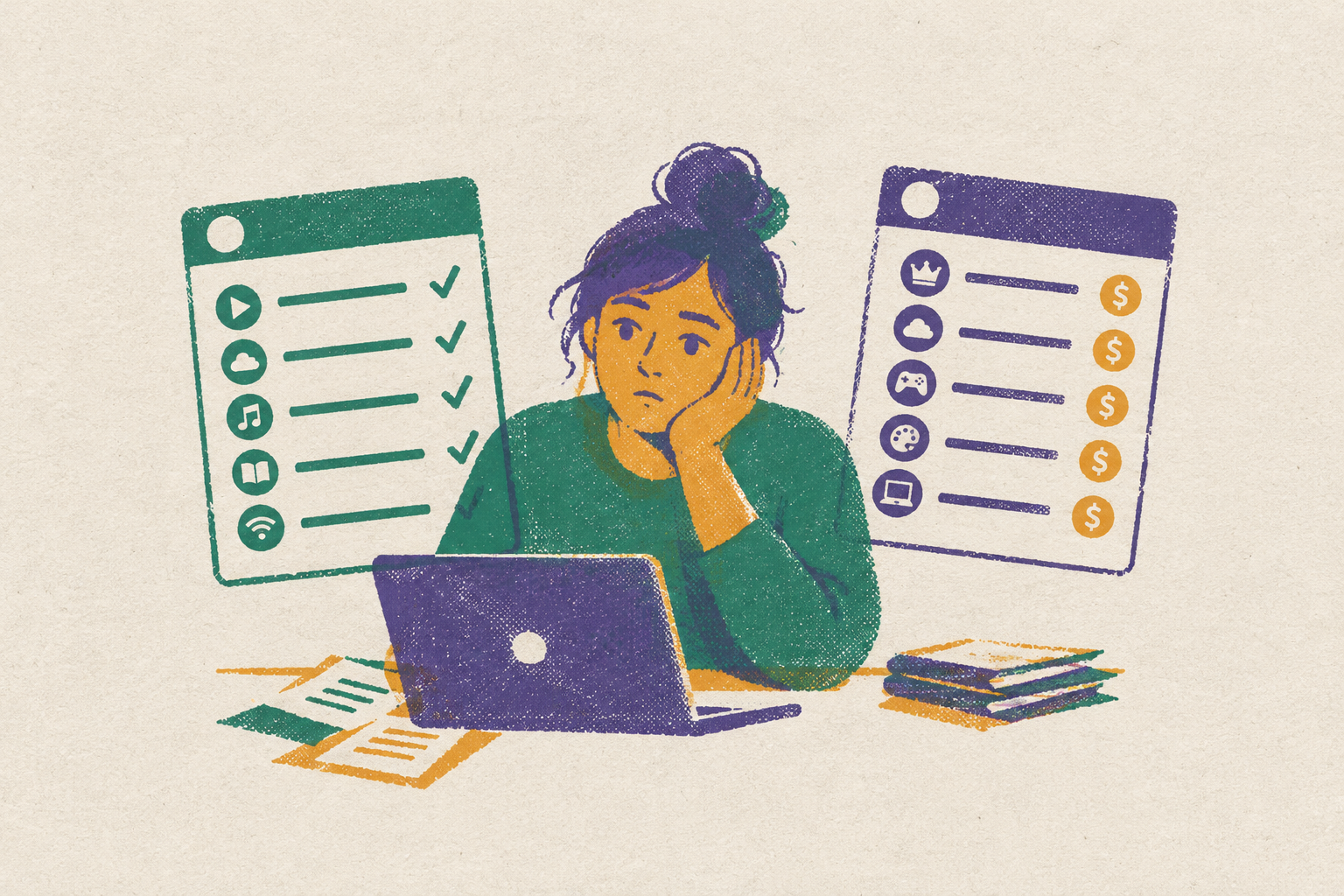
The subscriptions you remember are not necessarily the subscriptions you pay for. Automatic payments make that gap easy to miss. A charge can keep leaving an account long after the service has dropped out of your daily life, without asking you to make another spending decision. The list you could write from memory may therefore be much shorter than the one a full bank-and-card audit would produce.
That is not simply a story about careless spending. Charges accumulate across cards and accounts over time, often without a single moment when everything gets reviewed together. Budget pressure makes those scattered payments harder to absorb, but it does not make them easier to name. Self Financial’s 2026 survey found that most users have at least one subscription going entirely unused each month. For lower-income households, the combined cost takes a meaningful share of pre-tax income.
This makes the buying decision genuinely awkward. The person who most needs help finding wasted payments may have the least room to pay for that help. A useful comparison must therefore start with what a tracker can uncover.
How a tracker actually finds subscriptions, and why the method determines what it can and cannot surface
Every tracker starts with the same question. Where does its subscription list come from? The main methods are bank-linked transaction scanning, manual entry and email receipts. Each draws from a different source, so each has a different limit on what it can find.
A bank-linked tracker connects to bank and card accounts through an aggregator and reads recurring charges. It can surface a subscription you have completely forgotten because the payment, rather than your memory, supplies the evidence. Its reach still depends on the accounts connected. It cannot offer a complete picture of scattered spending from only part of that spending history.
Manual entry works in the opposite direction. You supply the subscription, amount and renewal date, which keeps the process private but makes completeness your responsibility. Email-based tracking has a separate boundary, because a charge that generated no receipt has no receipt to find.
That distinction comes before the price tag. A free bank-linked tool can uncover forgotten charges that a paid manual tool cannot, while paying for manual entry gives it no discovery power beyond a free spreadsheet. For someone who suspects missing subscriptions, the data method is the first filter.
What free trackers actually deliver, and where each method stops
Free manual trackers can do a perfectly good job. If you already know every subscription, a tidy list and renewal reminders may be all you need. Wallos is a free self-hosted option for people running their own server.
Manual tracking requires upkeep: someone must enter each plan, keep the price current and remove canceled services. A subscription you have forgotten will not appear just because the list is neatly organized. Free manual tracking serves a known inventory well, but it does not establish that the inventory is complete.
Email-based tracking can help assemble a list from receipts. Its usefulness depends on those receipts existing, so a forgotten subscription with no email receipt remains outside its reach. That is a coverage gap. It is enough for some situations and inadequate for others.
Apple’s free subscription list shows App Store-billed plans and lets users cancel them in Settings. It is useful within that boundary, but it is not a full audit of bank and card spending. The free built-in list from Apple or another platform can establish a baseline before a paid tool is considered.
What paid trackers add, and the specific cases where the addition earns its cost
The strongest reason to pay is discovery you would otherwise miss. A bank-linked tracker can find a recurring charge on a card you rarely check. That can justify a fee when subscriptions are scattered across accounts. It does not justify one when a free tool already gives you the coverage you need.
Copilot Money’s official help article says recurring detection uses past transaction patterns and requires “at least one previous transaction”. A free trial with no charge yet cannot appear automatically through that method.
Other paid features solve narrower problems. Emma’s official help page places data export on Emma Pro and Emma Ultimate. Export access may be useful, but it is not the same benefit as discovering an unwanted charge. Whether that addition solves your problem matters more than whether it makes the paid plan look more complete.
Cancellation help deserves its own price test. Most subscriptions allow self-service cancellation, so assistance earns its cost when it gets you through a difficult exit you would otherwise abandon. Bill negotiation is a separate service again, with results that vary by provider and region. Neither feature should be counted as savings merely because it appears on a pricing page.
Pricing traps inside the tracker market itself
A tracker can reproduce the problem it promises to solve. A plan described as free may actually be a 14- or 30-day trial that converts into another recurring charge. For someone with little spare cash, the distinction belongs in the buying decision.
The pricing structure is also a warning signal. Subscription trackers that charge by the week are best skipped. A tool intended to make recurring costs easier to control should not be assessed only by how small its first payment looks. Its own continuing charge belongs in the same budget as the services it tracks.
Privacy labels deserve similar attention before payment. MonoBoost’s App Store listing declares contact information under “Data Used to Track You”. A label that says the app tracks users is a reason to look elsewhere unless the app does something no other app does. That is a separate issue from whether the tracker finds subscriptions accurately, but a low price does not make it irrelevant.
These checks narrow the comparison to the real offer. A permanent free tier, a converting trial and a paid plan are different commitments, even if each starts with a download that costs nothing.
The financial data access question for anyone connecting accounts
Read-only access restricts what a token can do: it cannot initiate transfers or payments. If that token is exposed in a breach, it cannot be used to move money through the connection. Someone could see sensitive financial data, though they could not use that access to make payments.
The amount of visible data can be broader than expected. Plaid may pull up to 24 months of transaction history when an account is connected, even if the app needs only a current balance. The app sees what it requested, while Plaid retains what it pulled.
For a product built purely to display and analyze subscriptions, read-only access should be enough. It has no legitimate need for write access, payment scope or more than a few months of transaction history.
A Plaid connection stays active until it is explicitly revoked, so an app used briefly in 2022 may still have read access in 2026. When the tool is no longer needed, the connection must be revoked even if the app has been uninstalled.
How bill creep and price increases make even a known subscription list go stale
A complete list is only complete at a moment in time. Existing services can raise prices without a notification that reliably catches your attention. A manual tracker then keeps displaying the amount you entered, which may differ from the amount leaving your account. Nothing new has to be added for its total to become wrong.
Spotify’s US individual plan is documented at $11.99/month. Someone whose tracker still has the old price will see the wrong spending total even if they remember the subscription perfectly. Discovery finds missing services, while ongoing monitoring catches changes to services already on the list.
Trial conversions create a similar gap between the recorded plan and the actual payment. The streaming trial that becomes paid, the fitness app that auto-renews and the news subscription that raises its price all increase spending without feeling like new purchases. Without a price-change alert from the tool, those changes can pass without notice.
Manual users must keep amounts current themselves, while anyone choosing automated monitoring needs to distinguish transaction discovery from change alerts. Finding the service once does not establish what it will keep costing.
Cancellation friction, and how the tool you pick affects whether you actually stop paying
Finding an unwanted subscription does not stop its next charge. The exit is a separate task, and providers can build enough friction into it that the payment continues despite the user’s decision to leave.
Apple’s list provides self-service cancellation in Settings for App Store-billed plans, but that route does not cover subscriptions billed elsewhere. Manual-only trackers provide no cancellation help. Their users must navigate each provider’s process independently.
Paid cancellation assistance can close that gap when the process would otherwise defeat the user. Its value is not the existence of a concierge feature but whether it turns an intended cancellation into a completed one. If you can easily cancel the service yourself, paying someone else to do it adds little.
AI-mediated cancellation offers a different mechanism from a human concierge. An agent can interact directly with account management APIs or remove cognitive barriers step by step, reducing the effect of friction in the provider’s process. That operates at a different scale, but the financial test stays concrete. The useful outcome is a stopped payment.
Which subscription tracker is right for your situation?
The right tier depends on forgotten subscriptions and the upkeep you can maintain. A free manual or email-based tool is adequate when you can name every active service, the charges sit on a single account you review regularly, and you mainly want reminders. In that situation, paying for discovery solves a problem you do not have. The list still needs to be kept up to date.
A bank-linked tool can help more when you think there are charges you cannot name across several accounts or cards. It is also a stronger fit when you have not done a full audit recently and the list you would type is probably incomplete. If connecting accounts is unacceptable to you, that choice rules out transaction-based discovery. Paying for a manual tool does not remove the resulting coverage gap.
The break-even test is then specific. Savings found in the first month should exceed the tool’s monthly cost, and cancellation help should count only when it removes a barrier you would not otherwise get through.
The final distinction is between information and action. A tracker that identifies a forgotten charge has done half the job. A tool that quantifies the cost and gives you a clear next step helps turn that information into a decision. When money is tight, the best tracker is not the one that displays the most features, but the one whose findings you can use to stop spending.