How Employer-Sponsored Benefits Exclude Part-Time Workers
Conflicting federal definitions of full-time work let employers exclude part-timers from benefits.
A worker might be full-time under one federal rule and part-time under another, and that contradiction is built into how the law works. It is baked into how the law works.
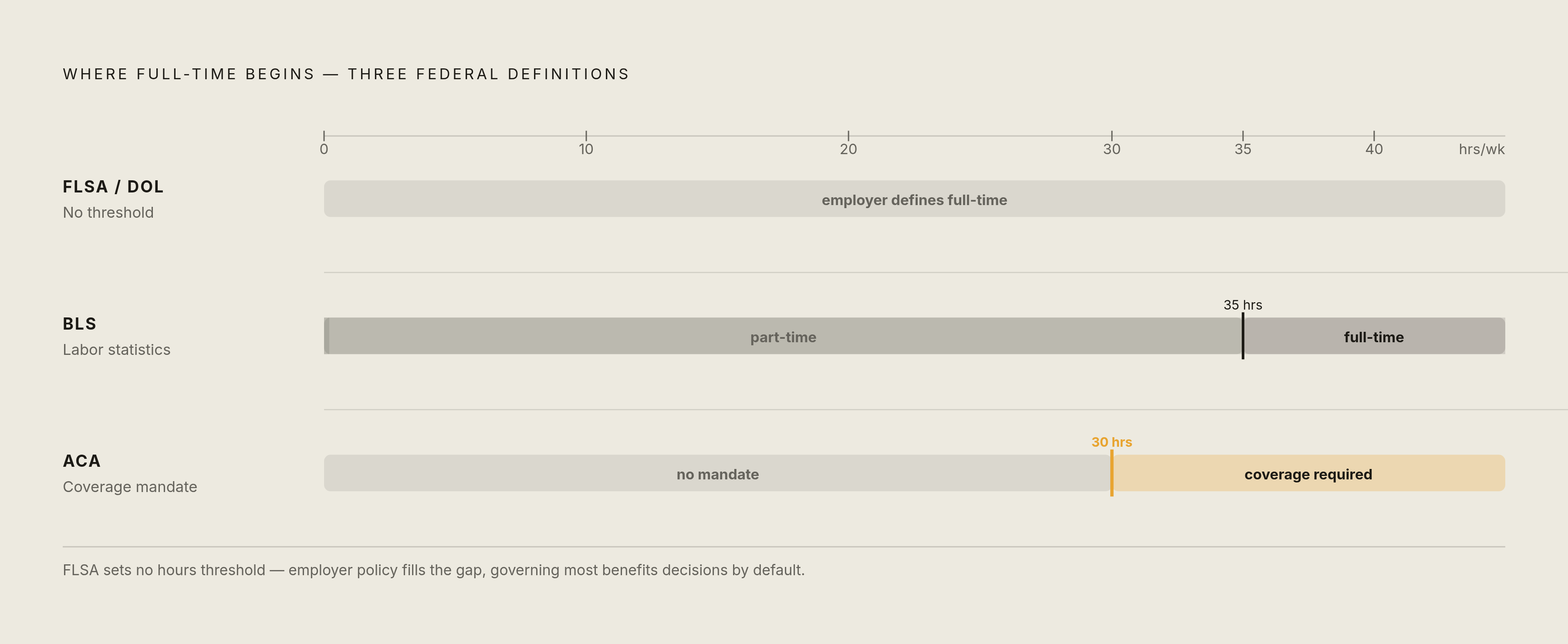
The FLSA sets no hour threshold for full-time or part-time status at all, leaving classification to employer discretion. Zero. The FLSA leaves that call entirely to the employer. Meanwhile, the Bureau of Labor Statistics uses its own yardstick for tracking the labor market: anyone working fewer hours than a standard full-time week gets counted as part-time in its statistics. The ACA uses 30 hours per week as the threshold that triggers employer coverage obligations, a different number, serving a different legal purpose.
None of these three numbers talk to each other. And because federal law refuses to settle on one definition, employers fill the vacuum themselves. Most employers internally define part-time as under a threshold somewhere in the thirty-to-thirty-five-hour range, but some set the cutoff lower, and that internal definition, not federal law, controls most benefits eligibility decisions, so the practical result is three overlapping definitional frameworks (DOL/FLSA, BLS, ACA) that draw the line at different places, with employers navigating between them to minimize obligations. A worker can feel full-time, work what most people would call a full-time schedule, and still fall on the wrong side of a boundary a company set to its own advantage.
What the ACA mandate requires
The ACA's employer mandate is the most consequential single rule shaping part-time benefits access, and it was written to exclude workers below its hours threshold from its protections.
The mandate functions as follows: companies classified as Applicable Large Employers, meaning those with 50 or more full-time equivalent employees, have to offer minimum essential coverage to at least 95% of their full-time staff or pay IRS penalties. "Full-time" in this context means averaging 30 or more hours a week, or an equivalent monthly calculation. Anyone under that line sits outside the mandate completely.
It also matters who enforces this. The IRS runs the mandate, not the Department of Labor, which tells you what kind of rule this actually is: a tax compliance mechanism, built to collect penalties from noncompliant employers, not a worker protection statute designed to guarantee coverage. And within companies that are subject to the mandate, the 30-hour line is a cliff, not a gradient, so a part-timer working just under the weekly threshold owes the employer nothing. None of this is a loophole being exploited. It's the statute working precisely as written.
Retirement exclusion runs just as deep, and the fix is partial
Health coverage isn't the only benefit part-time workers get locked out of. Retirement savings follow nearly the same pattern of exclusion, and while a recent law cracked the door open, the crack is narrower than it looks.
Start with the baseline: 401(k) plans are voluntary. ERISA never required any employer to offer one, to anyone, and these plans were built decades ago around a workforce that stayed full-time and stayed put for years. Even when a company does offer a 401(k), ERISA lets it set a minimum annual hours threshold for eligibility, and workers who don't clear that bar can be shut out entirely.
The original SECURE Act chipped at that wall. The SECURE Act created a secondary pathway: long-term part-time employees working 500 or more hours per year for three consecutive years must be offered elective deferral rights. SECURE 2.0 shortened that waiting period to two consecutive years, with the change fully in effect as of 2025, opening the door to more part-time workers who want to put their own money into a retirement account.
That's real progress, and it deserves to be treated as such. But the limit matters just as much as the gain: employers still owe these workers nothing in matching or additional contributions. Part-timers get access to the tax-advantaged account. They don't get the employer subsidy that actually builds wealth over time, the free money that makes a 401(k) worth having in the first place. On April 30, 2026, the White House issued an executive order to expand access to retirement savings accounts for workers without employer-sponsored plans, acknowledging the scale of the gap that remains even after SECURE 2.0. And the cost compounds over a career: MacroMonitor data shows gig workers expect to retire, on average, three years later than full-time employees, a plain measure of what years of exclusion from retirement benefits actually costs someone.
The exclusion lands on a specific, predictable population
None of this falls evenly across the workforce. Bureau of Labor Statistics data from March 2025 showed that nearly three-quarters of civilian workers had access to health benefits through their jobs, but that access clustered heavily in management and professional occupations, leaving service workers far behind.
Service and retail jobs carry the heaviest concentration of part-time schedules, and workers in those roles face exclusion from benefits at something close to double the rate of white-collar employees. Low-income workers, younger workers, women, part-timers, and non-citizens all show up less likely to qualify for employer-sponsored insurance. The NWLC found that close to half of employees who work part time involuntarily, who would take full-time hours if offered, are women, as of 2024 data. Involuntary part-time work itself is not evenly distributed by gender, and neither is the benefits gap that follows from it.
Scale matters here too. Tens of millions of Americans work part-time jobs, which makes this exclusion a structural feature of how the labor market runs, not some marginal case affecting a handful of workers. And even at companies that do offer health benefits to part-timers on paper, a meaningful share of those workers still don't qualify to enroll. An employer offering a benefit and a worker actually being eligible for it are two separate facts, and the gap between them is where a lot of part-timers fall through.
Employers have real financial reasons to keep the line where it is
This system persists because keeping part-timers below the benefits line saves money, and the savings are large enough to shape scheduling decisions across entire industries.
The ACA's cliff structure at 30 hours creates a specific incentive to schedule workers just below that threshold, since staying under it eliminates the coverage obligation entirely. It's a scheduling decision with a clear payoff, repeated across thousands of shift assignments in retail, food service, and hospitality every week. Independent contractor and gig classification pushes the exclusion further still, since treating a worker as a non-employee eliminates benefits obligations altogether, creating a second tier of exclusion below the part-time/full-time line itself.
Company size stratifies the picture too. Employers below the ACA's size threshold face no mandate whatsoever, and plenty of them choose not to offer health benefits to any worker, full-time or not. The whole architecture traces back to a benefits system built in the 1980s around a stable, long-tenured, mostly full-time workforce. Labor markets have since filled up with flexible, contingent, and gig arrangements that the original design never anticipated, and the gap between how the system assumes work happens and how work actually happens today keeps widening. None of this requires bad intent from any single employer. It requires only that the rules reward a particular kind of scheduling, and employers, operating rationally within those rules, follow the incentive.
A handful of employers chose differently
Some companies have extended real health coverage to part-time staff anyway, and their example proves the exclusion is a choice rather than an operational necessity, even if it also shows the limits of choice alone.
Lowe's, Chipotle, REI, Staples, and JPMorgan Chase are among the employers identified as offering medical coverage to part-time workers, and this pattern appears most in retail and financial services. The logic behind it is a retention bet: part-time workers with benefits stay longer, and the savings from lower turnover can match or exceed what the benefit itself costs. Paychex has framed the shift directly, noting that benefits were once treated as an exclusive perk for full-time staff, but that some small businesses now see a part-time benefits package as a way to attract talent. That word "some" is doing real work in that sentence. Voluntary adoption remains the exception.
And the exception clusters in a specific place. It appears mostly among employers with the margins to absorb the added cost, larger firms and established retailers with steady revenue. Low-margin service businesses, small operators, and seasonal employers are the least likely to follow voluntarily, and those are precisely the employers where the most excluded workers, the ones in service and retail roles, tend to work. The voluntary path exists, but it doesn't reliably reach the population that needs it most.
Portable benefits are gaining ground, and drawing real opposition
The most active policy response to this gap right now is the portable benefits model, and it's drawing genuine, substantive pushback, not just procedural objection.
The idea is straightforward: a company contributes to a benefits fund attached to the worker, not the job, so an independent contractor or part-timer can build up coverage across multiple employers instead of losing everything each time they switch gigs. DoorDash ran a pilot in Pennsylvania testing exactly this, contributing substantial benefit payments to independent delivery workers. A large majority of previously uncovered workers gained new access to portable benefits through it, most reported feeling more financially secure, and an even larger share said they'd feel more secure still if the arrangement became permanent.
State legislatures have moved fast. In June 2025, both chambers of the Wisconsin legislature passed portable benefits legislation championed by State Senator Julian Bradley and Representative Alex Dallman, with support that crossed into union households. Governor Tony Evers vetoed it anyway, arguing it locked drivers into independent contractor status without guaranteeing any benefits in return. Alabama and Tennessee both passed similar laws in April 2025, following Utah's 2023 law, each removing legal barriers that had kept companies from offering benefits to independent workers.
The objection deserves its own weight. DoorDash, Instacart (legally Maplebear Inc.), and Uber all lobbied directly for the Wisconsin bill, a fact that sharpens the argument that these frameworks serve platform interests as much as worker interests. Jeff Worthington, president of Utah's AFL-CIO, has said he doubts these laws will actually push businesses to contribute anything meaningful, calling them a legal permission structure without enforcement teeth. Bernie Sanders made the sharpest version of this case during a Senate hearing on portable benefits, arguing the legislation would make it easier for large corporations to misclassify workers as contractors specifically to dodge decent wages and benefits, and that universal healthcare or defined-benefit pensions would serve workers far better. Portable benefits let an employer exit the full-time employment relationship while looking like it built a safety net, without ever locking in how much it has to contribute or how good the benefit actually has to be.
The fallback options are narrowing, not expanding
While states experiment with portable benefits, federal policy is moving in the opposite direction, shrinking the backup options part-timers have relied on when a job offers nothing.
Consider what happened with contractor classification rules. A 2024 Department of Labor rule made it harder for gig platforms to classify workers as independent contractors, opening a path for some workers to get reclassified as employees eligible for benefits. In 2025, the DOL under the Trump administration announced it would stop enforcing that rule, reverting instead to a 2008 standard that favors platforms.
The public safety net is tightening too. KFF projects that changes to Medicaid and the Affordable Care Act in the Republican tax and spending package will leave 10 million more people uninsured by 2034, a program that has served as the last resort for part-timers with no coverage through work. Enhanced premium tax credits that have reduced ACA Marketplace costs are scheduled to expire at the end of 2025; if not extended, millions more are projected to lose coverage, a second compressing force on part-timer options. Some states are weighing portable benefits laws as a partial counterweight to this federal retreat, but a state-by-state patchwork means protection depends heavily on where a worker happens to live. Put together, the population already most locked out of employer-sponsored benefits is watching both its employment-based options and its public fallback options shrink at the same time.
What a part-time worker can do right now
Understanding this system doesn't erase it, but it does reveal specific rights that already exist and go unused simply because no one flags them.
SECURE 2.0 is the clearest example. Any worker who has logged 500 or more hours a year for two consecutive years at the same employer now has a legal right to demand access to elective deferrals in that employer's 401(k). An employer cannot grant or withhold this at its discretion. It's a right written into federal law, and plenty of workers who qualify never ask, simply because they don't know the two-year, 500-hour threshold exists. The retirement exclusion for part-time workers has been nearly as absolute as the health coverage exclusion, and while SECURE 2.0 opened a narrow door, it left the most important threshold untouched. C|It won't fix the ACA's 30-hour threshold for employer coverage obligations, and it won't produce an employer match. But it converts a right that exists on paper into money actually going into an account, which, given how little else the system currently offers this group of workers, counts as real ground gained.
Sources
- Offering Benefits To Part-Time Employees | Paychex
- Full-Time vs Part-Time Employee Benefits: What Employers Need to Know - SBMA Benefits
- Part-Time Workers Have Less Access to Employer-Based Coverage Than Full-Time Workers | KFF
- How employers support lower-waged workers' access to health insurance options - Peterson-KFF Health System Tracker
- Employee Benefits in the United States, March 2025 : U.S. Bureau of Labor Statistics
- Employer shared responsibility provisions | Internal Revenue Service
- SECURE Act 2.0: Incentives for Retirement Plans | Paychex
- Health Insurance Coverage for Part-Time Versus Full-Time Workers | The Regulatory Review