How AI Catches the Quiet $8 Double-Charge Your Bank Statement Buries
Pattern-learning AI spots duplicate charges that exact-match rules and monthly statements miss.
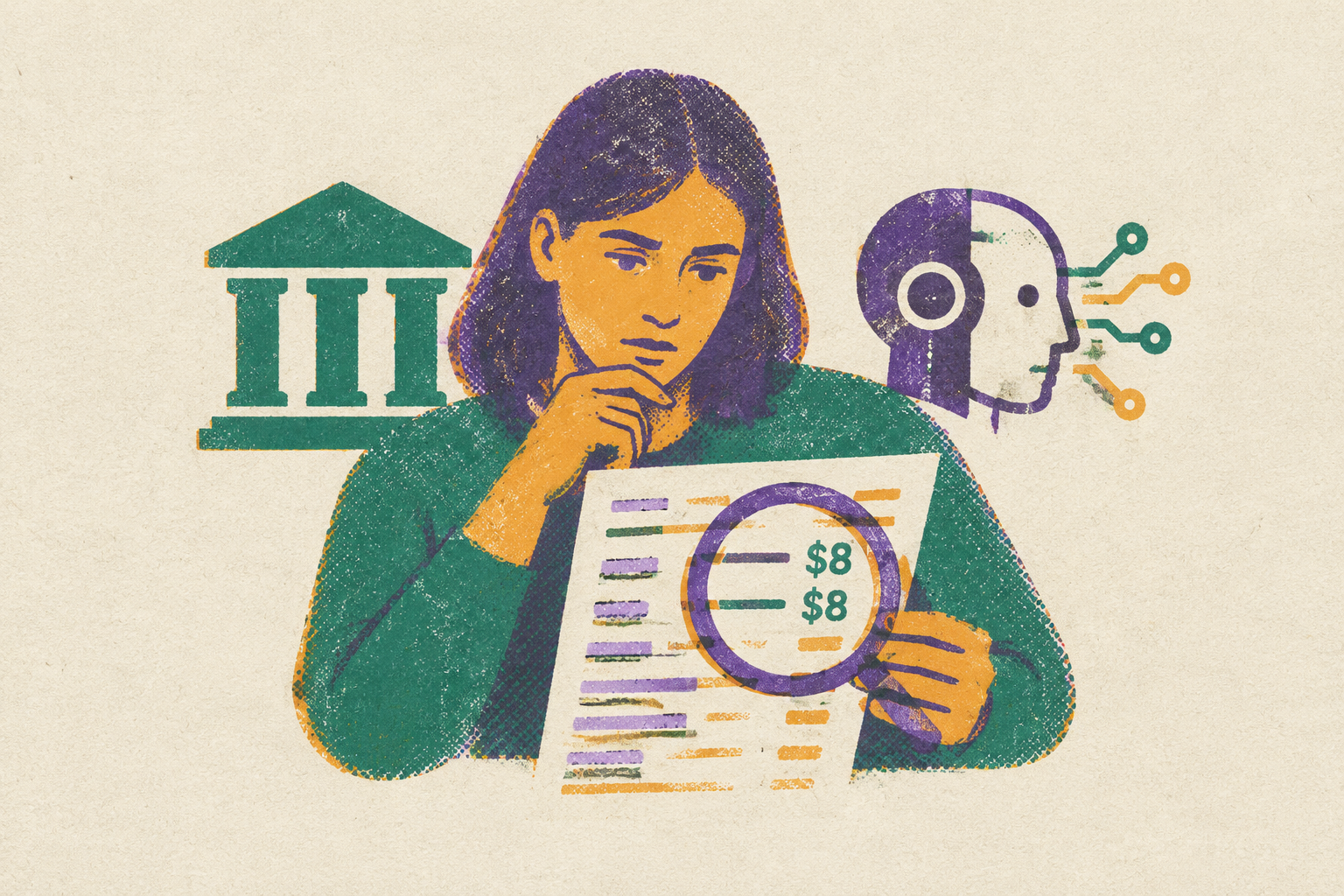
Adaptive AI monitoring can catch a quiet double-charge by looking at spending patterns, even when the dates and merchant names do not match. To catch subscription prices that quietly rose, pair that monitoring with a record of recurring bills and their expected amounts. The strongest safety net combines early alerts with a simple review habit, because a monthly statement can reveal the error after it has already hurt the budget.
Why small recurring charges are structurally invisible to consumers and rule-based systems
Traditional duplicate checks have a design flaw. Systems built around exact matching look for the same amount, date, and merchant name, so a resubmitted charge with a shifted date or reformatted label can pass as a different transaction. The money may have been taken twice, but the records do not match exactly. A fixed rule sees the difference without recognizing the relationship. That gap exists before a consumer ever opens a statement.
Bank statements create a similar problem for people. They are records of transactions, and a small line item can disappear among dozens of other small charges. A monthly PDF puts the evidence in front of the reader without necessarily making the duplication visible. This is not simply a failure to pay attention. The format asks a person to spot a connection that the bank’s own exact-match logic can miss.
Many people pass over a charge of a few dollars, and banks require much larger amounts before a person reviews them. Yet the size of the charge says little about its consequences. For an account with almost no buffer, a quiet billing error can become a much larger financial problem.
What makes small duplicate charges dangerous for people living paycheck to paycheck
An unexpected debit can take money already needed for a bill. If it pushes the account into overdraft, the resulting fee can cost far more than the duplicate charge itself. That fee can then delay another payment. The original error may be small, but the sequence it starts is not. A household with spare cash can absorb the interruption more easily than one counting on every remaining dollar.
A majority of Americans live paycheck to paycheck, and most people in that group have very little left after expenses. Their budgets have little room for mistakes. A small duplicate consumes money needed for household essentials and payments that still have to clear, making “money available to lose” a misleading category. Describing it as a minor annoyance ignores what that money was supposed to cover.
The timing of income makes this more difficult. Paychecks and bills do not always arrive on matching schedules, leaving narrow windows when an account is especially exposed. A charge that would be manageable after payday can cause trouble just before it. Detection therefore has to account for more than the amount lost. It has to happen early enough to interrupt the next consequence.
How AI’s adaptive pattern recognition catches what static rules miss
AI monitoring learns what normal spending looks like. It compares a new charge with patterns involving the consumer, merchant, and transaction type, then flags departures from that baseline. Instead of asking only whether two entries are identical, it considers whether they belong to the same suspicious pattern. The key advantage over exact matching is the ability to recognize a connection across different posting dates or merchant formats.
Machine learning is the technical name for this approach. Models can examine every transaction in a dataset and weigh amount, timing, frequency, merchant format, and behavioral context together. Supervised methods, including gradient boosting and XGBoost, learn from labeled examples, while clustering methods look for patterns without those labels. The useful output is a warning about a charge that looks wrong when viewed against the surrounding activity.
Navan’s 2026 analysis of AI expense management describes systems that capture and code charges at the moment of swipe, allowing exceptions to be handled during the month. That way of checking business spending is starting to reach tools that monitor consumers’ transactions. The same basic logic can compare a new bill with an established pattern, rather than treating each month as an unrelated record. Whether an app actually flags subscription increases depends on its coverage.
The 2025 paper Regulatory Graphs and GenAI for Real-Time Transaction Monitoring and Compliance Explanation in Banking explores another layer. Graph neural networks can use those links to find suspicious connections that are hard to see in a charge on its own. The paper’s combined graph-and-generative framework achieved high precision and recall on a simulated financial transaction stream. That research result leaves equivalent detection in consumer apps unproven.
Why real-time detection matters more than monthly statement review
A monthly review works on the statement’s schedule. An overdraft works on the account’s balance. The interval between a duplicate charge and a failed bill payment can be hours rather than days, so finding the error at month-end may mean discovering it after the damage. Timing is part of the protection.
Navan’s analysis describes how monitoring at the point of swipe can flag or decline out-of-policy spending before it clears. Consumers also need a warning early enough to act before an overdraft. That does not mean every consumer app can stop a charge. Systems that get transactions at authorization have a chance to act at a different point than tools that first look at posted records. “Real-time” is useful only when it describes when the tool receives and surfaces the transaction.
Consumers increasingly expect warnings when something looks out of character. That expectation reflects the order in which harm happens. First the duplicate reduces the balance, then another payment may arrive, and then a fee may follow. An early alert gives people a chance to act between those events. For someone with tight margins, avoiding the follow-on fee can be more valuable than identifying the original error alone.
What AI-powered fraud tools look like in practice, from enterprise platforms to consumer apps
Stripe Radar shows that AI fraud detection operates at commercial scale. It is trained on more than 70 trillion data points across Stripe’s network and has delivered a meaningful average reduction in fraud for businesses using it. Radar handles duplicate charges solely as a dispute management category. It is not evidence that a consumer can use Radar as a personal duplicate-subscription detector.
Copenhagen Business School’s Agentic AI for Financial Crime Compliance describes a prototype that automates onboarding, monitoring, investigation, and reporting. Each agent has a bounded role, and actions are logged for audit. The prototype points toward systems that do more than generate an alert. They can also support investigation with explainable outputs. It remains a compliance example rather than a ready-made household budgeting recommendation.
For individual consumers, the bridge is transaction monitoring. Much of the most sophisticated AI still operates inside banks and payment processors, while consumer apps are beginning to adopt the architecture for alerts and anomaly detection. What these tools catch varies widely, so success with a business system says little about what a given app will catch. The useful consumer output is concrete, such as a warning that a charge resembles one from three days ago. None of these named examples establishes a ranked winner for automatically spotting both household duplicates and quiet bill increases.
How can you tell whether a fintech app’s security and monitoring are trustworthy?
An app using the word “AI” should explain its features: what activity it monitors, what it flags, and what data it uses. For duplicate charges, check whether it can spot patterns when dates and merchant labels change or only find entries that match exactly. For rising bills, the question is whether it compares recurring amounts over time and surfaces the change.
Account access needs protection of its own. Multi-factor authentication is the least an app should have, because transaction monitoring still leaves access to the account in need of protection. Continuous behavioral authentication goes further by examining signals such as typing cadence, swipe pressure, scroll patterns, and how a person holds the phone. A matching profile can let normal use continue without repeated authentication, while a deviation prompts another verification step. This protects access, but it does not by itself prove that the app detects duplicate bills.
Encryption and consent deserve the same scrutiny. Look for clear encryption disclosures, including the encryption standard used. The app should also explain its data use in plain language and give meaningful control over sharing. Hidden choices are a warning sign.
What to do when an AI alert fires or a duplicate charge slips through anyway
An alert identifies a candidate for a dispute. The next step is to confirm whether the charge is actually a duplicate, then contact the merchant or card issuer directly to dispute it. Most card networks have a formal dispute process. Duplicate charges leave clear evidence, so they offer a strong case for a successful chargeback. But even after the error is found and disputed, it may take time to get the money back.
Consumer monitoring may flag a charge only after it posts. Even with a prompt response, a dispute can take days or weeks to resolve, leaving the household without that money in the meantime. This is the practical gap to address. A bill can fall due before the dispute ends, and a correct chargeback decision later does not remove the pressure now. A small, fee-free advance against upcoming income is one way to bridge that interval without adding interest or requiring a credit check.
Gerald offers eligible users a cash advance with no interest, subscription fee, transfer fee, late fee, or credit check if they first make a qualifying household-essentials purchase through Gerald’s Cornerstore. Using part of an advance on that required purchase unlocks the free cash advance transfer to a bank account. Its value during a dispute is limited to the fee-free bridge.
Other ways to cover the gap have different costs. Payday loans have extremely high effective APRs and are set up in ways that can lead people to borrow again and again, while an overdraft fee can cost more than the original duplicate charge. Subscription-based advance services add a monthly cost that reduces their value for a tight budget. Credit union Payday Alternative Loans have much lower rate limits than payday loans, but require membership and an application process that is not instant. The practical comparison is how much the bridge costs and whether it is available before the next bill lands.
Building a simple system to catch duplicate charges before AI does
A quick check of charges each week can help alongside AI monitoring. Scanning a smaller window of transactions is more manageable than sorting through a full month, and it can expose errors within days of posting. It may still miss harm that follows within hours. Banks still need strong systems, even when people get better at checking their accounts.
Keep a simple record of recurring bills and how much each should cost. A phone note or spreadsheet is enough to provide the reference a statement lacks. Compare new charges with that record during the weekly review, looking for both repeated payments and changed amounts. It is easier to spot a subscription increase when the old price is written down. Without that record, a merchant name that someone knows can make a changed amount look like the usual charge.
Alerts for bank or card transactions can help too. Setting alerts to flag even small charges can bring them to light before the statement arrives, even if the alerts use no adaptive AI. Where AI-enhanced monitoring is available, enable its notifications and review each flag promptly so a possible duplicate can become a confirmed dispute.